Last updated: November 19, 2026
Quick Answer: You can learn AI for free and get hired, but the practical route is usually a 3-step plan: choose one role, build 2-3 proof projects, and apply when you can explain one project end to end. This article, Learn AI for Free, Get a Job: Role-Based Roadmaps That Work: related questions, shows which free path fits which job and what to learn first.
You can learn AI for free and get hired, but only if you train for a role, build proof, and ignore the shiny stuff. A role-based roadmap is usually faster than a pile of random courses. The sections below show which path fits which job, what to learn first, and where beginners waste months.
Key Takeaways
- Pick one target role first: data analyst, ML engineer, or AI product role.
- Free learning works best when it ends in a portfolio project, not more notes.
- Python, SQL, and one cloud or model tool beat five half-finished certificates.
- Hiring managers look for evidence of shipping, debugging, and clear thinking.
- If you cannot explain one project end to end, you are not job-ready yet.
I write about technical hiring paths and AI skill building, so I can separate what sounds useful from what actually gets interviews.
Which AI job should you aim for first in Learn AI for Free, Get a Job: Role-Based Roadmaps That Work?
The right first role is the one that matches your current base, because a 12-week plan for the wrong job turns into months of drift. If you come from spreadsheets, analytics is the cleanest entry. If you already code, ML or LLM work makes more sense.
Picture this: you have evenings, a laptop, and a free course tab open, but no clue whether to learn TensorFlow, SQL, or prompt engineering first. The answer is to choose one job title and build backward from the skills that job listing repeats. That keeps you from studying six tools and becoming employable in none of them.
- Data analyst with AI tools: best if you like business questions, dashboards, and Excel-to-SQL thinking.
- Machine learning engineer: best if you already code in Python and want model pipelines, APIs, and deployment.
- AI product builder: best if you want to ship apps with LLM APIs, evals, and user workflows.
- Research path: best if you have a strong math base and can spend months on theory, not if you need income soon.
The truth is, most beginners do not need a research roadmap. They need a job-shaped one. That means the first filter is not “What is AI?” It is “What role does a recruiter actually hire for?”
Can you really learn AI for free and still get hired?
Yes, if you turn free material into proof that looks like work. Hiring teams do not pay for a playlist of courses; they pay for people who can solve a problem, explain trade-offs, and ship something that runs. A portfolio with 2-3 strong projects beats a shelf of certificates.
Picture this: you finish a free course on YouTube, but your GitHub is empty and your resume has no work samples. That gap is why many self-taught learners stall. The fix is not another course. It is a public project that shows data, code, model choice, evaluation, and a short write-up.
Use free sources with a clear job outcome in mind:
- Google Machine Learning Crash Course for practical ML basics.
- Kaggle Learn for quick, hands-on notebooks and Python practice.
- Hugging Face docs and courses for transformers, inference, and model use.
- fast.ai for applied deep learning with less theory drag.
- Microsoft Learn and AWS Skill Builder for cloud and AI service basics.
The best free resources are often the ones that make you build, not just read. That matters because the market rewards evidence, and evidence is public.
What should a beginner learn first?
Python, SQL, and basic statistics come first for most people, because they show up in nearly every entry-level AI or data role. After that, learn one model stack end to end. Do not start with advanced papers or custom architectures unless your target job explicitly needs them.
Picture this: you want an AI job in six months, but your study plan starts with backprop math and transformer internals. That is backwards for most beginners. A recruiter wants to see that you can work with data, handle a model, and explain what changed when the model got better or worse.
A practical order:
- Python basics: functions, loops, lists, pandas, notebooks.
- SQL: joins, group by, window functions, filtering.
- Core ML: train/test split, overfitting, precision, recall, classification, regression.
- One framework: scikit-learn first, then PyTorch or TensorFlow if needed.
- One deployment path: Streamlit, FastAPI, or a simple cloud app.
- AI workflow tools: prompt design, retrieval, evaluation, and API usage.
This sequence works because it matches how many junior tasks are actually done. You clean data, run a baseline, compare results, and explain the result. That is job material.
How do the roadmaps change by role?
The roadmap changes because the job changes. A data analyst needs fewer model internals and more business-facing proof. An ML engineer needs more code quality, deployment, and model behavior. An AI product builder sits between the two and wins by shipping useful tools quickly.
Picture this: three job posts sit on your screen, each asking for “AI skills,” but the day-to-day work is different. One role wants dashboards and insights. Another wants training pipelines. A third wants product sense and LLM integration. Treating them as the same path can waste time, so it helps to map your learning to the role you actually want. Consult a career or hiring professional if you are unsure which path fits your background.
Data analyst with AI tools
This path wins for people who want the shortest ramp from office work to an AI-adjacent role. Start with Excel, SQL, Python, and a little BI work. Then add AI use cases like summarizing reports, classifying text, or building a simple recommendation script.
Real strengths:
- Fast entry into the job market.
- Easier to show value with one solid business project.
- Less math than ML engineering.
- Good fit for people who already understand KPIs.
Real weaknesses:
- You may get boxed into reporting work.
- Some teams want “AI” but really mean automation.
- You can look underqualified if your projects never touch models.
Who Should Skip This: If you already deploy code or want model work, the better fit is the ML engineer roadmap below.
Buy this if: you are a spreadsheet-heavy beginner who wants a realistic first job.
Skip this if: you want to spend your time tuning models or building APIs.
Machine learning engineer
This path wins for people who already code and want a deeper technical role. Learn Python well, then scikit-learn, feature engineering, model evaluation, and deployment patterns. Add one cloud platform and one serving tool so your project does not stop at notebook stage.
Real strengths:
- Clear hiring signal when projects run end to end.
- Better long-term ceiling than pure tooling work.
- Strong fit for people who like debugging and systems.
Real weaknesses:
- Harder ramp for non-coders.
- More competition at junior level.
- A weak deployment story hurts you fast.
Who Should Skip This: If Python still feels shaky, the data analyst path is a better first step.
Buy this if: you can already write basic Python and want to build production-style ML projects.
Skip this if: you need a faster, less technical route into your first AI-adjacent role.
AI product builder
This path wins for people who want to ship useful apps without chasing deep model theory first. Learn prompt design, API calls, retrieval-augmented generation, evaluation, and simple front ends. Then build a tool that saves time, answers questions, or processes documents.
Real strengths:
- Fast way to show something demoable.
- Great for people who think in user problems.
- Lets you create portfolio work with visible output.
Real weaknesses:
- Easy to build shallow demos that impress nobody.
- Can become tool-chasing if you skip basic engineering.
- Many candidates can copy a ChatGPT wrapper.
Who Should Skip This: If you want a durable engineering path, ML engineer is the better fit.
Buy this if: you want to build AI apps and explain why users should care.
Skip this if: you do not want to touch product thinking or basic deployment.
The honest side-by-side
The cleaner choice is ML engineer for technical coders and data analyst for everyone else who wants a faster entry. AI product builder is a good side path, but it rarely beats the first two for a clear hiring story. The reason is simple: hiring managers trust concrete skill stacks more than broad enthusiasm.
Picture this: you have two months of learning behind you and need to decide what to show in interviews. The question is not which path sounds cooler. It is which one creates believable evidence on your resume in the shortest time.
| Criteria | Data Analyst with AI | ML Engineer | Winner for [condition] |
|---|---|---|---|
| Entry difficulty | Lower for spreadsheet users | Higher for coders only | Data analyst for non-coders |
| Math depth needed | Basic stats | Moderate to strong | Data analyst for faster ramp |
| Coding depth needed | Python and SQL basics | Strong Python plus tooling | ML engineer for coders |
| Portfolio type | Dashboards, analysis, automation | Models, APIs, deployment | ML engineer for technical roles |
| Time to first proof | Shorter | Longer | Data analyst for quick wins |
| Hiring clarity | Clear in ops, BI, analytics teams | Clear in product and platform teams | Depends on target job |
| Salary ceiling potential | Solid, but role-bound | Usually higher ceiling | ML engineer for long-term growth |
| Interview focus | Business questions, SQL, case work | System design, code, model trade-offs | Depends on interviewer |
| Risk of shallow projects | High if you only make charts | High if you only train toy models | Neither, if you lack depth |
| Best fit personality | Curious, organized, business-minded | Builder, debugger, systems-minded | Depends on how you think |
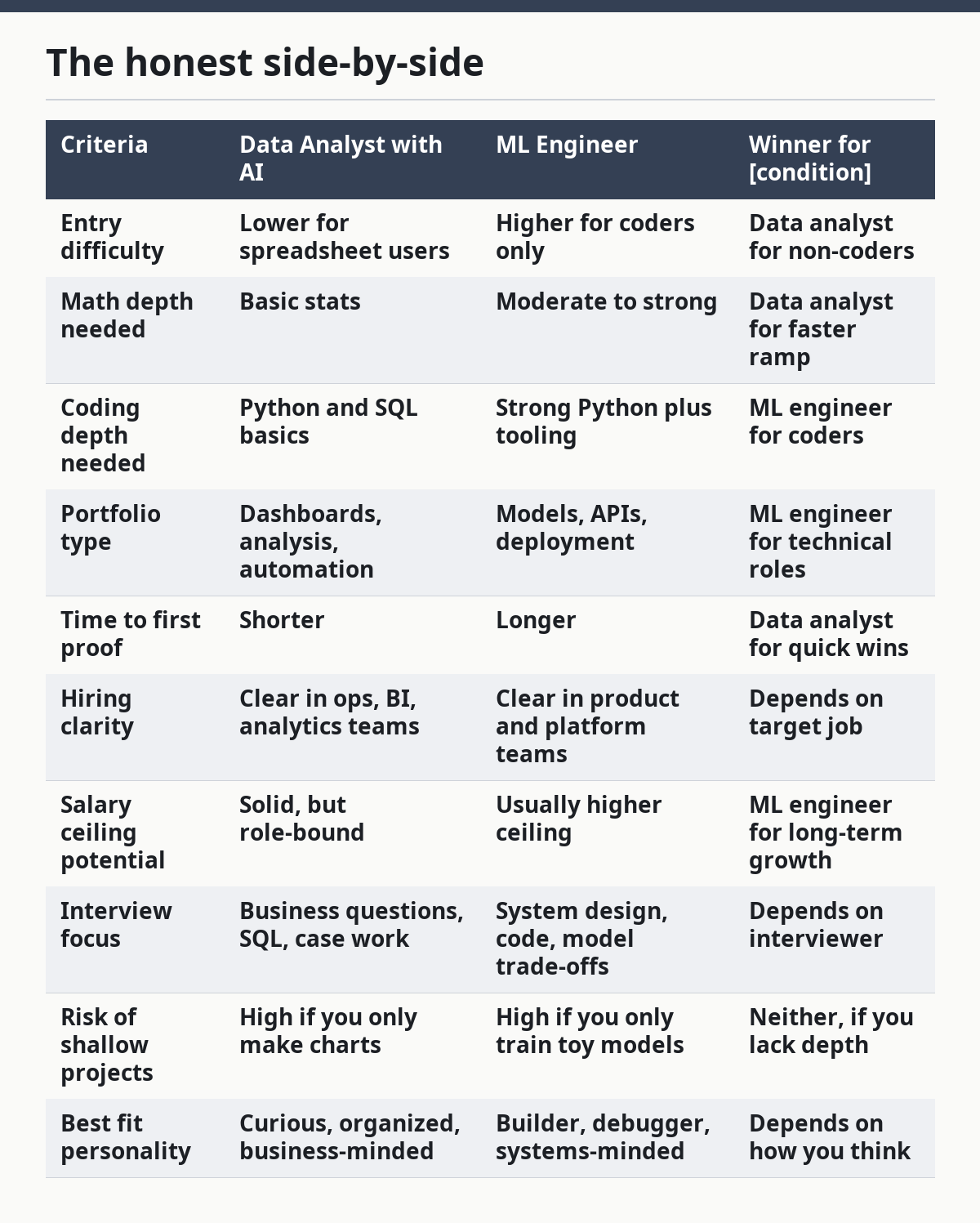
The table is blunt on purpose. If you want a job fast and your math is rusty, data analyst is the safer bet. If you already code and want a stronger technical ceiling, ML engineer wins.
What a portfolio has to show to count as job-ready
A job-ready portfolio shows problem, data, method, result, and limitation in one place. If a project page does not include those five pieces, it is decoration, not proof. A hiring manager should be able to skim it in 3 minutes and know what you did.
Picture this: your GitHub has six repos, but each one is a half-finished notebook with no README. That does not help. A single polished project beats a folder full of experiments because it shows judgment, not just activity.
Use this structure for each project:
- Problem: what question or task you solved.
- Data: where the data came from and what shape it had.
- Method: baseline first, then improvements.
- Result: one metric or clear business outcome.
- Limitations: where the model or analysis breaks.
Good portfolio ideas:
- A churn model with a simple dashboard.
- A document Q&A app with retrieval and citations.
- A sales forecasting notebook with error analysis.
- A text classifier that flags support tickets by topic.
The catch is that “AI project” is not a category. A toy chatbot is weak unless it solves a real problem and shows evaluation. That is why so many projects fail to get interviews. They look flashy and say nothing.
Which free resources are actually worth your time?
The best free resources are the ones that make you build, not just read. Kaggle, fast.ai, Google ML Crash Course, Hugging Face, and official docs from Python, scikit-learn, and your cloud provider are enough to start. You do not need paid bootcamps to become employable if you can keep a disciplined pace.
Picture this: you have ten tabs open and a promise to yourself that you will “finish the basics” before building. That delay is the trap. Use one course, one practice set, and one project at a time.
A practical stack:
- Kaggle Learn for Python, pandas, and intro ML.
- Google ML Crash Course for model concepts and practical exercises.
- fast.ai for applied deep learning.
- Hugging Face course/docs for transformers and LLM workflows.
- freeCodeCamp for Python and web basics if you need a programming reset.
- Official docs for scikit-learn, PyTorch, Streamlit, and FastAPI.
Two authoritative places worth bookmarking are the U.S. Bureau of Labor Statistics for labor market context and NIST for AI risk and terminology. They will not teach you to code, but they help you understand the standards and the job market around the work.
When should you stop learning and start applying?
You should start applying when you can explain one project clearly, write SQL without panic, and answer basic interview questions without notes. That usually means you have enough to try, not enough to stop learning. Waiting for “ready” is the most expensive mistake beginners make.
Picture this: you keep adding courses because the market feels scary. That habit feels productive and produces no interviews. Applications force you to find gaps, and gap-finding is faster than passive study.
Use this checkpoint:
- One finished project with a README.
- One second project that is smaller but different.
- Basic interview answers for Python, SQL, and model evaluation.
- A resume that names the tools you used and the result you produced.
On the flip side, if your projects cannot run, your code is unreadable, or you cannot explain your own choices, keep building. But do not hide in preparation forever. A fair target is to apply while still learning.
Which path should you choose?
Choose data analyst with AI tools if you want the fastest realistic entry and you come from spreadsheets, reporting, or operations. Choose ML engineer if you already code and want a deeper technical role with a stronger long-term ceiling. Neither if you refuse to build public proof, because that leaves you as a learner, not a candidate.
Picture this: you want the cleanest answer, not a motivational speech. Here it is. The roadmap that works best is the one that matches your current skill base and gives you a portfolio a recruiter can inspect in one sitting.
That call matters because role choice changes the time it takes to get hired.
Drafted with AI; not yet reviewed by a person.