Last updated: November 19, 2026
Quick Answer: Audience growth and subscriber management works best when you keep the list focused, because one weak segment can lower engagement across the whole channel. Audience growth and subscriber management is the work of turning first-time visitors into people you can reach again, without burning them out. The answer is to grow the right audience, then keep list health tight enough that emails still land, get opened, and earn replies. The sections below settle what to do first, what to fix later, and what to stop doing altogether.
Key Takeaways
- Growth means nothing if the list is full of the wrong people.
- Subscriber management starts the day someone signs up, not after complaints begin.
- A smaller list can be more profitable in practice when it is well matched to the offer.
- Segmentation beats blasting everyone the same email.
- Re-engagement, suppression, and preference controls protect deliverability.
- A clean list is a system, not a one-time cleanup.
What audience growth and subscriber management really means

Audience growth and subscriber management means you are building a list that can actually be used. If you only chase signups, you get a bigger number and a weaker channel; if you only prune, you stall growth and miss new readers. The right move is acquisition, consent, segmentation, and cleanup working together.
Because of that, the topic of Audience growth and subscriber management — The Complete Guide is not really about volume alone; it is about matching the signup promise to the mailing plan. If the promise and the plan do not line up, the list grows in the wrong direction.
Picture this: you’re getting traffic from search, social, and referrals, but your emails are ignored, muted, or sent to spam. That usually means the sign-up promise, the subscriber source, and the sending plan do not match. The fix is not “send more.” It is to tighten the entry point and manage the list like a living asset.
Here’s the catch: subscriber management is not just email hygiene. It includes how people join, how often they hear from you, what they signed up for, and when you stop mailing them. A healthy list often grows slower at the top and performs better where it counts. That trade-off is normal.
A useful benchmark is simple: if someone cannot tell why they subscribed within 10 seconds of looking at the form, the acquisition path is probably too vague. If they can’t see what kind of emails they’ll get, expect more unsubscribes later.
A quick filter for every signup source:
- Can the new subscriber explain the value in one sentence?
- Does the form match the content they just read?
- Is the frequency clear?
- Does the list need a new segment, not a generic bucket?
Quick check: if your list keeps growing but open rates sink, the problem is usually list fit, not list size.
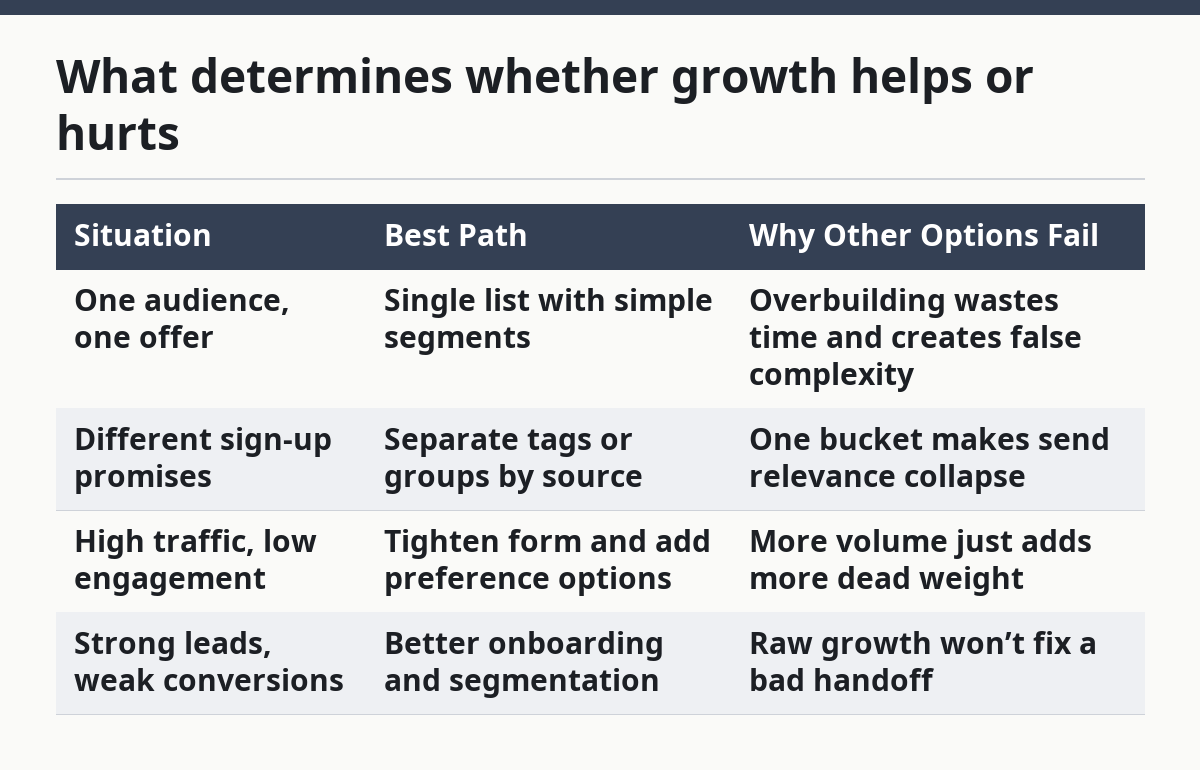
What determines whether growth helps or hurts
Growth helps when the new subscriber matches the offer, the content, and the sending cadence. It hurts when the same form captures everyone from a blog post, a webinar, and a checkout page, then drops them into one generic sequence.
For Audience growth and subscriber management — The Complete Guide, that means the same acquisition channel can help or hurt depending on what happens after the signup. A form is only useful if the follow-up fits the source.
Picture this: you’re running a newsletter with one signup box on every page. That sounds efficient until you see that some people wanted product updates, some wanted tips, and some only wanted a lead magnet. One form, three intents, and a muddled inbox. The answer is usually to separate intent by source or by preference.
The most useful tools in that setup are the ones that let you tag people by source and segment them by interest. Tools like Mailchimp, ConvertKit, Beehiiv, Klaviyo, and ActiveCampaign all support tags, segments, or groups. The tool matters less than the decision tree behind it.
| Situation | Best Path | Why Other Options Fail |
|---|---|---|
| One audience, one offer | Single list with simple segments | Overbuilding wastes time and creates false complexity |
| Different sign-up promises | Separate tags or groups by source | One bucket makes send relevance collapse |
| High traffic, low engagement | Tighten form and add preference options | More volume just adds more dead weight |
| Strong leads, weak conversions | Better onboarding and segmentation | Raw growth won’t fix a bad handoff |
If you need a practical rule, use this: every subscription source should answer one of three jobs — newsletter, product education, or transaction follow-up. If it does not fit one of those, it probably does not belong in the list.
Common signs the list is growing the wrong way:
- Opens flatten while signups rise.
- Spam complaints rise after a promotion.
- Unsubscribes spike after a welcome email.
- The same message goes to buyers and browsers.
Quick check: if you cannot say what a person wanted when they joined, your growth problem is also a management problem.
How do you grow subscribers without attracting the wrong people?

You grow subscribers without attracting the wrong people by making the promise narrower, the form clearer, and the first email better than the pitch. That means fewer random signups and more people who stay.
For Audience growth and subscriber management — The Complete Guide, this is where acquisition quality starts to matter more than acquisition speed. A smaller but better-matched audience is easier to manage than a large list that never wanted the same thing.
Picture this: you’re offering a lead magnet because everyone says you should. It gets downloads, but the list is full of people who wanted a free file, not a relationship. That is the classic trap. The fix is to attach the signup to a real use case, not a generic giveaway.
The truth is, subscriber growth often comes from small, specific entry points: a content upgrade on a post, a webinar tied to one problem, a checkout opt-in, a downloadable template, or a product waitlist. A vague “join our newsletter” form can work, but only if the site already has strong brand pull.
Use this workflow when the goal is cleaner growth:
- Pick one audience segment and one problem.
- Write a signup promise that names the result, not the format.
- Place the form next to related content, not everywhere at once.
- Set a welcome email that restates the promise in plain English.
- Use tags or fields to capture source, interest, or product stage.
- Review unsubscribes, spam complaints, and reply quality after 2 to 4 sends.
The sign-up flow should also reduce friction. If a form asks for too much, the right people bail. If it asks for too little, you get a list you cannot manage well later. Email alone is often enough at the start; name, role, or topic choice can come later if the list earns it.
A strong benchmark: if a signup source brings in people who never click after the welcome sequence, the source is likely too broad or the promise is off. That is a content problem, not a volume problem.
Quick check: if your lead magnet would appeal to “everyone,” it probably appeals to no one in particular.
How to manage subscribers once they’re on the list
You manage subscribers by segmenting early, setting cadence rules, and removing dead weight before it damages the rest of the list. Subscriber management is the part that keeps growth useful after the signup.
Because the list only stays healthy if the right people keep hearing from you, management has to begin with the first send, not with the first complaint. That is especially true in Audience growth and subscriber management — The Complete Guide, where acquisition and retention depend on the same system.
Picture this: you’ve got buyers, browsers, trial users, and inactive readers all sitting in one pool. If they all get the same email, the content will miss someone every time. The answer is to sort by intent and then send smaller, sharper messages.
Here’s the catch: segmentation does not have to be fancy. In many cases, three to five groups are enough:
- New subscribers
- Active readers
- Buyers
- Inactive subscribers
- Source-specific segments, if needed
A basic management system should also include suppression rules. If someone buys a product, stop receiving promotional emails for that offer. If someone unsubscribes from a category, respect that choice without deleting every other contact path unless they ask for it.
Some teams try to save time by blasting the whole list once a week. That only works when the audience is tiny or the offer is narrow. Once the list grows, broad sends usually drag down engagement and can hurt inbox placement. A smaller, more targeted email often beats a bigger one sent to everyone.
Use this sequence to clean up management:
- Map every signup source to one or more tags.
- Separate new leads from buyers and repeat buyers.
- Set a re-engagement rule for inactive subscribers.
- Suppress anyone who has hard bounced, complained, or opted out.
- Review segment performance after 30 to 90 days.
- Adjust cadence by group, not by guesswork.
According to Google’s Search Central documentation on helpful content and intent, content should be made for people first, which aligns with segmenting by what the reader wanted rather than by list size alone. The tools matter less than the discipline. Most email platforms can do this with tags, segments, and automation. What breaks the system is using one giant list as if everyone on it wants the same thing.
Quick check: if your send plan is “one newsletter for all,” you need management before more growth.
When the standard advice is wrong
The standard advice is wrong when your audience has mixed intent, your send volume is already high, or your list is old and uneven. In those cases, “grow faster” or “clean the list” alone is the wrong answer.
Because the list may contain different buyer stages, the right fix is often to separate those stages before you add more growth. In Audience growth and subscriber management — The Complete Guide, this is the point where structure matters more than tactics.
Picture this: you’re told to add more signup forms across the site, but half your list is inactive and the other half only cares about one topic. More forms will not fix the mismatch. You need a narrower offer, not more surface area.
This is where many generic guides fail. They pretend every list should grow the same way. A creator newsletter, a SaaS list, an ecommerce list, and a course list all need different controls. The same cadence can work badly in one and fine in another.
A useful decision table:
| Situation | Best Path | Why Other Options Fail |
|---|---|---|
| Mixed buyer and reader intent | Split by stage or interest | One sequence will always miss part of the list |
| Old list with weak engagement | Re-permission or re-engagement flow | Sending more to everyone deepens the problem |
| New site with little traffic | Focus on one high-intent signup | Broad growth has no signal yet |
| Heavy promotional calendar | Suppress recent buyers | Repeated sales emails can raise complaints |
| Strong organic traffic, low opt-ins | Improve content upgrade and CTA | More traffic without a better offer wastes reach |
The answer often flips based on list maturity. A new list needs more acquisition work. A mature list needs more management work. If you are sending to people who have not clicked in months, the priority is not another form. It is a cleaner mailing system.
When growth is slow but engagement is strong, keep going. When growth is fast but engagement falls, stop scaling the source that is causing the drag.
Quick check: if your biggest problem is not reach but relevance, the fix is list structure, not more traffic.
What to do if your subscriber list is already messy
If your subscriber list is already messy, clean it in layers: hard bounces first, then obvious inactive contacts, then source fixes, then preference controls. Trying to “fix” a messy list with one giant cleanup usually misses the real issue.
Picture this: you inherited a list from a launch, a giveaway, or an old CRM export. Some contacts are buyers, some are cold, some were added with no clear consent trail, and some have not opened anything in a year. That is not a list optimization task. That is triage.
Then start with the contacts that hurt deliverability most, then move outward. A hard bounce should go fast. A long-inactive subscriber may deserve a re-engagement sequence before removal. If someone has never shown interest and has no useful source data, they are probably not worth rescuing.
Use this cleanup path:
- Export the list and identify hard bounces, role accounts, and invalid addresses.
- Suppress contacts who have not engaged in a long window, based on your send frequency.
- Separate buyers, prospects, and newsletter-only readers.
- Send a short re-engagement email with one clear choice.
- Remove contacts who do not respond after the re-engagement window.
- Fix the signup source so the same mess does not return.
Here’s the catch: if the list was built with weak consent language, cleaning engagement alone will not solve trust problems. You may need to rewrite the form, the confirmation email, and the welcome series. If the list came from a giveaway, expect lower intent than a content upgrade tied to a real problem.
A practical standard is to keep records of source and consent type where possible. That helps you send the right messages later and avoid treating every address like the same kind of lead. If you are not sure whether a record should be used that way, consult a qualified email-deliverability or privacy professional, because the right handling depends on your consent and data practices. The FTC and CAN-SPAM guidance are useful starting points for compliance-aware list management.
Quick check: if you do not know where most addresses came from, the list is already telling you what needs to change.
What tools and metrics matter most?
The tools that matter most are the ones that show source, segment, engagement, and deliverability in one place. You do not need the fanciest stack, but you do need clear fields and clean reports.
Because of that, Audience growth and subscriber management should be measured in a way that shows which sources keep performing after the welcome series ends. If a tool cannot tell you which source produced engaged subscribers after 30 days, it will not help you manage growth well.
Picture this: you’re choosing between platforms with automation, tags, and analytics, but the real decision is whether you can act on the data.
Useful tools include:
- Email service providers like Mailchimp, ConvertKit, Beehiiv, Klaviyo, or ActiveCampaign
- Web forms and landing pages with source tracking
- Analytics tools that show traffic source and conversion path
- CRM or customer database, if sales and support matter too
The metrics that matter are not just opens. Opens can be noisy. Look at click rate, reply rate, unsubscribe rate, spam complaint rate, and conversion by segment. If possible, track the engagement of each signup source after the welcome flow and again after 30 to 60 days.
According to Google Search Central, helpful content should satisfy a clear audience need, and according to HubSpot’s reporting guidance, segment-level measurement is more actionable than list-wide averages. A good management habit is to review these patterns monthly:
| Metric | What It Tells You | What Usually Breaks |
|---|---|---|
| Clicks by segment | Whether the content fits the audience | Broad sends, weak targeting |
| Unsubscribes by source | Which signup path attracts the wrong people | Vague promise or poor placement |
| Replies | Whether the email feels human and useful | Over-automation or generic copy |
| Spam complaints | Whether the expectation was wrong | Bad frequency or unclear consent |
| Re-engagement results | Whether cold contacts are worth saving | Old list decay or weak offer |
One benchmark worth remembering: if a segment gets regular sends and still produces almost no clicks, it’s not an audience yet. It may just be a holding pen.
Quick check: if your platform reports only “delivered” and “opened,” you do not have enough visibility to manage the list well.
Edge cases where normal advice breaks down
Audience growth and subscriber management gets weird when the audience is split, the consent trail is thin, or the product changes faster than the list can keep up. In those cases, the usual “grow and clean” advice breaks down.
Because the list may serve more than one job, you need different rules for each edge case. That matters especially in Audience growth and subscriber management — The Complete Guide, where a single mailing habit can distort several audience types at once.
Picture this: you run a business with both free readers and paying buyers, or you inherited a newsletter from a founder who never documented the list sources. The normal playbook won’t fit neatly. The fix is to make a different rule for each edge case.
- Situation: a launch list with short-term intent → What changes: many subscribers wanted one event, not an ongoing newsletter. → What to do instead: send a short follow-up series, then move them to a lower-frequency segment or suppress them if they do not opt in again.
- Situation: a buyer list and a content list are mixed → What changes: purchase behavior matters more than interest alone. → What to do instead: separate buyers from prospects and stop using one message for both.
- Situation: growth comes from a giveaway or contest → What changes: intent is usually weaker than for a content upgrade. → What to do instead: set a stricter welcome path and expect lower long-term engagement.
- Situation: the list is old and no one knows how it was built → What changes: consent and relevance may both be unclear. → What to do instead: send a permission-based re-engagement email and remove non-responders.
- Situation: traffic spikes from one viral post → What changes: the new readers may care about one topic only. → What to do instead: tag them by source topic and avoid dumping them into a generic weekly blast.
- Situation: you send infrequently, like once a quarter → What changes: inactivity thresholds need to be much longer. → What to do instead: judge engagement against your own cadence, not someone else’s weekly cadence.
These edge cases are fixable if you stop treating every address the same way. The list gets stronger when the sending rules reflect how people actually arrived.
Quick check: if your list has more than one kind of subscriber, the edge cases are probably your real case.
How do I know if my audience growth is healthy?
Audience growth is healthy when new subscribers keep engaging after the welcome series, not just on day one. If the list is rising and the replies, clicks, and conversions hold steady, you are probably growing in the right direction.
For Audience growth and subscriber management — The Complete Guide, the question is not whether the list gets bigger. It is whether the new people still behave like the people you want to keep.
Picture this: you see a chart climbing every month, but revenue and replies stay flat. That usually means the top of the funnel is too loose. A healthy list grows in a way that preserves quality, not just quantity.
Look for these signs:
- New subscribers click within the first few sends.
- Unsubscribes stay tied to clear reasons, not confusion.
- Spam complaints stay low.
- Different segments respond to different offers.
- Re-engagement can recover some cold contacts, but not all of them.
If growth looks strong but these signals weaken, tighten the source. If engagement is strong but growth is slow, improve acquisition without widening the promise too much. Both can be true at once.
Quick check: if the list is bigger but the channel feels weaker, the growth is probably outpacing the management system.
FAQ
How often should I clean my subscriber list?
You should clean it on a regular schedule, not only when problems appear. For an active list, that usually means reviewing bounces, inactive contacts, and complaint patterns every month, then running a deeper cleanup every quarter.
Is it better to grow fast or keep the list small?
It is better to grow in a way that keeps engagement high. A smaller list with strong intent often beats a larger list full of people who never click.
Should I use one list or separate lists?
Use one system with clear segments unless the audience has truly different jobs, like buyers versus newsletter readers. Separate lists can help, but too many lists make management messy fast.
What is the biggest mistake in subscriber management?
The biggest mistake is sending every subscriber the same message. Once the list mixes different intent, broad sending starts to weaken engagement, complaints rise, and cleanup gets harder.
When should I stop mailing inactive subscribers?
You should stop mailing them after a fair re-engagement attempt and a window that matches your cadence. If they still do not respond, keeping them on the list usually helps less than removing them.
Drafted with AI; not yet reviewed by a person.