Last updated: November 19, 2026
Quick Answer: For an AI tools newsletter, the best subject lines are usually 5 to 9 words long, specific, and plain. They name the tool or use case, then add one clear reason to open.
Key Takeaways
- A good subject line gives the main value in 5 to 9 words without sounding like spam.
- Balance curiosity with clarity so readers want detail, not confusion.
- A strong formula is number or category + tool type + benefit or use case.
- Preview text should add one new detail, not repeat the subject line.
AI tools newsletter subject lines need to do two jobs at once: say what’s inside and give the reader a reason to open now. For how to write subject lines for an AI tools newsletter, clarity usually beats cleverness, and the strongest lines often name the tool, the use case, or the problem in plain English. The steps below show how to write subject lines that fit an inbox, not a slogan.
What a good AI tools newsletter subject line has to do
A good subject line tells a reader what they’ll get in 5 to 9 words or a short phrase, and it does it without sounding like spam. For an AI tools newsletter, that usually means one clear promise, one named category, or one specific benefit.
Picture this: you’ve got three new tools, a short recap, and a crowded email inbox. Your subject line has to do the sorting before the reader ever opens the message, or the rest of the newsletter never gets seen. That’s the whole game.
- Say the topic plainly.
- Add one useful hook.
- Keep the promise narrow enough to trust.
The mistake most writers make is trying to sound clever before they sound useful. That usually creates a subject line that feels like a riddle, and riddles get ignored in an inbox full of work mail. If your issue is about an image tool, say that. If it covers automation for meeting notes, say that too.
An AI tools newsletter is not the place for vague tease copy like “You need to see this.” Readers already know it’s about AI. They need the angle, such as “3 AI meeting note tools” or “Best AI tools for faster research.” That specific wording is what earns the open.
How do you balance clarity and curiosity?
You balance them by making the reader curious about the detail, not confused about the topic. The subject line should answer “what is this?” first, then leave one small gap that the preview text can fill.
Picture this: you have a strong article, but the subject line sounds like a mystery box. That may win a few clicks once, but it trains readers to distrust the next email. The better move is a clear noun plus a small twist, not a vague tease.
- Clear: “New AI tools for weekly reporting”
- Curiosity with control: “AI tools that cut research time”
- Too vague: “You’ll want this one”
Curiosity works best when it comes from a real editorial choice. A named use case, a comparison, or a fresh angle can pull the reader in without hiding the subject. A line like “3 AI design tools worth testing” is readable, specific, and easy to skim on mobile.
You can test curiosity without losing trust. Swap the hook, not the whole message. For example, “AI writing tools for faster drafts” and “3 writing tools that save 30 minutes” both work, but they do different jobs. The first sells the topic. The second sells the payoff.
The subject line formula that works for tool roundups
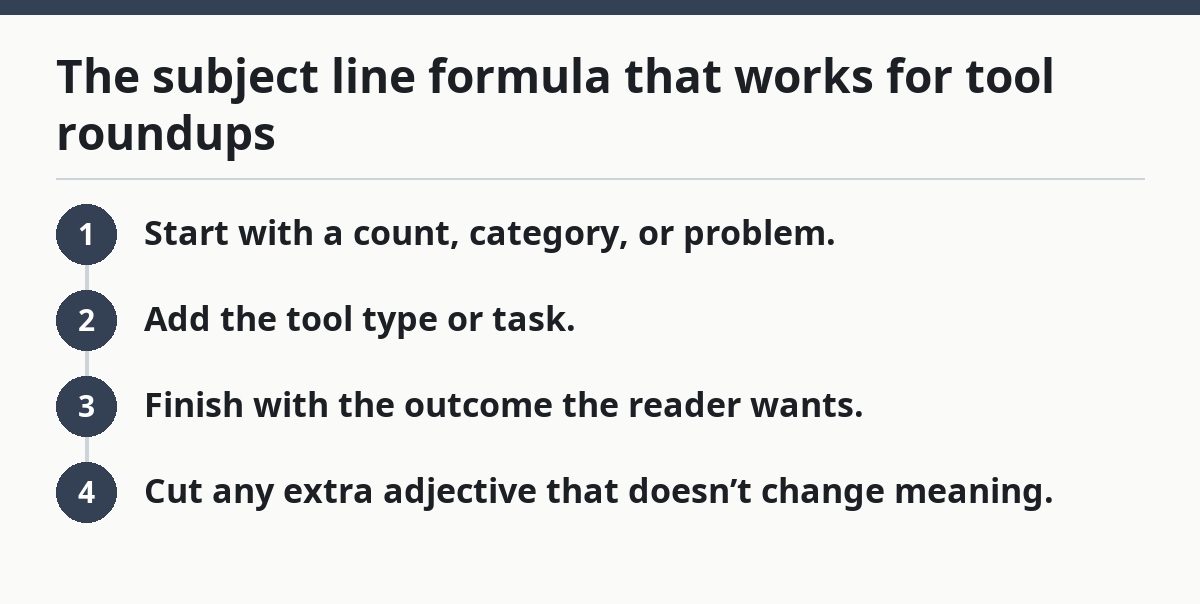
A strong formula is [number or category] + [tool type] + [benefit or use case]. For a roundup, that structure gives the reader a fast read and a clear reason to open.
Picture this: you’re pulling together a Friday newsletter with several tools, and you need the subject line to make the whole issue feel organized. A simple formula helps you avoid clutter and keeps the line readable on a phone screen, where only part of it may show.
- Start with a count, category, or problem.
- Add the tool type or task.
- Finish with the outcome the reader wants.
- Cut any extra adjective that doesn’t change meaning.
Here are examples that fit an AI tools newsletter without sounding like ad copy:
- “4 AI tools for faster inbox cleanup”
- “AI note tools that save time in meetings”
- “This week’s best AI tools for creators”
- “3 tools for better AI search results”
A generic article often says “keep it short,” but that’s not enough. Short can still be vague. “New AI roundup” is short and useless. “4 AI tools for research” is short and useful. That difference matters because the inbox rewards speed, not mystery.
The formula also protects you from stuffing too much into one line. If you try to cram every tool name into the subject, the line turns heavy and the main promise gets lost. Use the subject line to frame the issue. Put the list in the body.
What to put in preview text so the subject line lands
Preview text should add one detail the subject line leaves out, not repeat the same words. In most inboxes, you get about 40 to 90 characters of preview space, so every extra word has to earn its place.
Picture this: the subject line gets the click, but the preview text gets the trust. If both lines say the same thing, you waste that second line and the email feels thin before it opens.
- Subject line: “3 AI tools for faster research”
- Preview text: “One helps summarize sources, one finds quotes, one cleans up notes.”
That second line should answer the reader’s next question: which tools, for whom, or why these instead of the last issue? A good preview line can add the angle, the format, or the editorial filter. It can also calm a skeptical reader by making the email feel useful rather than salesy.
Preview text matters even more for AI tools because readers have seen a lot of hype. If the subject line sounds broad, the preview text can make it concrete. If the subject line is already specific, the preview text can supply the payoff without repeating the wording.
The truth is, subject line and preview text work as a pair. One opens the door. The other shows the room. If you write them separately, the email often sounds stitched together. Write them as a unit, and the message feels deliberate.
Which words help, and which ones hurt open rates?
Plain words help open rates, and inflated words usually hurt them. In an AI tools newsletter, readers respond better to direct nouns and verbs than to hype, because they’re scanning for usefulness, not applause.
Picture this: you’re choosing between “Amazing AI tools you can’t miss” and “AI tools for meeting notes.” The first sounds like marketing. The second sounds like something a busy person might actually need today. That gap is why wording matters so much.
- Use concrete nouns: tool, notes, draft, search, image, summary.
- Use plain verbs: save, cut, find, compare, write.
- Avoid empty boosters: amazing, revolutionary, must-read, unbelievable.
You also want to avoid labels that mean little on their own. “AI roundup” is broad. “AI tools for sales teams” is clear. “New AI features” is weak unless the email really is about product changes, not tools.
The biggest trap is stuffing the subject line with adjectives. “Best, smart, powerful, fast” all pile up and tell the reader nothing. One useful detail beats three shiny ones. If you need a test, ask whether a reader could repeat the line back in one breath and still know what the email is about.
This is where many generic guides go wrong: they treat subject lines like ad copy. Newsletter subject lines are not ads. They’re signs on a crowded street. The sign has to be visible at a glance, and the meaning has to land in under a second.
How to A/B test subject lines without guessing
You A/B test by changing one thing at a time and judging the result against a single goal, usually opens over a 24-hour send window. If you change the topic, tone, and length all at once, you learn nothing useful.
Picture this: you’ve got two decent subject lines and no clear winner in your head. That’s the right moment for a test, not a coin flip. You want to compare one variable, such as number versus no number, or use case versus tool name.
- Pick two lines that differ in one way only.
- Send them to similar audience segments.
- Keep the send time the same.
- Read the result next to the open rate and the click pattern.
- Save the winner’s pattern, not just the exact wording.
For example, you might test “3 AI tools for faster research” against “AI tools that speed up research.” That tells you whether your readers respond more to a count or to a promise. You might also test a direct line against one with a little curiosity, such as “AI tools for meeting notes” versus “The tools I’d use for meeting notes.” Different audiences react to different levels of personality.
Here’s the catch: a subject line that wins one week may fail the next if the newsletter topic changes. That’s normal. A/B testing helps you learn a pattern, not find a magic phrase that works forever.
If you want a deeper structure guide for the newsletter itself, the hub on Free AI tools newsletter — The Complete Guide can sit above this page without repeating the same advice.
Common mistakes that make AI tools newsletter subject lines fail
The most common failure is being too vague, and the second is promising too much. Both cost opens because the reader either doesn’t know what the email contains or doesn’t trust the promise.
Picture this: you’ve spent an hour assembling useful links, but the subject line says “Weekly update.” That tells the reader almost nothing. Or it says “The only AI newsletter you need,” which sounds like a pitch you’ve heard before. Neither line earns attention.
- Vague line: low clarity
- Overhyped line: low trust
- Too long line: weak scanability
Another mistake is leading with the editor instead of the reader. “What I found this week” centers the writer. “AI tools for faster editing” centers the reader. That shift matters because the inbox is a selfish place. People open what helps them, not what flatters the sender.
A third mistake is writing a subject line that can fit any newsletter. If your line could belong to a marketing email, a product launch, or a random blog post, it’s too generic for a niche tool roundup. The best subject lines have a narrow enough footprint that they feel made for the issue at hand.
The fix is simple but not easy: choose one reader problem, one tool type, and one reason to care. Then stop. If the line already tells the truth, don’t keep polishing it into mush.
What should you use as a final check before sending?
Your final check should confirm that the subject line is clear in one scan and still makes sense paired with the preview text. If either line needs a second read, the inbox will probably move on.
Picture this: you’re 10 minutes from send time and staring at three versions of the same line. Read each one as if you’re rushed, distracted, and not looking for a puzzle. If the main promise doesn’t land immediately, cut words until it does.
- Does it say what the issue is?
- Does it sound specific to AI tools?
- Would a reader trust it enough to open?
The last pass is also where you check for balance. Too much clarity can make the line flat. Too much curiosity can make it slippery. The sweet spot is a line that sounds plain at first glance and interesting on the second. That’s especially true for tool roundups, where the value is in the filter, not in the drama.
A good subject line for this kind of newsletter is not trying to be clever, famous, or viral. It’s trying to be useful in a packed inbox. That’s a smaller goal, and a better one.
Should subject lines be short or descriptive?
Shorter is usually better, but only if the line still says what the email is about. For an AI tools newsletter, a descriptive subject line often beats a tiny one because readers need context fast. A line like “AI tools for meeting notes” is stronger than “This week’s drop,” even though it uses more words.
How much curiosity is too much in a subject line?
Curiosity is too much when the reader can’t tell what the email contains. If the line feels like a riddle, it loses trust. A little curiosity is fine when the topic is still clear, such as “3 AI tools for faster research,” but the subject should never hide the newsletter’s main point.
Drafted with AI; not yet reviewed by a person.