
Last updated: November 19, 2026
Key Takeaways
- Start with workflow fit, since it shows which tool matches a newsletter editor’s day.
- Check pricing against the real task, because a cheap plan can become costly at the first limit.
- Count handoffs, because each extra step adds friction to a weekly routine.
- Recommend the tool that fits best, not the one with the flashiest demo.
If you need to compare two AI tools for a newsletter, start with the feature list, pricing page, and workflow fit—not the demo shine. This page explains how to compare two AI tools before recommending one, using the same task, the same prompt, and the same judging rules.
Pick the tool that saves your readers the most time with the fewest extra clicks.
The table and steps below will help you choose one tool to recommend, and explain why the other belongs in a different issue. For background on workflow and comparison standards, see NIST’s AI Risk Management Framework and the FTC’s guidance on deceptive claims.
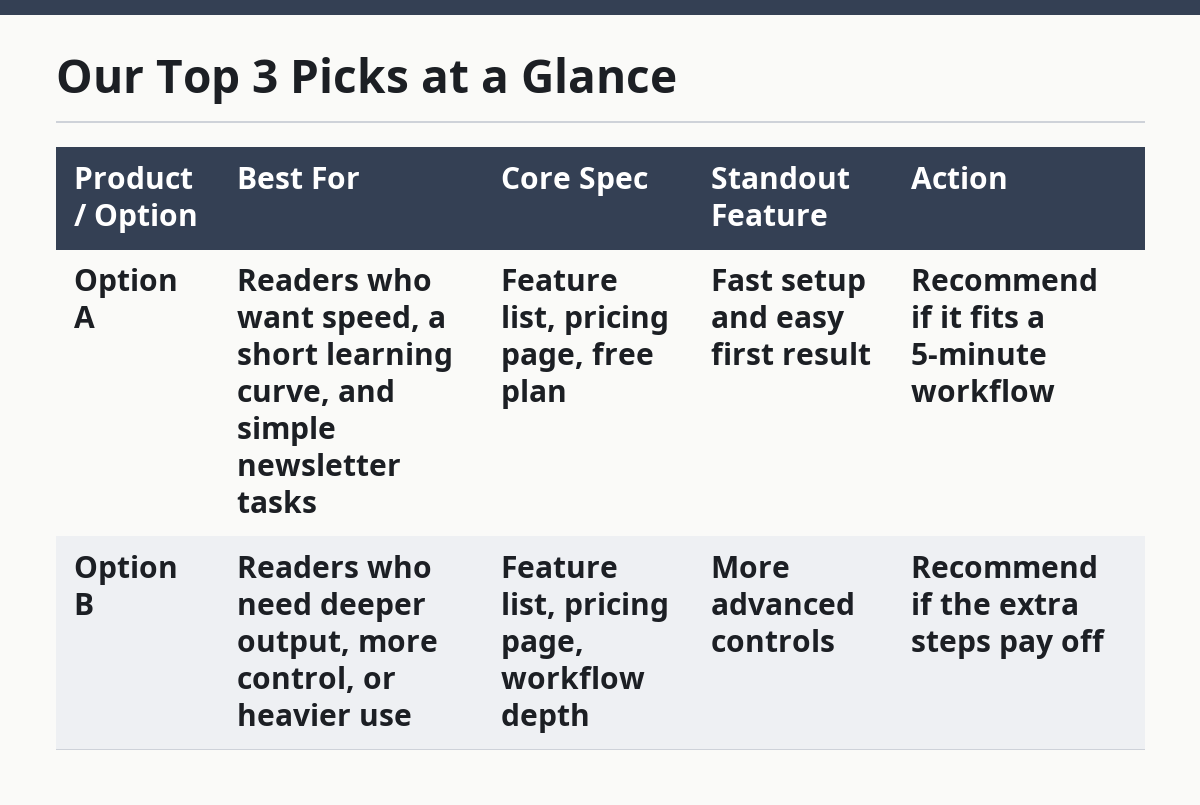
Our Top 3 Picks at a Glance
#1 Best Overall: the tool that matches the newsletter workflow with the fewest setup steps and the clearest output.
#2 Best Budget Pick: the tool with the strongest free plan or lowest entry point for readers who only need light use.
#3 Best Heavy-Duty / Upgrade Pick: the tool that handles larger tasks, more complex prompts, or team use without falling apart.
| Product / Option | Best For | Core Spec | Standout Feature | Action |
|---|---|---|---|---|
| Option A | Readers who want speed, a short learning curve, and simple newsletter tasks | Feature list, pricing page, free plan | Fast setup and easy first result | Recommend if it fits a 5-minute workflow |
| Option B | Readers who need deeper output, more control, or heavier use | Feature list, pricing page, workflow depth | More advanced controls | Recommend if the extra steps pay off |
What should I compare first when I compare two AI tools?
Compare the workflow first, because that tells you which tool will actually fit a newsletter editor’s day. If one tool takes 3 clicks to draft a blurb and the other takes 9, the faster one often wins even when the feature list looks thinner.
Picture this: you’re choosing between two AI tools for a weekly newsletter, and both look good on the surface. One has a cleaner interface, the other has more buttons. The right first question is simple: which one helps a reader finish a draft faster, with less fixing?
Start with these 5 items:
- Feature list — What can the tool actually do for newsletter work: idea generation, rewriting, summaries, tone control, or image support?
- Pricing page — What is free, what is paid, and what sits behind a paywall?
- Workflow — How many steps does it take from prompt to usable output?
- Learning curve — Can a new user get value in 10 minutes, or does it take training?
- Best fit — Is this tool for solo writers, editors, or teams?
The first mistake is comparing feature names instead of outcomes. “AI writing,” “AI assist,” and “chat” can mean very different things. A tool that makes a strong first draft in one box may still be a bad recommendation if it needs heavy cleanup.
The second mistake is chasing the longest feature list. That usually costs clarity. A newsletter reader does not need 40 tools if the job is “turn a source into a clean paragraph.”
How do I compare pricing without getting fooled?
Compare the pricing page against the real workflow, because a cheap plan can become expensive the moment you hit a limit. A free plan that blocks exports, caps usage, or hides the one feature you need is not really free for newsletter work.
The truth is, pricing comparison only works when you tie it to a task. If a tool costs less but forces extra manual editing, the savings may disappear in the first 20 minutes. If another tool costs more but cuts editing time in half, that can be the better recommendation for a paying audience.
Use this quick check:
- Free plan comparison: Does the free tier let a reader complete the newsletter task, or only sample it?
- Paid plan gates: Are core features locked behind a subscription?
- Usage limits: Does the tool cap runs, prompts, or outputs in a way that breaks weekly use?
- Team access: Does one account cover a solo editor, or does collaboration cost extra?
- Upgrade path: Does the paid version add real value, or just remove annoyances?
Here’s the catch: a pricing page can look tidy and still hide the real trade-off. Some tools charge less but require more prompt tuning. Others charge more and reduce friction. For newsletter recommendations, that difference matters more than the sticker price.
Who this section is for: editors comparing two AI tools with the same core promise but different limits.
Who this section is not for: anyone trying to sort out free vs paid ai tools in general. That belongs on a different page. For pricing and plan language, see OpenAI’s pricing pages and Anthropic’s pricing pages.
How do I judge the workflow a newsletter editor will live with?
Judge the workflow by the number of handoffs, because every extra step adds friction to a weekly routine. A strong tool should move from prompt to publishable draft in one clean path, not five tabs and a copy-paste loop.
Picture this: you’ve got one source article, one audience, and a deadline in 20 minutes. The best AI tool is the one that turns that source into a usable newsletter paragraph without forcing you to rebuild the tone from scratch.
Use this comparison procedure:
- Open both tools on the same task. Use one newsletter job, such as summarizing a source, rewriting a subject line, or drafting a short intro. The result should show which tool is faster on the exact work you publish.
- Count the steps. Track how many clicks, prompts, or tabs each tool needs before you can copy the output. A tool that takes 4 steps is easier to recommend than one that takes 8, even if both look polished.
- Check output control. See whether the tool lets you set tone, length, or format without guesswork. Good control reduces editing time and makes the recommendation easier to defend.
- Test a bad prompt. Enter a vague prompt on purpose. The better tool usually recovers more cleanly and gives you a usable next draft.
- Note the cleanup burden. Look at how much editing the output needs before it can go into a newsletter. The less rescue work, the stronger the recommendation.
A generic article often skips this and talks only about features. That misses the real job. Newsletter work is not a software demo; it’s a repeatable publishing flow. For a broader workflow lens, the Nielsen Norman Group has useful material on usability and task completion.
The best part? This step also reveals the learning curve. If you need a 30-minute setup just to get a decent first draft, that tool may be fine for power users and wrong for most readers.
Which details make one tool the better recommendation?
The better recommendation is the tool that wins on fit, not the tool with the flashiest demo. That means the tool should match the reader’s skill level, the newsletter’s pace, and the kind of content you publish every week.
Picture this: you’re deciding whether to send readers toward a simple writing assistant or a more advanced system. One tool may be easier for beginners. The other may be better for editors who need finer control and can handle a steeper learning curve.
Use this shortlist:
- Learning curve: Can a new user get value on day one?
- Feature depth: Does the tool handle only basic drafting, or does it also support rewriting, summarizing, and tone changes?
- Free plan comparison: Is the no-cost tier useful enough for casual readers?
- Pricing page clarity: Can a reader see the difference between plans in under 2 minutes?
- Workflow fit: Does the tool fit a 10-minute newsletter routine or a longer editorial process?
The honest limitation here is that a more advanced tool is not always the better one to recommend. If your audience mostly wants quick drafts and clean rewrites, extra controls can become clutter. A simpler tool may be the smarter pick because it creates less decision fatigue.
A good rule: recommend the tool that matches the most common use case in your newsletter, then mention the stronger alternative for advanced users. For decision framing, see NIST’s AI RMF and the FTC’s advertising guidance.
How do I write the comparison so readers trust it?
Write the comparison around a single decision, because a split verdict feels mushy and weak. Say which tool wins for the newsletter reader you serve, then explain the trade-off in plain language.
The most useful structure is simple:
- Winner for speed
- Winner for control
- Winner for price
- Winner for beginners
- Winner for heavy use
If one tool wins three of those five, that is usually your recommendation. If the other tool only wins on one narrow point, name that point and move on.
Now, you might be wondering what to do when each tool wins in a different category. That happens often. In that case, rank the categories by what matters most to your audience. For a newsletter, workflow and learning curve usually beat raw feature count.
Use a verdict sentence like this:
- Tool A is the better recommendation for most newsletter readers because it is faster to learn and easier to use.
- Tool B is the better fit for advanced editors who need deeper control and can tolerate a heavier setup.
That language works because it states the trade-off, not just the praise. It also tells the reader who should skip one option. A comparison without that line is just advertising in two columns.
What are the common mistakes in AI tool comparisons?
The biggest mistake is ranking tools by feature count alone, because more features can hide more friction. A long list does not tell a reader whether the tool is useful in a real newsletter workflow.
Picture this: you’re staring at two product pages, and one has 20 feature bullets while the other has 8. The longer page looks stronger, but it may hide slow setup, weak free access, or a clumsy editor.
Watch for these traps:
-
Mistake: comparing marketing claims instead of actual tasks.
Cost: you recommend a tool that sounds powerful but slows down publishing.
Do instead: test the same newsletter task in both tools. -
Mistake: ignoring the pricing page.
Cost: readers hit a paywall after the first use.
Do instead: check what the free plan really includes. -
Mistake: treating the learning curve as an afterthought.
Cost: beginners abandon the tool before it helps them. Consult a professional or product specialist if the tool affects workplace decisions or compliance.
Do instead: note whether a first-time user can get value in 10 minutes. -
Mistake: hiding the weaker tool’s bad fit.
Cost: the comparison sounds biased.
Do instead: name who should skip it and why.
A comparison becomes useful when it says, “This tool is not for everyone.” That honesty makes the recommendation stronger, not weaker. It tells the reader you compared the tools as tools, not as brand names.
Which AI tool should I recommend for a newsletter?
Recommend the tool that is easier to use, cheaper to adopt, and more useful in the reader’s actual workflow. If one tool clearly wins on speed and clarity, that should be the one you put in the newsletter.
Picture this: both tools can write, but only one gives a clean draft fast enough for a weekly deadline. That one is usually the better recommendation for a newsletter audience, especially if it has a useful free plan and a short learning curve.
Use this final decision rule:
- Pick the tool that works best on the most common task.
- Break ties with the pricing page.
- Break any remaining tie with the learning curve.
- If the advanced tool only wins for power users, label it as the secondary option.
- If the simpler tool gets the job done with less editing, make it the main pick.
This approach also keeps your comparison honest. You are not pretending both tools are equal. You are showing which one fits the newsletter reader who needs a dependable result, not a long product tour.
If you want a broader method for curating tools, the hub on How to Curate Free AI Tools for a Newsletter belongs next in the path, but this page should stay focused on side-by-side comparison.
What criteria should be compared first?
Compare workflow first, then pricing, then the learning curve. Workflow tells you whether the tool fits real newsletter work, pricing tells you whether readers can keep using it, and the learning curve tells you whether they’ll stick with it after the first week.
How do you avoid bias in a tool comparison?
Use the same task, the same prompt, and the same judging rules for both tools. Then name one thing each tool does well and one thing it does poorly. That keeps the comparison grounded in use, not in brand preference or feature hype.
Drafted with AI; not yet reviewed by a person.
