
Last updated: November 19, 2026
In short: AI tools newsletter examples: what a useful issue looks like show you what changed, why it matters, and what to do with it in under 10 minutes. This article uses that phrase consistently because it is the topic here, not a loose cluster of examples. It names the tool, gives a plain-English use case, links out to the source, and avoids dumping 30 items into one unreadable block.
A strong AI tools newsletter issue is not a random list of links. It is a curated tool roundup with a clear structure: a short top story, a few tool notes, a use case summary, and resource links that let a busy person decide what deserves a click. If you want examples of what a good issue looks like before you subscribe, this article breaks down the anatomy.
What a useful AI tools newsletter issue includes
A useful issue gives you three things in one screen: signal, context, and next steps. The best AI tools newsletter examples usually do not try to cover every launch on Product Hunt or every model update from 2024; they choose a small set of items and explain why those items matter.
A good issue usually has 4 to 8 tools, not 20. That range keeps the issue scannable and gives each entry room for a real use case. If a newsletter stuffs in more than that, the result often reads like a release feed, not a guide.
Look for these parts:
- a headline or theme for the issue
- a 1- to 3-sentence summary of why the issue matters
- a tool roundup with named products
- a use case summary under each tool
- resource links to the product page, docs, demo, or announcement
A good issue answers the question, “What can I do with this?” instead of only “What is this called?” That difference matters. A tool name alone is forgettable; a tool name plus “turns a PDF into a draft brief” is useful.
This is also where many generic articles go wrong. They treat “newsletter examples” as a gallery of layouts, but a useful issue is more than a layout. If you need guidance on whether a newsletter’s claims fit your situation, consult a professional and check the source material first. The real value is editorial judgment. A useful issue filters the flood, then explains why the chosen tools are worth a 30-second scan or a deeper click.
What does a newsletter issue look like?
A useful newsletter issue looks like a short briefing, not a magazine spread. The structure is usually simple: a top section for the main update, a middle section for the tool roundup, and a bottom section for links, notes, or a brief close.
A clean issue often fits on one scroll on a phone. That does not mean thin content. It means the writing is compressed enough that the reader can move from item to item without losing the thread.
A typical issue may include:
- Top item or theme — one sentence that sets the focus, such as a new image model, a workflow tool, or a major platform update.
- Tool entries — each entry names the tool, gives a one-line summary, and adds one concrete use case.
- Resource links — direct links to the source, docs, or launch page.
- Short close — often a note on what to watch next or what category the issue covered.
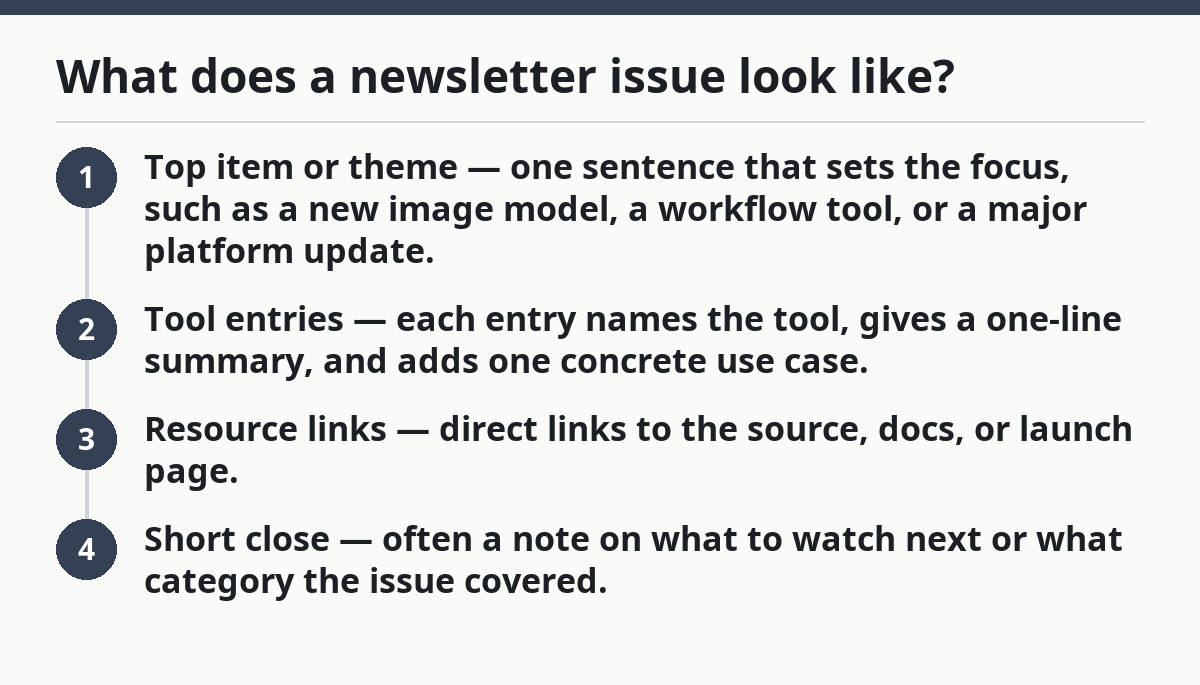
That structure matters because it teaches the eye where to go first. If everything in the issue is styled the same way, the reader has to work too hard. A useful issue uses hierarchy: headings, short paragraphs, and enough white space to separate the items.
One good sign is whether the issue can be skimmed in about 5 minutes and still leave the reader with one action. That action might be “try this writer” tool, “save this prompt library,” or “skip this until it matures.” If the issue cannot help the reader decide, it is just a pile of links.
How are tools usually presented?
Tools are usually presented as one-line descriptions plus a use case, not as feature dumps. The strongest entries give the product name, the category, the problem it solves, and one practical example in 2 to 4 sentences.
A standard format looks like this:
- Tool name
- What it does
- Where it helps
- Link
That basic pattern is enough for most issues. The reason it works is simple: people do not subscribe to memorize software names. They subscribe to find tools they can use in a writing workflow, a research workflow, or a content workflow.
Here is the kind of presentation that helps:
- Tool: a meeting-note assistant
- Summary: turns a call transcript into action items
- Use case: useful for teams that need a fast recap after a 30-minute client call
- Resource link: product page or docs
That is much better than “new AI note app, cool features, check it out.” The first version tells the reader why the tool exists. The second version asks the reader to do the work.
Good issues also avoid overpromising. A tool can be fast and still poor at edge cases. A text generator may be useful for outlines but weak at exact brand voice. A design tool may make quick mockups but still need human cleanup. Honest presentation builds trust because it admits the limits upfront and points readers back to the source.
Why use cases matter more than feature lists
Use cases matter more because they show the reader where the tool fits in a real workflow. A feature list tells you what exists; a use case tells you whether it matters on a Tuesday afternoon.
This is the difference between “supports multimodal inputs” and “lets a marketing manager turn a screenshot into a rough campaign brief.” The second line gives the tool a job. Without that job, even a clever tool feels abstract.
Good AI tools newsletter examples usually add one of these use case types:
- content drafting
- meeting notes
- research summarization
- image generation
- code assistance
- customer support automation
- knowledge-base search
That list is broad enough to cover most readers, but a solid issue narrows it further. If the issue is aimed at marketers, a tool for transcript cleanup may matter less than one for ad variation generation. If the issue is aimed at founders, the same transcript tool may be the most useful item in the bunch.
A strong issue also signals who the tool is for and who it is not for. A lightweight browser add-on may be great for solo operators and a bad fit for teams that need admin controls. A free trial may suit a hobbyist but not a company that needs SOC 2 documentation or role-based permissions. Those details do not need a long paragraph, but they do need to exist.
A vague use-case section can still look polished while saying very little. Instead of the absolute claim, it is more accurate to say that “great for productivity” is too vague to help. A useful issue names the task, the setting, and the likely user.
The difference between a curated issue and a link dump
A curated issue makes decisions; a link dump merely transmits them. That distinction is the whole game.
A link dump may still have 10 links, 15 links, or even 25 links. The number is not the problem by itself. The problem is that the reader has to infer relevance, credibility, and use case without any editorial framing.
A curated issue does at least four things a dump does not:
- Ranks importance. One item is clearly top of the issue.
- Explains context. The writer says why the item matters now.
- Adds interpretation. The writer gives a use case, not just a headline.
- Cuts noise. The issue leaves out items that do not earn attention.
That last point is the one readers feel immediately. A newsletter that omits weak launches feels more trustworthy than one that includes every shiny release. Curating takes discipline, and discipline is useful when the category changes weekly.
There is also a practical benefit. If a newsletter consistently uses the same 3-part rhythm — headline, use case, resource link — readers learn how to scan it. That lowers effort. Lower effort means higher retention, especially when people subscribe to multiple newsletters and only have a few minutes for each issue.
This is where a lot of generic newsletters fail: they confuse volume with value. They assume more items equal more usefulness. In practice, the opposite is often true. A smaller, clearer issue usually helps more than a long one with no hierarchy.
If you are comparing issue quality, ask one question: “Could I make a decision from this without opening five tabs?” If the answer is yes, the issue is doing its job.
A simple checklist for judging an issue before you subscribe
A good issue passes a 30-second scan test before it earns a subscription. I would use this checklist to judge whether an AI tools newsletter is worth keeping in your inbox.
-
Is there a clear theme?
The issue should have a focal point, even if it is broad. “AI tools for sales teams” is better than “random weekly tools.” -
Are the entries explained in plain language?
The best entries use short sentences and avoid jargon like “agentic workflows” unless the audience already speaks that language. -
Are there real resource links?
A useful issue points to the product page, docs, launch post, or demo. If the links are missing or vague, the issue is hiding the source. The FTC says advertising claims should be clear and not misleading, and that standard is a useful reminder here: readers should be able to trace the claim. https://www.ftc.gov/business-guidance/advertising-marketing -
Does each tool have a use case?
A tool entry should say where it fits: research, drafting, editing, support, or automation. That is the part a reader can act on. -
Is the issue easy to scan on mobile?
Short paragraphs, clear headings, and a few bullet points make a big difference. If the text becomes a wall, the issue is too dense. -
Does it leave out clutter?
A strong issue does not include every announcement. It selects.
A newsletter that passes most of those checks is probably doing the useful work a reader wants. One that fails them is probably just repackaging press releases. That can still be entertaining, but it will not stay open in a tab for long.
If you want a practical benchmark, the issue should feel like a well-edited 1-page brief. Not a catalog. Not a blog roundup that repeats itself. A brief.
Who this format is not for
This format is not for someone who wants a deep comparison article or a subscription buying guide. An issue example shows structure and usefulness; it does not decide the “best” newsletter or rank every AI publication on the market.
It is also not the right format for readers who want proprietary samples from a specific publisher. This page shows anatomy, not private archives. That distinction matters because the value here is educational: learning what a useful issue looks like before you sign up.
If you need a broader starting point, the hub on free AI tools newsletter belongs above this page in the site structure. This article supports that hub by showing what a good issue contains, not by trying to replace it.
The final judgment is simple: a useful issue respects time. It uses a recognizable structure, names the tool, explains the use case, and links to the source without noise. That is what makes it worth reading twice and keeping in a tab.
Key Takeaways
- A useful AI tools newsletter issue gives the reader a reason to care, not just a list of names.
- The strongest issues use a short, predictable structure so the important parts are easy to scan.
- Tool entries work best when they include a plain-language use case and a direct resource link.
- Curated issues beat link dumps because they cut noise and explain why each item matters.
- If a reader cannot tell what a tool does in a few seconds, the issue has not done enough editing.
What does a newsletter issue look like?
A useful issue looks like a short briefing with a clear theme, a few tool entries, and links to the source material. It is usually easier to scan than a long blog post and more helpful than a bare list of launches. Because the structure is compact, the best ones fit on one screen and still tell a reader what to do next.
How are tools usually presented?
Tools are usually presented with a name, a one-line summary, a use case, and a link. That format gives the reader enough context to judge whether the tool fits a workflow without reading a full review. Once the language stays concrete, the entries are easier to follow and explain in a few sentences.
What makes one issue useful?
A useful issue helps a reader decide quickly. It has a clear theme, explains why the tools matter, and shows where each one fits in real work. It also avoids clutter and keeps the focus on practical value rather than volume.
Drafted with AI; not yet reviewed by a person.
