Last updated: November 19, 2026
Quick Answer: a free AI tools newsletter referral loop has 3 parts: one invite link, one reward, and one share prompt. Build How to Turn a Free AI Tools Newsletter Into a Referral Loop around that structure, and each subscriber has a reason to forward it while every forward points back to the same signup path.
Key takeaways
- A referral loop starts with one action: make sharing easier than copying the whole signup form.
- A simple setup for a free AI tools newsletter is one invite link, one reward, one thank-you flow.
- Tracking does not need a complicated dashboard at the start; a basic count of referrals is enough.
- The wrong incentive can slow the loop if it attracts freebie hunters instead of readers who care about AI tools.
- Forward-to-a-friend still matters because many people share by email before they share by social post.
What should the loop do?
A referral loop should turn one subscriber into a sender in under 10 seconds. For a free AI tools newsletter, that means the reader gets a reason to share, the friend lands on a clean signup path, and the new signup creates another chance to share.
The loop has three parts. First, the newsletter asks for one referral action, usually through an invite link or a forward-to-a-friend button. Second, the newsletter gives a subscriber reward when the reader reaches a set referral count. Third, the thank-you flow pushes the new subscriber to share the same issue again. That is the whole machine.
The loop fails when the share step feels like work. If a reader must copy text, find a link, and explain why the newsletter matters, most will skip it. A stronger setup gives them a prewritten invite copy, a clear call to action, and a reward that matches a free editorial product, not a product launch funnel.
Because of that, the loop works best when the newsletter has a steady content cadence. A referral loop depends on trust and repeat sends, and a one-off issue will not give readers enough reason to pass it along. It also will not work well if the newsletter has weak subject lines, because the share needs a reason to feel worth passing on.
How do you set up the referral program?
You set up the referral program by choosing one share path, one reward, and one tracking rule. The simplest setup is an invite link tied to each subscriber, a forward-to-a-friend option inside the email, and a reward threshold that the reader can understand in one sentence. For more on email mechanics, see email marketing best practices and newsletter growth tactics.
- Choose the invite link in your email platform so every subscriber gets a personal referral URL. The result is a share path that is easy to copy and easy to attribute.
- Write the share prompt with one short line under the link, such as “Send this to one friend who hunts free AI tools.” The result is less hesitation and less blank space.
- Set the subscriber reward at a level that fits a free newsletter, such as access to a bonus issue, a tools shortlist, or early access to a new send. The result is a prize that feels editorial, not salesy.
- Add the forward-to-a-friend option to the email footer or top bar. The result is a second sharing path for readers who prefer email over social.
- Tag referral completions in your platform so you can see who shared and who signed up. The result is basic tracking without a tangled workflow.
- Send the thank-you flow when a referral hits the threshold. The result is a new message that confirms the reward and asks for one more share.
The important part is not the software name but the structure. A referral program for a free AI tools newsletter should feel like a reader perk, not a contest. If the reward needs a spreadsheet to explain, it is already too hard.
What incentive fits a free newsletter?
A subscriber reward should match the value of the newsletter, not the price of a course. For a free AI tools newsletter, the cleanest incentives are content-based: a bonus issue, a private list of tools, a template, or a first look at a roundup. Those rewards fit the product and do not force the newsletter into a discount loop. If you want a benchmark, Mailchimp’s email marketing guide and ConvertKit’s newsletter resources both frame consistency and audience fit as central to email performance.
The wrong reward can pull in the wrong behavior. A cash prize or a random giveaway may spike referrals, but it often attracts people who want the reward more than the newsletter. That can distort tracking and leave you with signups that never care about AI tools. A reward tied to the content keeps the loop closer to the audience you want.
Use a simple rule: the reward should be useful within 24 hours. If a reader can use it right away, they are more likely to share. If the reward feels vague, the loop slows down because the reader has to guess what happens after they refer. The HubSpot newsletter guide also emphasizes clear value and immediate relevance.
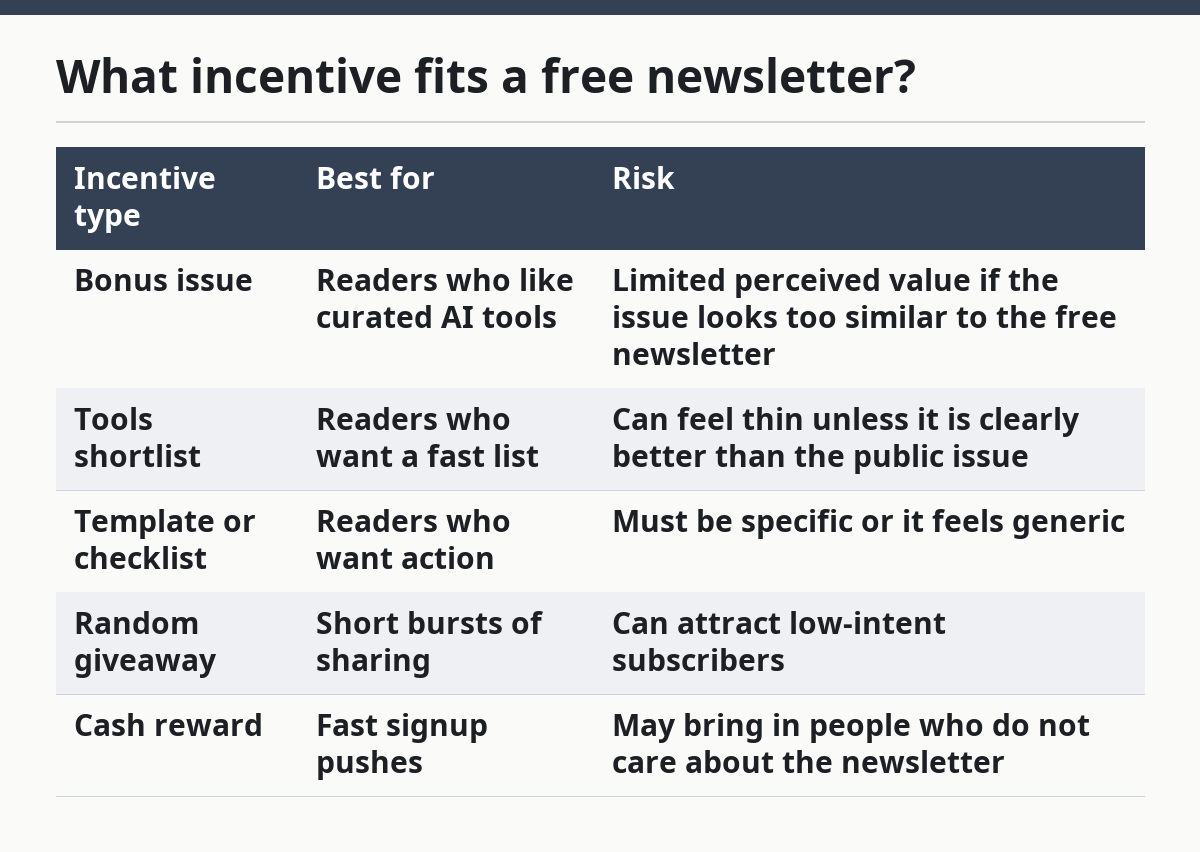
Here is a practical comparison:
| Incentive type | Best for | Risk |
|---|---|---|
| Bonus issue | Readers who like curated AI tools | Limited perceived value if the issue looks too similar to the free newsletter |
| Tools shortlist | Readers who want a fast list | Can feel thin unless it is clearly better than the public issue |
| Template or checklist | Readers who want action | Must be specific or it feels generic |
| Random giveaway | Short bursts of sharing | Can attract low-intent subscribers |
| Cash reward | Fast signup pushes | May bring in people who do not care about the newsletter |
A free editorial product usually does better with access, not prizes. That keeps the loop aligned with the reason people signed up in the first place.
How do you write the share prompt?
You write the share prompt by telling the reader exactly who should get the email and why it is worth forwarding. A good prompt sounds like something a person would say in one line, not a campaign slogan.
Start with the audience. “Forward this to a friend who wants free AI tools for writing, design, or workflow” is better than “Share our newsletter.” The first version gives a clear target and a clear use case. The second one asks the reader to do the thinking.
Keep the invite copy short enough to fit on a phone screen. Two sentences are enough in most cases. One sentence can describe the value, and one can ask for the share. If the message gets longer than about 40 words, it starts to feel like marketing copy and loses the casual feel that helps forwarding behavior.
The best share prompts reduce the fear of overexplaining. Readers often do not forward because they do not want to write their own pitch. A ready-made line in the email lowers that barrier. That matters even more in a free AI tools newsletter, where the topic changes often and readers may not know how to describe the current issue in their own words.
Use a few versions of the prompt over time. One month can focus on “free AI tools,” another on “workflow tools,” and another on “new apps every week.” That gives the reader different ways to share the same newsletter without repeating the exact same sentence in every issue. For more examples, see newsletter copywriting tips and email subject line ideas.
What happens after someone shares?
A thank-you flow should confirm the reward, show the referral count, and ask for the next share in the same email. That keeps the loop alive instead of ending at “thanks.”
The first thank-you email should arrive as soon as the threshold is reached. It should say what the subscriber earned, where to find it, and what happens next. If the reward is a bonus issue, the email should point to that issue directly. If the reward is access to a resource, the email should name that resource in plain language.
The second part of the flow is the ask. After the thank-you, include one short line that invites another share. That line can point back to the invite link or forward-to-a-friend button. The goal is to make the next action obvious while the reader still feels the win from the first reward.
This is where many referral programs stall. They celebrate the referral, but they do not convert the moment into another share. A loop needs a handoff from reward to repeat action. Without that handoff, the program becomes a one-time perk instead of a cycle.
A clean thank-you flow also reduces support questions. If the reader can see the reward, the count, and the next step in the same message, there is less confusion about what “counts.” That saves time and keeps the program from feeling like a puzzle.
How do you track referrals without overcomplicating it?
You track referrals by counting three things: invites sent, signups earned, and rewards claimed. That is enough to see whether the loop is moving without building a heavy dashboard.
Start with the basics in your email platform. Most platforms can tag subscribers, record referral links, or note when a subscriber reaches a threshold. If that is available, use it before adding anything else. The point is to see which prompt, which reward, and which send creates the most sharing.
Do not turn tracking into a second product. A free newsletter does not need a full analytics project to prove the loop works. A simple weekly check is enough: how many readers shared, how many new subscribers came in through those shares, and how many rewards were triggered. That gives you a usable picture without burying the email in process.
Because the most useful signal is often issue type, it helps to track by issue. A tool roundup may earn more shares than a general editorial note, while a long analysis may earn fewer shares but better readers. That is a useful trade-off. The right answer is not always the biggest referral count; sometimes it is the issue that brings in the readers who keep opening future sends.
One practical rule helps keep this manageable: if a tracking step cannot be explained in one sentence, it is probably too much for a free newsletter. The loop should be visible to the reader and easy for you to maintain.
What mistakes break the loop?
The biggest mistake is asking for a share before the reader feels any payoff. That costs trust, and it usually lowers forwarding behavior. The fix is simple: give value first, then ask for the invite link click.
Another mistake is using a reward that belongs to a paid product. If the subscriber reward feels too large, the loop can attract people who only want the prize. That weakens the audience and makes the signup list noisier. A free newsletter should use a reward that matches the content, not the fantasy of a launch campaign.
A third mistake is hiding the referral path. If the invite link sits in a footer nobody sees, the loop is too weak to matter. Put the share prompt where the reader already looks: near the top, near the end, or in the thank-you flow.
A fourth mistake is making the program hard to explain. If your own team cannot describe the referral program in one sentence, readers will not remember it either. Keep the rule simple enough that someone can tell a friend in 5 seconds: “Send this to a friend, and after X referrals you get Y.”
This page supports the larger free AI tools newsletter hub, but the referral loop works only when the share path, the reward, and the follow-up all point in the same direction.
Do referral programs work for newsletters?
Yes, if the share path is short and the reward matches the newsletter. Referral programs work best when readers already trust the content and can forward it in one click. A newsletter about free AI tools has an easier time here because the topic gives readers something practical to pass along. For related guidance, see email list growth and newsletter engagement.
What incentive fits a free newsletter?
A content-based reward fits best. Bonus issues, tools lists, templates, and early access work well because they feel like part of the newsletter instead of a separate sale. Cash and random giveaways can pull in the wrong people, so they are usually a weaker fit for a free editorial product.
How do you track referrals without overcomplicating it?
Use one platform rule for the invite link, one count for completed referrals, and one trigger for the reward. That gives you enough detail to manage the loop without building a large system. If the tracking takes more than a quick weekly review, it is probably too complicated for a free newsletter.
Drafted with AI; not yet reviewed by a person.