Last updated: November 19, 2026
Quick Answer: a two-person review process for newsletter issues uses 2 roles and 5 steps—one person writes, a second checks accuracy and fit, then both agree the issue is ready to send. In this guide to How to Build a Two-Person Review Process for Newsletter Issues, the goal is a simple approval workflow with a short handoff checklist and final signoff. For related editorial setup, see the newsletter editorial calendar and newsletter style guide.
Key takeaways
- A two-person review process is for catching mistakes before send, not for debating every sentence.
- The writer and reviewer need different jobs, or both people will miss the same problems.
- A short handoff checklist keeps the review focused on facts, links, subject line, and timing.
- The process should be light enough to finish inside one issue cycle, not heavy enough to slow the newsletter down.
- Small teams can use this without adding extra software, as long as the approval step is clear.
What should a two-person review process do?
A two-person review process should catch factual errors, broken links, and unclear claims before a newsletter issue goes out. It should also make it obvious who has final signoff, so an issue does not sit in review for 2 days because both people think the other person is moving it forward.
The point is not to turn newsletter production into a committee. For a small team, the process should protect accuracy without creating a second draft from scratch. If the writer and reviewer do the same job, the review gets slow and the value drops.
A practical setup has three parts: editor review, fact review, and approval workflow. The editor checks structure, tone, and whether the issue fits the newsletter’s purpose. The reviewer checks names, dates, numbers, links, and any claim that could be wrong or out of date. Final signoff confirms the issue is ready to send.
This model is not right for a team that wants three or four layers of approval. It is also not a fit for a very fast-moving daily send if the issue changes right up to publish time. In those cases, a 2-person process can become a bottleneck unless the checklist is very short.
Who does the editor and who does the reviewer?
The editor shapes the issue, and the reviewer checks the issue against facts and standards. That split matters because one person should own the flow of the piece while the other looks at it with a colder eye.
The editor is usually the person who drafts or assembles the newsletter. That person decides what stays, what goes, and whether the issue has the right balance of links, short notes, and calls to action. The editor should also make sure the issue matches the newsletter’s usual format before it enters review.
The reviewer should not be the same person who just polished the copy. A second set of eyes works best when that person is slightly detached from the draft. In a small team, the reviewer can be another editor, a subject specialist, or a team lead who knows the publication’s standards. For a tighter handoff, pair this role with a newsletter link checklist and a newsletter production workflow.
Here is the simplest way to split the work:
| Role | Main job | Best at catching | Common weak spot |
|---|---|---|---|
| Editor | Builds the issue and prepares it for review | Missing context, rough structure, weak transitions | Can be too close to the draft |
| Reviewer | Checks facts and readiness to send | Bad links, wrong names, unclear claims | May slow down if scope is too broad |
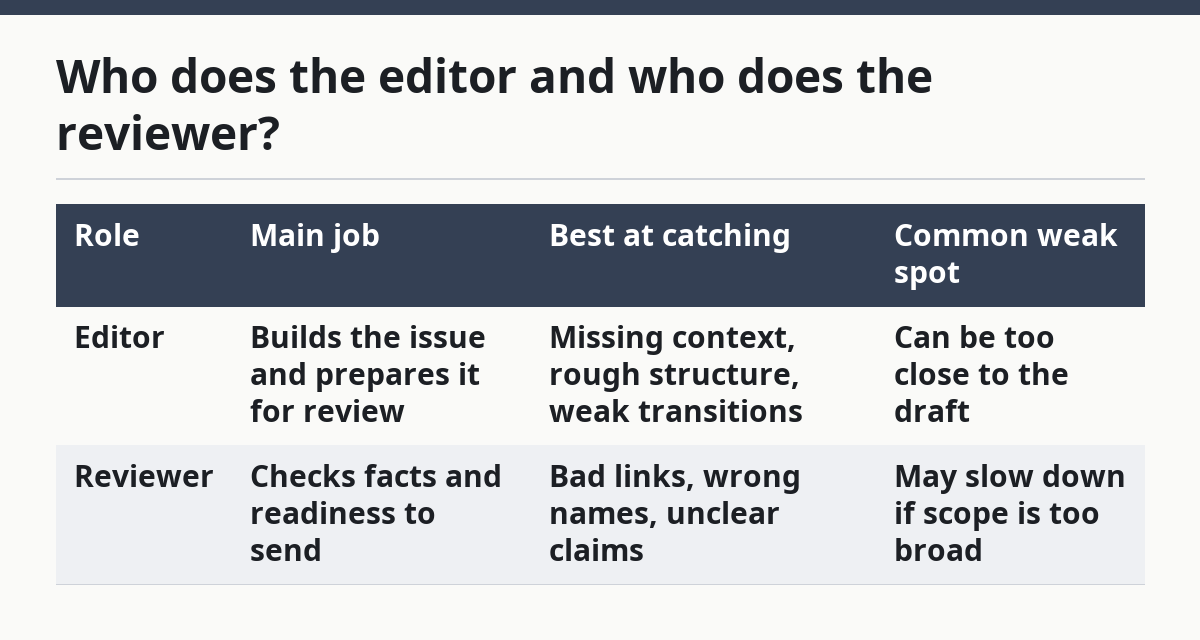
The split should stay stable for most issues. If the roles keep changing, people waste time guessing who owns the next step. A fixed split also makes it easier to train a new teammate in less than a week.
How do you build the handoff checklist?
A handoff checklist should fit on one screen and cover the 5 to 7 checks that matter most. If the checklist grows past that, the review turns into a scavenger hunt and people stop using it.
Start with the items that create the most damage when they fail: headline, subject line, links, names, dates, and any promise made in the copy. Then add one item for newsletter-specific fit, such as whether the issue matches the normal voice and format. Keep the language plain so the editor can finish it in under 5 minutes.
A good handoff checklist should answer these questions:
- Is the subject line accurate and specific enough?
- Are all links working and pointed at the right pages?
- Are names, titles, dates, and figures correct?
- Does the issue match the newsletter’s usual tone and length?
- Is the call to action clear?
- Is anything still marked as a draft or placeholder?
- Has the issue been approved for send?
The checklist is not a place for long notes. If a reviewer needs a full explanation, that belongs in a comment or task note, not in the checklist itself. A compact checklist is easier to reuse for every issue, including a weekly send and a special edition.
This is the point where many teams overbuild. They add extra boxes for every possible mistake, then the checklist takes 20 minutes to complete. That is too slow for a small newsletter team and defeats the point of having a lightweight approval workflow.
How to run the review steps?
Run the review steps in one fixed order so the issue moves forward instead of circling back. The cleanest flow is draft, handoff, review, fix, and final signoff.
-
Create the draft in the writing tool and mark anything uncertain with a comment before handoff.
This keeps the reviewer from guessing which lines still need attention. -
Send the issue with the handoff checklist attached or pasted into the task.
This gives the reviewer one place to start instead of hunting through email threads. -
Review the issue for facts, links, and obvious copy errors.
The result should be a short list of fixes, not a rewrite of the whole newsletter. -
Return the issue with comments tied to the exact line or section.
That makes corrections faster and reduces back-and-forth. -
Approve the final version after the fixes are made.
This is the signal that the issue is ready for send and should not change unless something urgent appears.
Because newsletter work is repetitive, the review steps should stay short and predictable. A 5-step flow is usually enough for small teams, and it is easier to remember than a custom process with 12 handoffs. If the issue needs more than one review round every time, the draft stage is probably not doing enough work.
One useful rule helps here: the reviewer should fix only the items they are responsible for, not polish the entire issue. That keeps the process from turning into invisible co-writing.
What should the second reviewer check?
The second reviewer should check accuracy first and style second. That order matters because a polished sentence with a wrong fact still creates a problem after send.
The reviewer should look at every external link, every name, every date, and every number in the issue. If the newsletter includes recommendations or summaries, the reviewer should check that the wording does not overstate what the source actually says. A claim that sounds fine in draft can become misleading once it is sent to thousands of inboxes.
The reviewer should also check for consistency across the whole issue. A subject line that promises one topic and a body that shifts to another topic creates a mismatch. The same is true for calls to action that point to the wrong page or use the wrong button text.
A simple standard helps here: if a reader could be confused, the reviewer flags it. That standard is better than trying to catch only major errors, because newsletter issues often fail on small mismatches rather than big mistakes.
For process consistency, the AP Stylebook and The Chicago Manual of Style are useful references. They are not newsletter-specific rulebooks, but they reinforce the same habit: decide the standard before the issue is reviewed, not after it is reviewed. See the AP Stylebook and The Chicago Manual of Style.
This page also fits the broader free AI tools newsletter hub, where the review process sits alongside the rest of the editorial setup. The process here stays focused on issue-level quality control, not on audience growth or content strategy.
How do you avoid bottlenecks in review?
You avoid bottlenecks by making the approval workflow narrow, visible, and time-bound. If the process has no owner or no deadline, even a 2-person team can stall.
Set one clear rule for turnaround time, even if the timing is informal. The editor should know when to hand off, and the reviewer should know when to respond. If the newsletter is weekly, the handoff should happen early enough that one round of fixes still leaves room for final signoff before send.
A second way to prevent bottlenecks is to keep review scope small. The reviewer should not be asked to rewrite the lead, check every image, and approve the subject line in the same pass unless that is truly the team’s plan. The more jobs one reviewer has, the more likely the issue will wait.
This table shows the trade-off between a light and a heavy process:
| Process style | What it gives you | What it costs | Who it suits |
|---|---|---|---|
| Light 2-person review | Faster send, fewer handoffs | Less room for deep debate | Small teams with regular issues |
| Heavy approval workflow | More checkpoints, more control | Slower publish cycle, more waiting | Teams with strict signoff needs |
The honest limit is simple: a two-person process is not ideal when every issue needs input from several specialists. It is also a weak fit for a team that changes direction late in the day. In those cases, the review step becomes a queue, not a quality check.
The fix is not always more reviewers. Often, a cleaner draft, a tighter checklist, and a firm rule that approval means the issue is done work better.
Do small newsletters need an approval process?
Yes, if the issue contains links, names, claims, or any promise to readers. A two-person review process catches the mistakes that show up most often in small teams, especially when one person is writing and shipping under time pressure.
If the newsletter is very short and rarely changes, the process can stay light. The goal is not extra bureaucracy. It is one clear checkpoint before send.
What should a second reviewer check?
The second reviewer should check facts, links, names, dates, and any statement that could mislead a reader. They should also check whether the subject line matches the body and whether the issue still fits the newsletter’s normal format.
They should not rewrite the whole issue unless that is part of the job. A focused review is faster and catches more real errors.
How do you avoid bottlenecks in review?
Use one handoff checklist, one owner for each step, and one clear approval signal. That keeps the process moving without extra meetings or long comment chains.
A good rule is to make the reviewer’s job as small as possible without making it shallow. If the review step keeps stalling, the process is too broad or the deadline is too vague.
Drafted with AI; not yet reviewed by a person.