Last updated: November 19, 2026
Quick Answer: Newsletter business model and monetization — The Complete Guide usually works best with 1 primary revenue stream at launch and 1 secondary stream only after the first is stable. A newsletter makes money when a reader pays, a sponsor pays, or a product tied to the list pays. Newsletter business model and monetization depends on whether the list earns trust, attention, or purchase intent first.
Key takeaways
- A newsletter is not one business model. It is a distribution channel that can support 3 to 5 revenue streams.
- Free newsletters grow faster, but paid newsletters can work earlier when the topic solves a narrow, expensive problem.
- Sponsorships fit attention and reach. Subscriptions fit trust and depth. Affiliate revenue fits recommendation-heavy content.
- The best model often depends on audience pain, not on follower count alone.
- The biggest mistake is trying to monetize every reader on day 1 and then starving growth.
What is a newsletter business model?
A newsletter business model is the way a newsletter turns attention into revenue, usually by selling access, attention, action, or a related product. In plain terms, the list brings readers in, and the business earns money from what those readers do next.
That sounds simple, but the structure matters. A newsletter can be free and still make money through ads, affiliate links, lead generation, or a product funnel. It can also be paid, where the subscription itself is the product. Many successful newsletters use both, with the free edition as the top of the funnel and the paid tier as the deeper offer.
The model you choose changes almost everything: how often you publish, what you write about, how much traffic you need, and how patient you must be. A newsletter about stock analysis can charge for depth on day one more easily than a general “daily internet links” roundup, because the reader’s pain is sharper and the outcome is easier to price. A broad newsletter usually needs scale first, often 10,000 subscribers or more before sponsorship starts to feel real, though that threshold varies by niche and engagement.
The main mistake beginners make is thinking “monetization” and “business model” are the same thing. They are not. Monetization is the method. The business model is the whole engine: audience, promise, content type, offer, and distribution. If the offer does not match the audience’s reason for subscribing, even a large list can stay weak.
Which monetization model should I choose first?
I would choose paid subscriptions first if the newsletter solves a narrow problem with clear value, and I would choose sponsorships or affiliate revenue first if the newsletter is built around reach or recommendations. That choice depends on how specific the reader’s problem is and how quickly the content can earn trust.
Paid subscriptions work best when the newsletter gives information the reader can act on immediately: market analysis, job leads, niche research, deal flow, legal updates, or time-sensitive intelligence. The reader pays because the newsletter saves time, reduces risk, or gives access to something hard to find elsewhere. The downside is that the newsletter has to earn that trust fast, and free readers are often harder to convert than founders expect.
Sponsorships work best when the newsletter has a repeatable audience and a stable theme. A sponsor is buying attention, not just content. That means open rate, click behavior, and niche relevance matter more than raw subscriber count alone. The strength is fit: a sponsor pays when the audience is clearly valuable.
Affiliate revenue works best when recommendations are natural and useful, such as tools, books, software, templates, or services that fit the topic. It is fast to start and low friction, but it can damage trust if the newsletter starts sounding like a sales sheet. Readers notice when every issue becomes a link dump.
Lead generation works best when the newsletter supports a higher-ticket service, such as consulting, coaching, recruiting, or agency work. This model can make sense with a small list because one client can be worth more than many subscriptions. The trade-off is that the newsletter is then a sales channel, not a standalone media business.
Here is the simplest rule: if the reader pays for certainty, sell subscriptions. If a brand pays for access to the reader, sell sponsorships. If a reader buys through your recommendations, use affiliate revenue. If the newsletter points toward a bigger service, use lead generation. A beginner who chooses the wrong first model usually ends up writing for the market instead of for the reader.
Free vs paid newsletter: which one wins?
Free wins for growth, and paid wins for revenue per reader. The better choice depends on whether the newsletter needs scale first or value first.
| Criteria | Free newsletter | Paid newsletter | Winner for this condition |
|---|---|---|---|
| Audience growth speed | Faster sign-ups because there is no paywall | Slower because every reader must decide to pay | Free, when the goal is reach |
| Cash from day one | Usually indirect through ads, affiliate, or leads | Direct through subscriptions | Paid, when immediate revenue matters |
| Trust barrier | Low friction, easy to sample | Higher friction, stronger commitment | Free, when readers do not know the brand yet |
| Content pressure | More pressure to publish broadly and often | More pressure to be specific and useful | Paid, when the topic has clear utility |
| Best for niche topics | Can work well, but monetization may take longer | Often stronger if the niche is sharp | Paid, for specialist knowledge |
| Best for large audiences | Easier to scale into sponsorships | Harder because paywall limits volume | Free, for media-style businesses |
| Risk if content quality dips | Subscribers can tolerate some inconsistency | Retention can weaken quickly | Free, if the editorial cadence is uneven |
| Revenue predictability | Less predictable at first | More predictable once retention stabilizes | Paid, when recurring income matters |
| Brand positioning | Open, broad, discovery-friendly | Premium, selective, expert-led | Paid, when authority matters |
| Long-term upside | Can feed many revenue streams | Can compound if retention is strong | Tie, depending on retention |
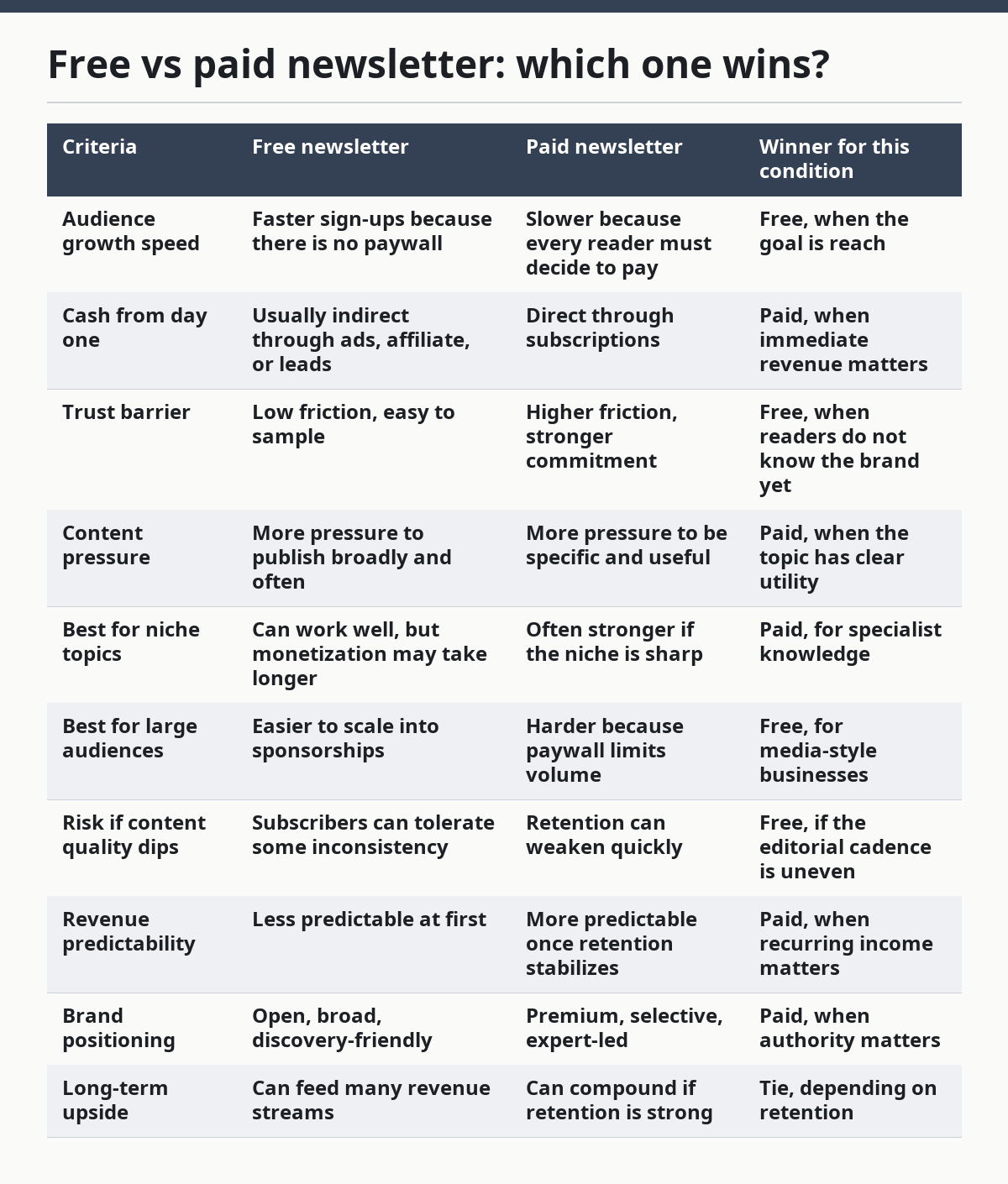
The right answer is often not either-or. A free newsletter can be the front door, with a paid tier behind it. That structure works because it lets readers test the voice before they pay. It also creates a natural ladder: free readers become repeat readers, then paying readers, then advocates.
The free model is wrong for a newsletter that exists mainly to sell expertise. If the real value is in the analysis, and the free issue gives away too much, the business may train the audience to wait for free content. The paid model is wrong for a newsletter still hunting for its audience, because a paywall can block the feedback needed to improve the offer.
How do sponsorships actually make money?
Sponsorships make money by selling a newsletter’s audience attention to a brand that wants a direct message in front of a relevant group. The sponsor pays for placement, not ownership of the list.
This model works when the audience is narrow enough to matter. A sponsor does not just want “readers”; it wants the right readers. A newsletter about HR software, remote hiring, or small-business accounting can be attractive because the reader intent is obvious. A general-interest newsletter usually has a harder time justifying sponsor rates because the audience is too mixed.
The strength of sponsorship is that it can monetize a free newsletter without asking readers to pay. That keeps growth easier and can support a larger top-of-funnel audience. It also fits newsletters with steady publishing cadence, because sponsors value consistency.
Sponsorship also creates a quality problem if the audience does not trust the separation between editorial and paid placement. The FTC’s endorsement and advertising guidance is a useful reference point here, especially the Federal Trade Commission’s page on endorsements and testimonials: https://www.ftc.gov/business-guidance/resources/ftcs-endorsement-guides-what-people-are-asking. The FTC’s advertising and marketing guidance also helps explain why clear disclosure matters: https://www.ftc.gov/business-guidance/advertising-marketing. Readers can feel when a recommendation has been softened for money.
A sponsorship-led newsletter is wrong for a tiny list with weak engagement, because the brand buyer usually wants proof that readers pay attention. It is also wrong for a newsletter whose core promise is deep, independent judgment. If the reader came for candor, too many sponsor messages can weaken the asset that made the list valuable in the first place.
How do subscriptions work without killing growth?
Subscriptions work by charging for depth, speed, exclusivity, or utility, while the free layer keeps discovery alive. The paid offer has to feel like a shortcut, not a punishment.
The strongest subscription newsletters usually have one of four clear promises. They save time by filtering a noisy field. They save money by helping readers avoid bad decisions. They make money by surfacing opportunities. Or they help reduce stress by turning a messy topic into a simple routine. If the paid tier cannot explain which of those it delivers, it will struggle.
The main benefit of subscriptions is direct recurring revenue. That makes the business easier to forecast than sponsorships or affiliate links, especially once churn is under control. A newsletter can lose momentum quickly if readers cancel after one or two billing cycles. Retention is the real test.
A subscription newsletter also needs a tighter content boundary than a free one. It cannot try to serve everyone. The more general the promise, the harder it is to justify payment. That is why broad commentary newsletters often stay free, while specialized research newsletters charge. The price is not just for content volume; it is for relevance.
This model is wrong for a creator who wants quick reach more than direct revenue. It is also wrong if the content is too easy to copy from public sources. If the reader can get the same answer from a search engine in 3 minutes, the paid offer needs a sharper edge than “curated for you.”
Where does affiliate revenue fit?
Affiliate revenue fits when the newsletter makes honest recommendations that naturally lead to a purchase, and when the recommendations are part of the reader’s problem, not a detour from it. It is the easiest monetization path to start, but also the easiest to misuse.
The appeal is simple: the newsletter earns a commission when a reader buys through a tracked link. That makes it useful for newsletters that review tools, compare products, or explain how to solve a task with a service or app. It can work with small audiences because the revenue comes from purchase intent, not from sheer reach.
The risk is that affiliate-heavy newsletters can drift into low-trust behavior. If every issue reads like a shopping cart, the reader stops believing the curation is honest. That is especially dangerous in niches where trust is the whole product, such as finance, health, or B2B software. A newsletter can survive occasional affiliate links; it usually cannot survive making those links the point of the newsletter.
Affiliate revenue is strongest when the recommendation is already valuable without the commission. If a reader would still want the tool, course, or book even with no tracking link, the model is healthy. If the recommendation exists only because it pays, the model is brittle.
This path is wrong for a newsletter with no buying context. If the reader is there for ideas, not purchases, affiliate links can feel forced. It is also wrong for a premium expert newsletter that sells confidence. Once every recommendation looks monetized, the premium promise starts to leak.
What should I build first if I want a real business?
I would build audience fit first, then one primary monetization path, then a second revenue stream only after the first is stable. The order matters more than the platform.
The first step is to define the reader so tightly that the newsletter has a natural job. “People who like business news” is too wide. “Solo founders deciding which free AI tools are worth their time” is much stronger. A specific reader gives the newsletter a reason to exist and a reason to be paid for later.
The second step is to choose one dominant monetization path. A newsletter can contain ads, subscriptions, affiliates, and services, but one of them should lead. If every issue tries to do all four, the message gets muddy. The reader should be able to answer, in one sentence, how this newsletter makes money.
The third step is to build a simple offer ladder. Free issue. Optional paid issue. Optional sponsor inventory. Optional affiliate links. Optional lead capture for a service. That ladder does not need to exist on day one in full form, but it should exist in structure so the business can grow without redesigning itself each month.
The biggest blind spot is founder time. A newsletter may look cheap to start, but the real cost is consistent writing, list management, editing, compliance, and promotion. A solo operator can run a newsletter with one model for a while. Two or three models add complexity fast. That is why many newsletters fail not because the content is weak, but because the business shape is too wide for one person to maintain.
This is also where a lot of advice goes wrong. It tells beginners to “monetize early” without saying what the audience is buying. Monetization is not the first move. Clarity is.
How do I price a paid newsletter?
I would price a paid newsletter around the value of the decision it helps the reader make, not around the number of words in the issue. The reader pays for outcome, not length.
A short newsletter can be worth more than a long one if it saves the reader from one bad call, one wasted hour, or one missed opportunity. That is why pricing should reflect use case. A market briefing, a deal tracker, a hiring brief, and a tactical how-to newsletter all sit in different value bands even if they are the same length.
The cleanest pricing structure is usually simple: free tier, paid tier, and maybe one premium tier if the work justifies it. Too many tiers confuse the decision. The reader should know what the paid tier does in one glance. If the offer page needs 12 bullet points to explain itself, the pricing may be hiding uncertainty.
A healthy paid newsletter also needs a reason to stay subscribed after the first month. That reason can be freshness, frequency, access, templates, archives, or community. If the subscriber feels they got the answer already, churn arrives fast. The billing cycle can become a reminder to leave.
I would not price by ego. High pricing with vague value is a common beginner mistake. Low pricing is not automatically safer either, because it can attract readers who never fully commit. The right price is the one the target reader can justify because the newsletter solves a real, repeated problem.
What are the biggest mistakes in newsletter monetization?
The biggest mistake is monetizing before the newsletter has a clear promise. A list with no clear promise is hard to sell, hard to sponsor, and hard to retain.
The second mistake is choosing a revenue stream that fights the content. A newsletter that should be trusted cannot sound like a sales funnel every week. A newsletter that should grow quickly cannot hide behind a paywall too early. The business model must fit the content pattern.
The third mistake is chasing multiple revenue streams before one works. Ads, subscriptions, affiliates, and services can all belong in a newsletter business, but not all at once in the early stage. Each added stream adds friction. The reader can feel that friction even when it is invisible on the page.
The fourth mistake is ignoring compliance and disclosure. Sponsored content, affiliate links, and endorsements all need clear labeling. The FTC guidance matters because trust is not a side issue in newsletter monetization; it is the asset itself. A newsletter that hides the commercial side may earn short-term clicks and long-term damage.
The fifth mistake is assuming subscriber count equals business strength. A 20,000-person list with weak engagement can be less valuable than a 2,000-person list with a tight, buying audience. The metric that matters is not vanity. It is whether the audience behaves in a way that supports the chosen model.
When should I rethink the whole model?
I would rethink the model when the reader, the content, and the revenue source stop matching. That usually shows up in 4 clear cases.
First, if the open rate stays decent but paid conversion stays flat, the problem may be that the free content is satisfying the need without creating a next step. In that case, the paid layer may need to be more specialized, not just longer.
Second, if sponsorship revenue grows but readers start to disengage, the newsletter may be trading trust for short-term cash. That is a real warning sign because trust loss often shows up late.
Third, if affiliate links are the main source of income but the editorial calendar keeps drifting toward products instead of problems, the newsletter may be monetizing the wrong audience behavior. The list may be better suited to subscriptions or lead generation.
Fourth, if the newsletter is clearly helping readers solve expensive problems but is still free and under-monetized, the business may be leaving value on the table. In that case, a paid tier or premium offer can fit better than more advertising.
A model switch is worth considering when the work has outgrown the original plan. Many newsletters start as hobby projects and later become businesses. The audience may keep the same name, but the economics do not have to stay the same.
The real trade-offs between the main monetization paths
The real difference is not “which one makes the most money.” It is which one fits the shape of the newsletter and the patience of the operator. A sponsored free newsletter can grow fast but depends on audience scale and brand demand. A paid newsletter can build cleaner recurring revenue but needs sharper value and lower churn. Affiliate-heavy newsletters start fast but can lose trust if the recommendations feel opportunistic. Lead-gen newsletters can be very efficient, but they are often really sales funnels in disguise.
Here is the simplest way to think about the trade-off:
- Choose sponsorships if the newsletter has a clear niche, consistent cadence, and a large enough audience to matter to advertisers.
- Choose subscriptions if the newsletter solves a painful, specific problem and the reader would pay for speed, access, or depth.
- Choose affiliate revenue if the newsletter naturally recommends tools or products the reader already wants.
- Choose lead generation if the newsletter exists to support consulting, coaching, recruiting, or another higher-ticket service.
The wrong move is trying to make a broad newsletter do a specialist’s job. A broad newsletter usually needs reach-based monetization. A specialist newsletter usually needs value-based monetization. Mixing those up creates weak economics and weaker content.
What should I choose?
Choose subscriptions if the newsletter solves one expensive problem for one specific audience and can justify recurring payment. Choose sponsorships if the newsletter is free, consistent, and attractive to a clearly defined buyer. Neither if the newsletter has no clear reader, no repeatable promise, and no reason for anyone to pay, sponsor, or click.
That is the cleanest call. A newsletter business works when the audience, the content, and the money all point in the same direction. If they do not, the model is the problem, not the platform.
FAQ
Can a newsletter make money with a small audience?
Yes, if the audience is narrow and valuable. A small list can still support subscriptions, consulting leads, or selective sponsorships when the readers are the right people. The key is engagement and intent, not just raw subscriber count.
Is a free newsletter better than a paid one?
A free newsletter is better for growth, and a paid newsletter is better for direct revenue. The better choice depends on whether the main goal is audience building or recurring income. Many strong newsletter businesses use both.
How many ways should a newsletter monetize?
Start with 1 main path and add a second only after the first is stable. Too many monetization methods at once can blur the editorial promise and make the newsletter feel less trustworthy. A simple structure is easier for readers to understand and easier for the business to run.
Do sponsorships hurt trust?
They can, if the sponsorship line is unclear or the ads start to overwhelm the editorial voice. Trust stays stronger when paid placements are labeled clearly and the newsletter still feels useful without the sponsor message. Disclosure is part of the product, not a side note.
When is a newsletter ready for paid subscriptions?
A newsletter is ready when it solves a specific problem well enough that readers can explain the value in one sentence. The paid tier should offer something the free version does not, such as depth, speed, access, or a better decision path. If the value is vague, the subscription will be hard to sell.
Drafted with AI; not yet reviewed by a person.