Last updated: November 19, 2026
Quick answer: ChatGPT free can cover 4 main job-search tasks—drafting, sorting, interview practice, and follow-up—but it cannot be the final source of truth. This guide covers ChatGPT free for the entire job search workflow, its real limits, and related questions. It works best as a drafting and sorting tool for search, applications, interview prep, and follow-up. It is weak where a human needs to verify facts, tailor proof, or handle anything that depends on current job listings and exact company details.
Key takeaways
- Free ChatGPT can cover the main job search steps, but it should not be trusted as the source of record.
- The biggest risk is not “bad writing”; it is wrong facts, stale job details, and generic advice that sounds polished.
- It is most useful for drafts, checklists, and practice rounds, not for final truth.
- A job search still needs human review for company names, dates, role requirements, and salary talk.
- The free plan may be enough for a light search, but anyone applying to many jobs will feel the limits fast.
Can ChatGPT free cover the whole job search?

Yes, but only as a helper, not as the full system. The free version can support the main steps in a job search: choosing target roles, tightening a CV, drafting a cover letter, preparing interview answers, and writing follow-up messages. It cannot replace careful fact-checking, current job boards, or your judgment about which roles are worth applying for.
The practical limit is simple: free ChatGPT is good at language, not at truth. A job search asks for both. A polished paragraph that gets a company name wrong or copies a stale job requirement does more harm than a plain sentence you can trust.
OpenAI’s pricing page explains the free tier and paid tiers, while its help material also makes clear that feature access can change. That matters because a job seeker who builds a process around one feature may find it missing later. The NIST AI Risk Management Framework is useful here too: it treats AI as something to manage with oversight, not something to hand the keys to. If a job search involves legal status, salary negotiation, or other high-stakes detail, consult a professional or the hiring source directly.
A good rule is this: use ChatGPT free for first drafts and structure, then verify every detail that came from outside your head. That includes role titles, dates, skills mentioned in the posting, and anything that affects whether you meet the job’s basic requirements. For a search with 2 or 3 role types, keep a separate fact sheet for each one.
What parts of a job search does it handle well?
It handles the writing-heavy parts well enough for most people. That includes turning rough notes into a clearer profile summary, rewriting bullet points, creating a skills list from past work, and shaping answers to common interview questions. It also helps when a job seeker feels stuck staring at a blank page.
A useful use is not “write my application for me.” A stronger use is “turn these notes into three stronger options,” then choose the one that sounds like a real person. That cuts the time spent on the blank-page problem without making the application sound fake.
It can also help with sorting. If you paste a job description, it can pull out repeated requirements, likely interview topics, and phrases that should appear in your answer if they are true. That saves time in the first pass. It does not remove the need to confirm what the company actually wants from the role.
Therefore, the workflow is strongest when the job seeker already has the raw material: work history, achievements, project details, and target roles. Without that, the output tends to drift into generic advice. That is the main reason free ChatGPT feels useful for the first draft and less useful for the final version.
Where does the free plan start to break?

The free plan starts to break when the job search needs current data, long context, or repeated heavy use. A job search often means opening many job posts, comparing several versions of a CV, and revising cover letters for different companies. Free access can make that feel stop-start rather than smooth.
The first limit is reliability of access to the same model and the same tools. Free access can change, and the available features can differ from paid access. That means a process built on one exact behavior is fragile.
The second limit is context. A job search gets messy fast: one role wants management experience, another wants technical depth, a third wants a different tone. If the model cannot hold all of that clearly in one place, the output gets flatter and less tailored.
The third limit is confidence without proof. ChatGPT can sound certain even when it is wrong. For job seekers, that is dangerous around salary talk, title matching, skill claims, visa language, and employment dates. Those are the kinds of errors that can damage trust in one screen.
| Area | Free ChatGPT | What that means in practice | Safer fallback |
|---|---|---|---|
| Draft writing | Good for first pass | Can turn notes into clean text | Human edit before sending |
| Current job details | Weak | May miss updates or mismatch requirements | Read the posting directly |
| Long, complex tailoring | Limited | Multiple roles can blur together | Keep one prompt per role |
| Repeated heavy use | Can feel constrained | Process may slow down or change | Save prompts and reuse them manually |
| Fact-sensitive claims | Risky | Can invent or distort details | Verify against your own records |
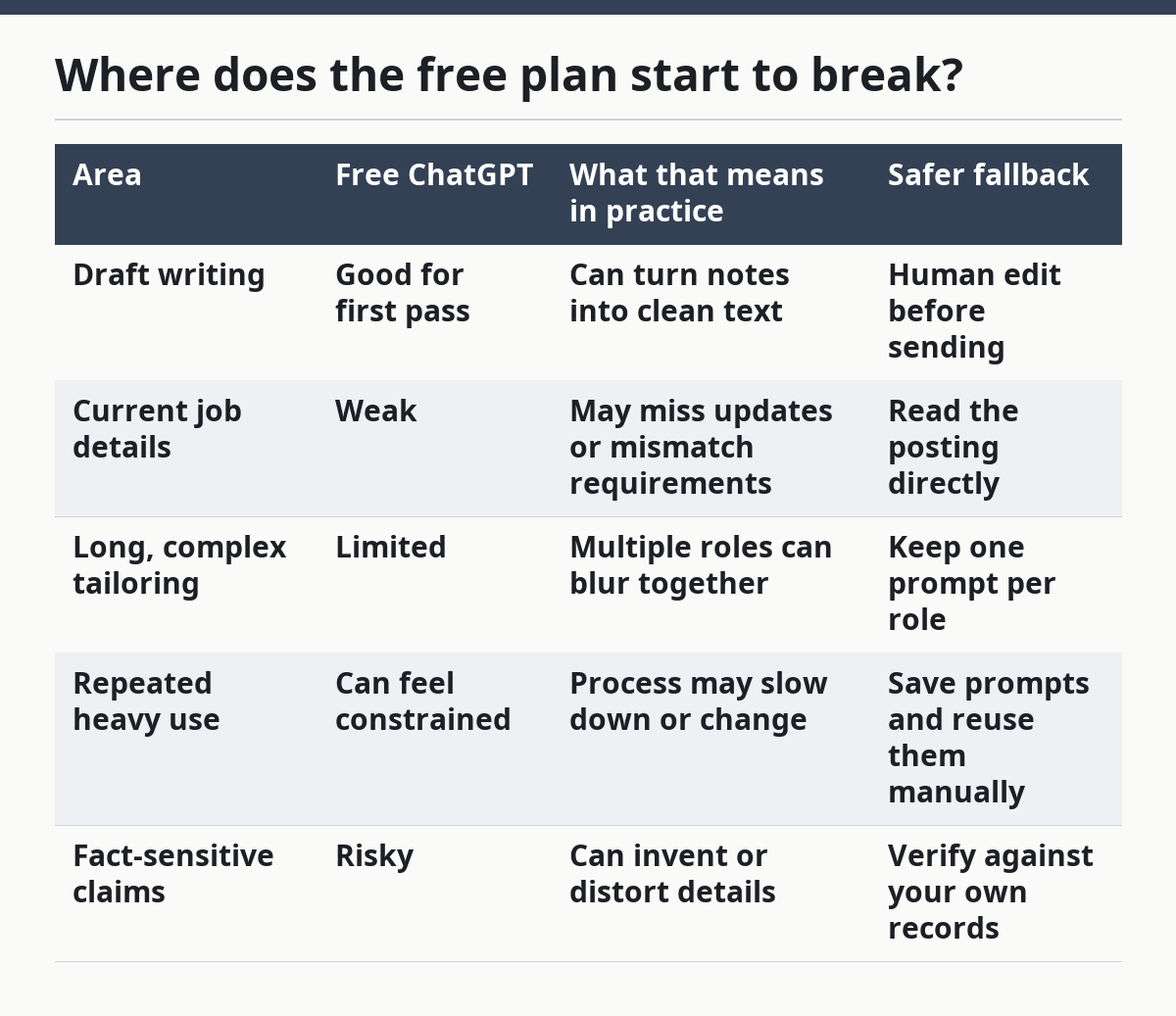
That trade-off is why the free plan suits a careful, low-budget search better than a high-volume one. If someone is applying to a small number of roles and can check everything line by line, free ChatGPT may be enough. If the search is fast, competitive, and detail-heavy, the friction rises.
How do you use it without letting it write the wrong thing?
You use it with a strict input-and-check routine. Give it only the facts you want it to use, and ask for a result in a narrow format: one summary, three bullet points, one answer, or two tone options. Then verify the output against your own records before sending anything.
That matters because job search writing contains small details that carry weight. A one-year gap can be explained badly. A title can be inflated. A skill can be implied when it was never used. ChatGPT is willing to smooth all of that over unless it is told not to.
A safer pattern is to keep the model inside four jobs:
- Draft a profile summary from your own notes.
- Rephrase bullet points without changing the facts.
- Generate interview practice questions from a role description.
- Rewrite a follow-up note into a cleaner tone.
For example, a prompt can ask for one CV summary, not five. Another prompt can ask for three interview questions, not a full mock interview. Smaller asks are easier to verify and less likely to drift.
A risky pattern is to ask it to invent missing parts of your story. If a job ad asks for a specific tool, the model should not guess that you have used it. If a salary range is needed, the model should not make one up. If the job posting says a degree is required, the model should not blur that requirement away.
That is the real limit of free ChatGPT in job search: it is strongest when the facts are already known and weakest when the facts matter most.
What should it not do?
It should not be the source for anything that must be exact. That includes job requirements, dates, company facts, salary ranges, legal status questions, and claims about credentials. It should also not be the final writer of any application that will be compared against a real posting by a recruiter or hiring manager.
It is also the wrong tool for judgment-heavy decisions that need a human read. For example, it can compare two role descriptions, but it cannot know whether one company’s culture, commute, or workload is worth the trade-off. It can suggest a stronger answer to an interview question, but it cannot tell whether that answer is believable unless the person using it knows the truth.
The honest alternative is not “do everything manually.” It is “let ChatGPT free handle the draft, then use your own records and the posting itself as the final check.” That keeps the time savings without handing over control. LinkedIn’s job search advice and similar career resources also put the burden on the applicant to tailor each application, not on a tool to decide it.
This is especially true for job seekers who are applying across 2 or 3 role types at once. The broader the search, the more likely it is that a generic AI draft will blur the differences between roles. A narrow search with a tight fact sheet is a much better fit.
Is free ChatGPT enough for related questions?
Yes, for related questions it can help in a limited, useful way, but only if the questions are about process, not truth. It can explain how to structure a CV, how to answer common interview prompts, how to turn a job description into a checklist, and how to write a short follow-up message. It is less useful when the question depends on a current posting or a personal situation that needs exact wording.
That means the useful related questions are the ones a job seeker asks on the way through the workflow. “What should I change in this summary?” is a good fit. “Am I actually qualified for this role?” is better answered by comparing the posting to real experience, then using ChatGPT only to help phrase the result.
The free plan is most useful when the questions are small and specific. It is less useful when the question is broad, urgent, or tied to risk. A job search has all three, so the user has to decide where the tool belongs.
If the goal is a full, repeatable search system, free ChatGPT can play a large role. If the goal is to remove every human decision from the process, it is the wrong tool. For a career workflow, the same applies to CV writing, cover letters, and interview prep.
Related questions
Is ChatGPT free enough for a CV and cover letter?
Yes, for a draft and a rewrite. It can help shape a CV summary, tighten bullet points, and adjust a cover letter to a job description. It should not be the last stop before sending, because the final version still needs a human check for accuracy and tone. For a 1-page CV, the tool can still save time.
Can I use ChatGPT free to prepare for interviews?
Yes, and this is one of its better uses. It can generate practice questions, help turn past work into short examples, and make answers shorter or clearer. The limit is that it can only practice with what it is told, so weak input leads to weak rehearsal.
Will employers know I used ChatGPT?
Not from the tool alone, but they may notice if the writing sounds generic, over-polished, or too broad. The risk is not detection; it is losing the thread of your real experience. A good job application still sounds like a person who did the work.
What is the biggest mistake job seekers make with free ChatGPT?
The biggest mistake is trusting it on facts instead of using it on drafts. A job search punishes small errors in dates, titles, and requirements. Free ChatGPT is strongest when it helps write around those facts, not when it replaces them.
When is the free plan not enough?
It is not enough when the search is high-volume, highly tailored, or full of detail checks. If a person is applying to many roles, revising the same documents again and again, or juggling several job tracks at once, the limits show up fast. In that case, free ChatGPT can still help, but it will not carry the whole workflow on its own.
Drafted with AI; not yet reviewed by a person.