Last updated: November 20, 2026
Quick answer: a free AI tools newsletter usually monetizes with 3 channels—sponsorships, affiliate links, and newsletter ads—without losing reader trust if every paid mention is labeled and the editorial line stays separate. This article on how to monetize a free AI tools newsletter without losing reader trust keeps the same useful format from one issue to the next.
Key takeaways
- Readers forgive ads when the newsletter still solves their problem fast.
- Sponsorships work best when the paid mention fits the same AI tools topic as the rest of the issue.
- Affiliate links can fit a free newsletter, but only with plain disclosure and a real reason for the recommendation.
- Native placements create more trust risk than simple banner-style ads.
- The biggest trust break is not earning money; it is making paid content look like unpaid editorial.
What should come first?
Trust should come first, because a free AI tools newsletter has no second chance with a skeptical reader. If the audience thinks every tool mention is for sale, the open rate and click rate lose their value, even if a sponsor pays more than a plain ad.
The clean rule is simple: keep editorial picks based on usefulness, then place monetization around that editorial. A reader should be able to tell, in about 5 seconds, what is editorial, what is sponsored, and what is affiliate-linked. That clear split matters more than squeezing every slot in the issue.
This is not the right model for a newsletter that wants to review tools like a paid directory disguised as a free digest. It also does not fit a brand that wants to claim total objectivity while selling placements. The business can work, but only if the issue keeps its promise to the reader.
Which monetization model fits a free AI tools newsletter?
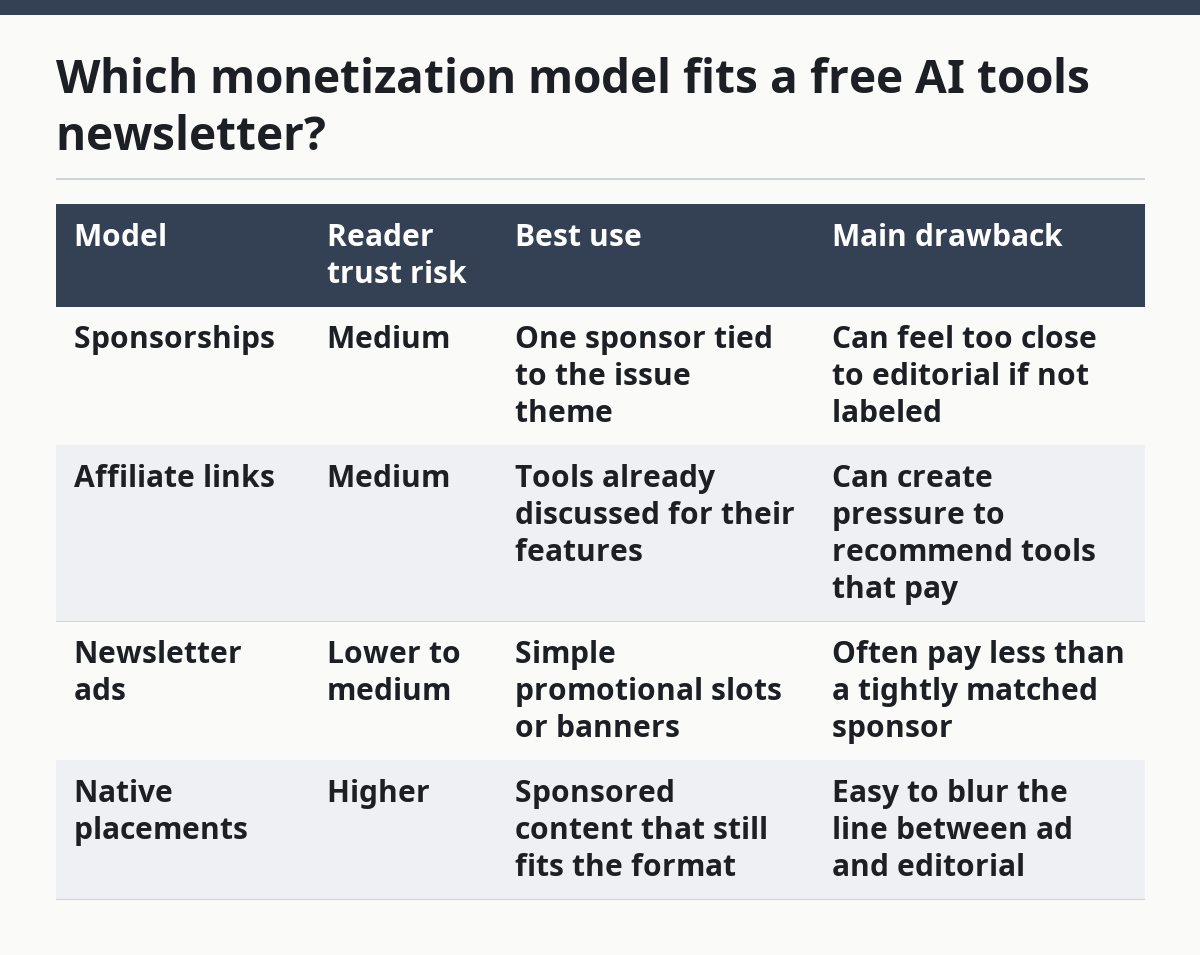
The best fit is often a mix of sponsorships, affiliate links, and occasional newsletter ads, because each one does a different job. Sponsorships tend to be the cleanest paid fit for a topic-specific newsletter, affiliate programs reward useful tool recommendations, and ads can fill inventory without forcing every issue to include a full sponsor pitch.
Here is the practical comparison:
| Model | Reader trust risk | Best use | Main drawback |
|---|---|---|---|
| Sponsorships | Medium | One sponsor tied to the issue theme | Can feel too close to editorial if not labeled |
| Affiliate links | Medium | Tools already discussed for their features | Can create pressure to recommend tools that pay |
| Newsletter ads | Lower to medium | Simple promotional slots or banners | Often pay less than a tightly matched sponsor |
| Native placements | Higher | Sponsored content that still fits the format | Easy to blur the line between ad and editorial |
The safest mix for a free AI tools newsletter is often one sponsor slot plus a few affiliate links in clearly marked tool mentions. That keeps the issue useful and leaves room for future growth. A newsletter that fills every line with paid content tends to lose the very attention it is trying to sell.
This model is not a fit for a newsletter that wants zero disclosure. It is also a poor fit if the audience expects deep technical analysis or highly opinionated tool rankings, because any payment link will draw extra scrutiny.
How do sponsorships stay honest?
Sponsorships stay honest when the paid message is clearly separate from the editor’s recommendation. A sponsor can pay for a placement, a mention, or a section, but that payment should not change the basic test for inclusion: is this AI tool useful to the reader right now?
Use a simple structure for every sponsored issue. Start with the regular editorial picks, label the sponsor section with words like “Sponsored” or “Paid placement,” and keep the sponsored copy in its own block. A reader should never have to guess where the editorial ends. The FTC Endorsement Guides are the right standard to keep in mind here, because the core idea is disclosure that ordinary people can notice and understand.
The hardest part is not the label. It is resisting the urge to edit the whole issue around the sponsor’s needs. If a sponsor sells image generation software, that does not mean the newsletter should suddenly fill with image tools for three straight issues. That kind of drift trains readers to distrust the next recommendation.
How should affiliate links be handled?
Affiliate links should be used only when the link sits inside a recommendation that still makes sense without the commission. If the product earns a place in the newsletter only because it pays a referral fee, readers will feel that shift sooner or later.
The cleanest method is to mark affiliate links at the item level and add one short disclosure near the top or bottom of the newsletter. The disclosure should be plain language, not legal wallpaper. “Some links may be affiliate links” is clearer than a paragraph of jargon, and it gives readers enough information to judge the recommendation.
A useful rule is to keep affiliate links for tools that already match the issue’s editorial theme. That means the tool belongs in the newsletter first, and the affiliate program comes second. If the order flips, trust drops fast. A free AI tools newsletter survives because the reader expects help sorting tools, not hidden sales pressure. If you need a template, our affiliate disclosure examples page shows simple wording that readers can understand quickly.
How do newsletter ads differ from native placements?
Newsletter ads differ from native placements because ads can stay visibly separate, while native placements try to blend into the editorial flow. That blend can work, but it carries more trust risk, especially in a newsletter built around AI tools where the reader already expects curation.
A plain newsletter ad is easier to explain: it is a paid slot, placed in a fixed spot, with a clear label. A native placement is harder: it may look like a recommendation, read like a recommendation, and still be a paid message. That is the place where trust most often gets blurred.
Use native placements only if the disclosure is impossible to miss. A small label hidden in a footer is not enough. If the placement looks like editorial, it should carry a stronger label than a standard ad, not a weaker one. The reader does not need a lesson in ad formats; the reader needs to know what is being sold. The IAB advertising glossary is useful background for format terms if you need to label ad units consistently.
What order should the issue follow?
The issue should follow a fixed order so readers know what to expect in every send. A predictable structure makes the paid parts easier to accept because they do not hijack the whole newsletter.
-
Open with the editorial lead by naming the most useful AI tool or trend first, then give the reader the reason it matters in 2 to 4 sentences. The result is a strong start that still feels like the newsletter they subscribed to.
-
Place the sponsor block second with a visible “Sponsored” label, one clear message, and one call to action. The result is a paid section that does not pretend to be the editor’s pick.
-
Add affiliate-linked tools after the sponsor and mark each item in the same way every time. The result is a repeatable pattern that readers learn to scan.
-
Close with the non-paid roundup so the newsletter still ends with utility, not a sales pitch. The result is a finish that reinforces the free value of the issue.
That order matters because it limits surprise. A reader who knows where the paid content sits is less likely to feel tricked by it. A random order, by contrast, makes every new issue feel harder to trust.
What mistakes cost you readers?
The biggest mistake is hiding the money relationship, and it costs trust faster than a weak recommendation does. Readers can accept that a free newsletter needs revenue; they do not accept being misled about who paid for what.
Another mistake is letting the sponsor choose the recommendation language. That usually turns the issue into a brochure, and brochures do not build long-term subscription value. It also weakens the editor’s role, which is the main reason people keep a free AI tools newsletter in a tab.
A third mistake is overloading one issue with too many paid links. Even if every link is labeled, the issue begins to feel crowded and transactional. A newsletter with 8 paid items and 2 editorial items is telling the reader that attention is for sale.
The fix is boring but effective: keep the paid count lower than the useful count, keep the labels obvious, and keep the editorial tone steady. That is the trade-off. Slower monetization can protect the audience that makes monetization possible. For a deeper framework, our newsletter trust checklist and ad labeling best practices cover the same risk from a publishing angle.
How much disclosure is enough?
Enough disclosure means a normal reader can spot the paid relationship without hunting for it. In practice, that means labeling the sponsor section, labeling affiliate links, and using plain language in the issue itself rather than burying the note in a separate page.
A short disclosure at the top or near the first paid item is usually stronger than a long legal block at the bottom. The reader should not need to scroll past the whole newsletter to find the truth. The FTC standard is useful here because it focuses on clarity, not legal theater.
The disclosure also has to match the placement. If the paid mention sits inside the main body, the label should sit there too. If the ad is in a side block or footer, the label should still be visible in the same area. A disclosure that is technically present but hard to find does not protect trust. The FTC’s disclosure guidance is the safest external reference for that standard.
Which approach is wrong for this newsletter?
The wrong approach is pretending the newsletter can monetize hard and stay invisible at the same time. A free AI tools newsletter is not a secret revenue machine; it is a reader relationship that can support revenue only if the reader feels respected.
That means aggressive native ads, vague affiliate behavior, and sponsor-led editorial calendars are all bad fits. They may produce short-term cash, but they also train the audience to skim past the issue or unsubscribe. The newsletter should not become a directory of whoever paid this week.
The better path is simple: keep the editorial promise clear, keep the paid parts labeled, and keep the revenue mix easy to explain. That makes the newsletter easier to sell to sponsors too, because sponsors are buying a real audience, not a confused one.
FAQ
Can a free AI tools newsletter include affiliate links?
Yes, if the links are disclosed clearly and the recommendation still stands on its own. The link should not be the reason the tool appears in the newsletter. A reader should be able to understand the suggestion even if the commission disappears.
How do you disclose sponsorships in a newsletter?
State that the section is sponsored or paid, and place that label next to the sponsored content itself. Keep the language plain and direct. A disclosure should tell the reader who paid and where the payment is influencing the issue, not hide behind legal wording.
What monetization methods work for a free newsletter?
Sponsorships, affiliate links, and newsletter ads are the most natural fit. Sponsorships usually work best when the topic is tightly matched, affiliate links work best for tools already worth mentioning, and ads work best when they stay clearly separated from editorial. The right mix depends on how much trust the audience already gives the newsletter.
Drafted with AI; not yet reviewed by a person.