Last updated: November 20, 2026
Quick Answer: a practical editorial operations and quality control system usually starts with 5 core steps, 1 owner per step, and 1 defined final check. Editorial operations and quality control — The Complete Guide is the system that keeps content moving on time without publishing avoidable errors. If a team has missed deadlines, inconsistent voice, broken facts, or “final-final-v3” files everywhere, the fix is not more hustle; it is a clearer workflow, a named owner for each step, and a review standard that catches the same mistakes every time.

Key takeaways
- Editorial operations is the workflow; quality control is the check that proves the workflow still works.
- If the team is small, one clean checklist beats a heavy approval chain.
- If the team publishes often, version control and naming rules matter as much as writing skill.
- A style guide helps with consistency, but it does not replace fact checks, copy checks, or sign-off.
- The right system depends on risk: a blog piece, a medical article, and a homepage need different controls.
What are editorial operations and quality control?
Editorial operations are the rules, roles, and steps that move content from idea to published page, and quality control is the set of checks that keeps errors out of the final draft. The two work together: one keeps work flowing, the other keeps standards from slipping.
A generic explanation usually stops at “create a process,” which is too vague to help anyone who has to run one. In practice, editorial operations includes intake, assignment, briefs, deadlines, editing stages, handoffs, approvals, file naming, version control, and post-publish fixes. Quality control covers the standards for spelling, structure, fact accuracy, links, metadata, tone, accessibility, and legal or brand review.
The useful distinction is this: operations tells people what happens next, while quality control decides whether the work is good enough to move on. If a team confuses the two, the process gets bloated. If the team treats them as the same thing, mistakes can pass through because “someone already reviewed it.” For regulated work, consult a professional or subject-matter expert and follow your organization’s standards; the ISO 9001 quality management page is a clear reference for that mindset.
A simple benchmark helps. ISO 9001 is a quality management standard, and the reason it matters here is not that editorial teams need a certificate. It matters because it pushes one useful idea: define the process, assign responsibility, and check the output against a standard, not a mood. The ISO 9001 quality management page is a clear reference for that mindset. The AP Stylebook is a useful reminder that style rules only work when they are shared and enforced.
The wrong move is to build operations around personalities. If the whole process depends on one senior editor remembering everything, the system breaks during vacation, illness, or turnover. Quick check: if you can’t explain who checks what in one minute, the operation is too loose.

What does a solid editorial workflow look like?
A solid editorial workflow is a chain of five or more named steps, each with one owner and one exit rule. If a step has no owner or no deadline, it is not a step; it is a hope.
For a small content team, the basic path often looks like this:
- Brief the piece with audience, goal, source list, and target length.
- Draft the copy with a clear angle and one main promise.
- Line edit for structure, tone, and clarity.
- Copyedit for grammar, consistency, names, numbers, and links.
- Fact-check every claim that could harm trust if wrong.
- Approve final layout, metadata, and publish settings.
- Review after publication for broken links, formatting drift, or updates.
That path changes when risk changes. If the content is low-stakes, such as a short educational piece, then the review chain can stay short. If the content has legal, health, money, or safety consequences, then the fact-check and approval stages need more scrutiny and may need a second subject-matter reviewer. The answer flips because the cost of an error changes.
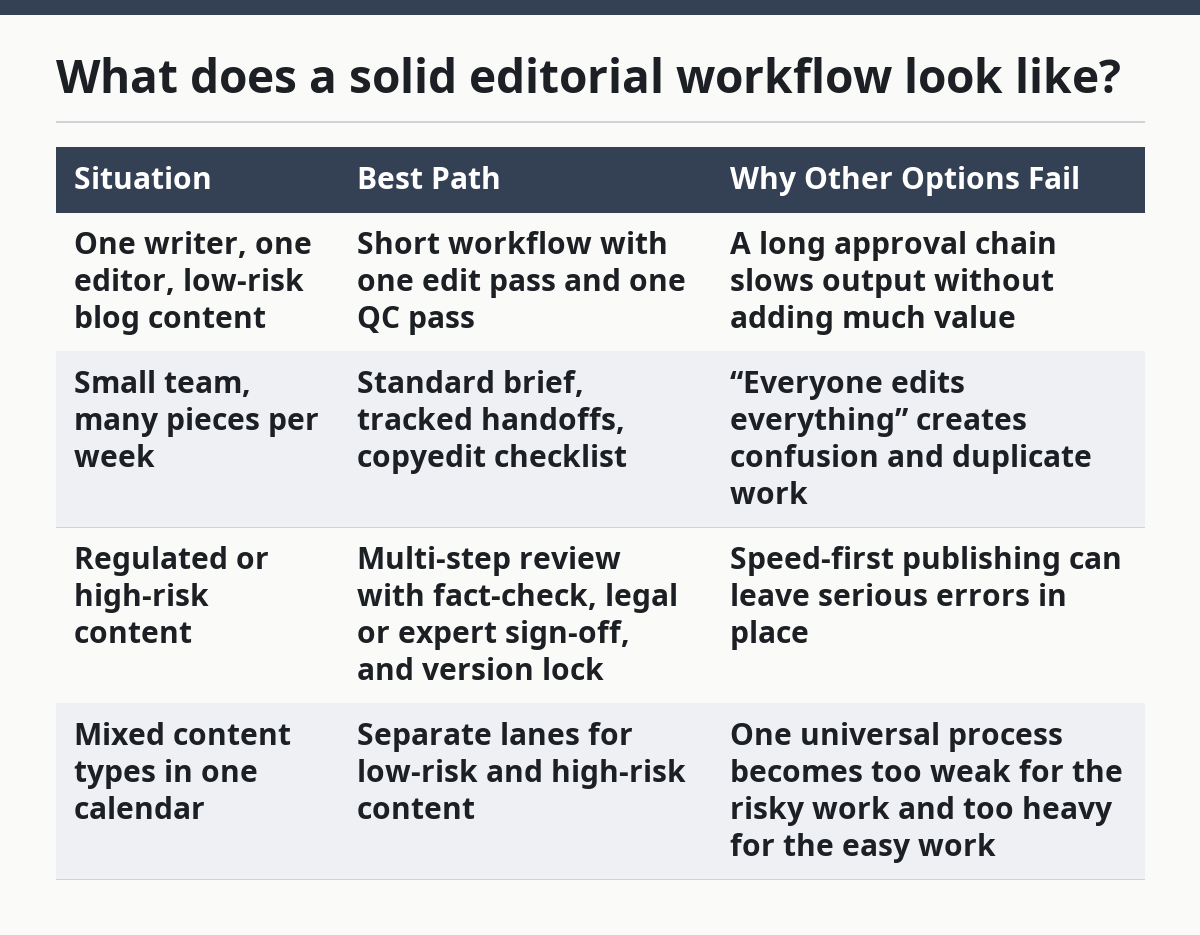
Here is the basic decision table most teams need before they build the workflow.
| Situation | Best Path | Why Other Options Fail |
|---|---|---|
| One writer, one editor, low-risk blog content | Short workflow with one edit pass and one QC pass | A long approval chain slows output without adding much value |
| Small team, many pieces per week | Standard brief, tracked handoffs, copyedit checklist | “Everyone edits everything” creates confusion and duplicate work |
| Regulated or high-risk content | Multi-step review with fact-check, legal or expert sign-off, and version lock | Speed-first publishing can leave serious errors in place |
| Mixed content types in one calendar | Separate lanes for low-risk and high-risk content | One universal process becomes too weak for the risky work and too heavy for the easy work |
If you want the workflow to survive real deadlines, the first control is naming. Use one file convention, one status label system, and one place where the current version lives. A simple rule like “draft, edit, legal, final” is better than five vague labels that mean different things to different people.
The second control is exit criteria. A piece should not move forward until it meets a defined standard, such as “all headings match the brief,” “all quotes are sourced,” or “all internal references are current.” Without exit criteria, reviewers spend time debating taste instead of checking quality.
The third control is rollback. If a page ships with a mistake, the team needs a quick way to correct it without hunting through email threads. That means version history, a clear owner, and a fast correction path. Quick check: if the team cannot tell the difference between “ready for edit” and “ready to publish,” the workflow needs fewer handoffs and clearer labels.

Which quality checks matter most?
The most important quality checks are the ones that catch mistakes readers notice first: facts, structure, language consistency, links, and publication settings. If time is short, these five beat cosmetic polishing every time.
The order matters. Many teams start with spelling because it is visible, but spelling is not the biggest risk. Broken claims, missing context, and bad links hurt trust more than a missed comma. A piece can look clean and still be wrong.
A useful way to think about quality control is by layer:
- Fact layer: names, dates, numbers, definitions, claims, and citations.
- Structure layer: headings, flow, repeated ideas, and missing steps.
- Language layer: grammar, word choice, tone, brand voice, and jargon.
- Technical layer: links, redirects, metadata, image alt text, and page format.
- Risk layer: legal review, compliance review, and expert review when needed.
The trade-off is simple. The more public or sensitive the content, the more checks it needs. A 300-word news brief does not need the same process as a 3,000-word medical explainer, and pretending otherwise wastes time. But the reverse is also true: high-volume teams cannot afford a review model that turns every piece into a committee meeting.
A practical checklist for copyediting and QC can be as short as 12 items, but it should be specific. For example:
- Does the headline match the piece promise?
- Is the angle clear in the first two paragraphs?
- Are all numbers written in the correct style?
- Are names spelled the same way everywhere?
- Are all links working and relevant?
- Is there one clear call to action or next step?
Then add category-specific checks. For regulated topics, that may include a source review. For brand content, it may include tone and approved terms. For multilingual teams, it may include localization checks and region-specific terminology.
One common mistake is to confuse “quality” with “preference.” A reviewer may prefer shorter sentences, but if the audience needs technical precision, brevity can hurt clarity. Another mistake is to review only the finished page. Quality improves when errors are caught at the brief stage, the draft stage, and the final pre-publish stage. Quick check: if your team’s QC checklist is only a spelling list, it is too shallow.
How do teams set standards without slowing everything down?
Teams set standards without slowing everything down by deciding which rules are fixed, which are flexible, and which require escalation. If every decision needs a meeting, the process is too heavy; if no decision is locked, the output drifts.
A practical place to start is three layers of standard:
- Non-negotiables: things that must always be true, such as source attribution, fact checks, and file naming.
- Style preferences: things that can vary, such as tone, sentence length, or brand vocabulary.
- Escalation points: things that require a second look, such as legal terms, medical claims, or policy statements.
That structure keeps the team from arguing about every comma. It also makes training easier because new editors can learn what must never change and what can flex.
A strong process usually has a short style guide, not a giant document nobody opens. The guide should cover the 20 or so decisions the team repeats most often: headings, capitalization, numbers, dates, quotes, links, attribution, and how to handle ambiguous terms. If the guide becomes a 60-page archive, it turns into shelfware.
A standard people can use during work is often the most effective. That means checklists, templates, and examples are more useful than long policy text. It also means the standard should sit where the work happens: in the brief, in the CMS, or in the review sheet.
Here is a useful rule. If a standard saves time three or more times a week, write it down. If a rule is only relevant once a quarter, keep it simple and move it to escalation. That balance matters because editorial teams fail in two opposite ways: too many rules, or too few rules.
This is also where a lot of generic advice gets it wrong. It says “create a style guide” and leaves it there. But the real question is enforcement. A standard that nobody checks is decoration. Quick check: if your team can name the rule but not the person who enforces it, the standard is too soft.

When should the process get stricter?
The process should get stricter when the content is high-risk, high-volume, or highly visible. If the piece can affect money, health, reputation, or legal exposure, the review chain should tighten even if that adds time.
Use stricter controls when one or more of these is true:
- A mistake could cause direct harm.
- The page will be used by many teams or customers.
- The content needs a dated promise, policy, or claim.
- Multiple authors touch the same file.
- Revisions happen close to publication time.
In those cases, a basic two-step edit is usually not enough. The team may need a second editor, an SME review, legal review, or a final sign-off gate. The trade-off is slower publishing, but the gain is lower error risk.
The other side of this is just as important: do not over-control low-risk content. A 500-word educational piece about a common tool does not need the same sign-off path as a policy page. If the process is too strict, writers start bypassing it. Then people stop trusting the workflow and use side channels instead.
A practical escalation model can look like this:
- Classify the content by risk before drafting starts.
- Assign a standard workflow lane based on that risk.
- Choose the required reviewers before the draft is written.
- Lock the source list for anything that cannot change casually.
- Set the final approval point and who can override it.
- Document corrections after publication so the same issue does not repeat.
This is where editorial operations and quality control become a management problem, not just a writing problem. The team needs to know which pieces are “fast lane,” which are “normal lane,” and which are “slow lane.” If everything is treated the same, either the risky work is under-checked or the easy work is delayed for no reason. Quick check: if your team publishes both social pieces and policy pages, they should not share the same approval chain.
What breaks in the real world?
The normal advice breaks down when speed, scale, or change outruns the process. In those cases, the right answer is not “follow the system harder”; it is “change the system to fit the situation.”

-
Situation: the team is tiny and one editor is doing everything. What changes: there is no spare reviewer, so the process must stay light. What to do instead: use a strict checklist, one short edit pass, and a final proof pass that catches only the highest-risk errors.
-
Situation: the content updates often, such as pricing, product specs, or policy text. What changes: the piece can go stale quickly. What to do instead: add a review date, a named owner, and a shorter correction path so updates do not wait for the next full editorial cycle.
-
Situation: several people edit the same draft in different tools. What changes: version confusion becomes the main risk. What to do instead: lock one source of truth, use one naming system, and keep comments in one place instead of scattered across email and chat.
-
Situation: a subject-matter expert is the bottleneck. What changes: expert time is limited, and drafts stall. What to do instead: send the SME only the exact sections that need review, with specific questions attached, rather than the whole piece.
-
Situation: the team publishes in more than one format, such as web pages, newsletters, and social pieces. What changes: the same content must fit different lengths and rules. What to do instead: create format-specific QC checks so the team does not force one checklist onto every channel.
-
Situation: the page has legal or compliance sensitivity. What changes: a wording choice can create risk. What to do instead: route those claims through pre-approved language, define what cannot be changed without sign-off, and keep a record of final approval.
A lot of advice says to “standardize everything.” That sounds efficient, but it fails when the work is uneven. Standardize the repeatable parts; customize the risky parts. If the system cannot handle exceptions, it will break the first time a deadline gets tight. Quick check: if your team has one review path for all content types, edge cases are already slipping through.
How do you know the system is working?
The system is working when errors drop, revisions shrink, and people stop asking where the latest version lives. If quality control is doing its job, the team should spend less time fixing avoidable mistakes and more time improving the work itself.
Good signs are easy to spot:
- Drafts come in closer to final on the first pass.
- Editors spend less time rewriting structure from scratch.
- Fewer corrections happen after publication.
- Review comments repeat less often.
- Deadlines are met without last-minute panic.
Bad signs are also obvious. If the same error keeps reappearing, the problem is not the writer; it is the process. If review takes longer every month, the checklist may be bloated. If people skip steps, the workflow may be asking for work that does not add value.
A useful review rhythm is monthly for the process and weekly for the output. Monthly, look at the workflow itself: where files stall, which steps create confusion, and which checks catch real issues. Weekly, look at the content: what slipped through, what took the longest, and what had to be corrected after publish.
The most honest metric is not “how many pieces were published.” It is “how many pieces needed avoidable rework.” That number tells the truth about operations quality. Another useful measure is reviewer load: if one person is carrying most of the final checks, the system is fragile.
A simple post-mortem format helps:
- What went wrong?
- Where in the workflow did it first appear?
- Why did the current check miss it?
- What rule or step would have caught it?
- What will change before the next similar piece?
That is the difference between a content team that learns and a content team that merely repeats work. Quick check: if the same correction keeps showing up in review notes, the process needs an adjustment, not more reminders.
FAQ
What is the difference between editorial operations and editorial quality control?
Editorial operations is the system that moves content through the pipeline, while quality control is the set of checks that decides whether the output meets the standard. Operations is about flow; quality control is about correctness. A team needs both, because smooth movement without checks produces errors, and strict checks without flow create delays.
Do small teams really need a formal workflow?
Yes, but the workflow can be very short. A one-page checklist, a naming rule, and a fixed review order are enough for many small teams. The goal is not bureaucracy; the goal is to stop the same mistakes from coming back every week.
What should be checked before publication?
At minimum, the headline, structure, facts, links, formatting, and final page settings should be checked before publication. If the content carries legal, medical, or financial risk, the review should also include a subject-matter check and a clear approval point. The exact list should match the risk of the page, not the size of the team.
How often should an editorial process be reviewed?
The process should be reviewed regularly, and monthly is a useful rhythm for many teams. That review should look at repeated errors, stalled handoffs, and steps that do not add value. If the team publishes in a fast-moving field, the review may need to happen more often.
What is the biggest mistake teams make?
The biggest mistake is often treating quality control like a final polish instead of a system. By the time a page reaches the last check, most of the costly mistakes are already baked in. The better fix is to build quality into the brief, the draft, and the review stages, not just the last pass.
Drafted with AI; not yet reviewed by a person.