Last updated: November 19, 2026
Key Takeaways
- Short blurbs are faster; long summaries help readers judge.
- Short blurbs fit crowded issues by keeping pages lean.
- Long summaries earn space when readers need help deciding to care.
- Short blurbs optimize speed; long summaries improve comprehension.
Short blurbs vs long newsletter summaries: the choice depends on how dense each issue is, how much reader attention you can ask for, and how much detail each section needs. Quick Answer: in a 6- or 8-section issue, a short blurb usually works better for speed, while a long summary works better for judgment.
Short blurbs vs long newsletter summaries: the real difference
Short blurbs are better for speed; long summaries are better for judgment. If the reader only needs to know what a linked item is, a short blurb does the job in one glance. If the reader needs to understand why it matters, the longer summary earns its space. In a 6- or 8-section issue, that difference is easy to see.
Picture this: you’re building a newsletter with six or eight sections, and each item competes for the same screen space on a phone. You need a summary format that helps the reader decide in seconds, not one that buries them in the first paragraph. That decision is the whole game.
The choice is not about writing style alone. It’s about reader attention, scan speed, and the amount of context your issue format demands. A short blurb can keep the page light. A long summary can stop a weak click from feeling like a bait-and-switch.
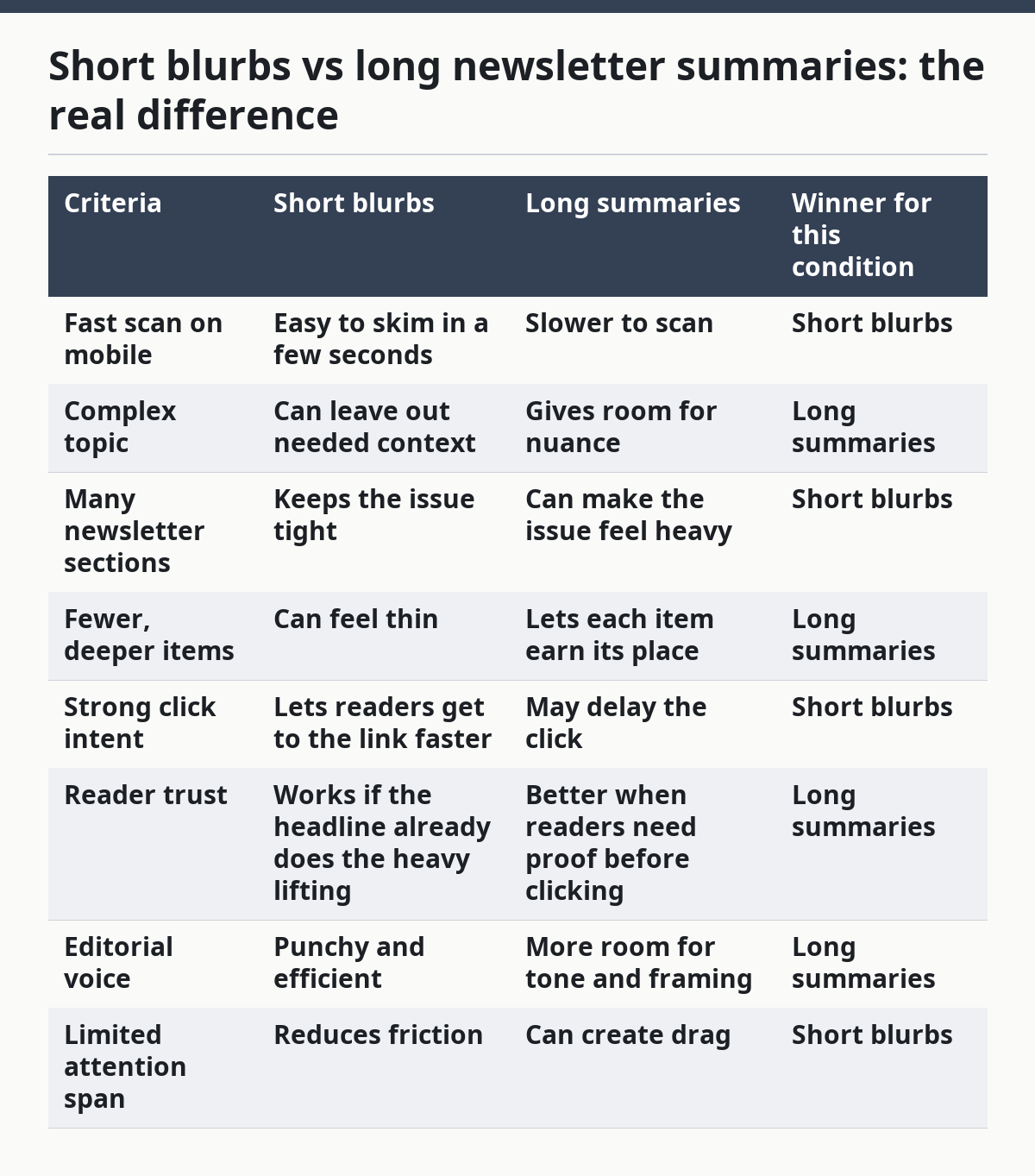
| Criteria | Short blurbs | Long summaries | Winner for this condition |
|---|---|---|---|
| Fast scan on mobile | Easy to skim in a few seconds | Slower to scan | Short blurbs |
| Complex topic | Can leave out needed context | Gives room for nuance | Long summaries |
| Many newsletter sections | Keeps the issue tight | Can make the issue feel heavy | Short blurbs |
| Fewer, deeper items | Can feel thin | Lets each item earn its place | Long summaries |
| Strong click intent | Lets readers get to the link faster | May delay the click | Short blurbs |
| Reader trust | Works if the headline already does the heavy lifting | Better when readers need proof before clicking | Long summaries |
| Editorial voice | Punchy and efficient | More room for tone and framing | Long summaries |
| Limited attention span | Reduces friction | Can create drag | Short blurbs |
Which format fits a newsletter issue with lots of sections?
Short blurbs fit a crowded newsletter issue better because they protect the page from drag. When a reader sees 10 sections, every extra sentence costs attention. A 1–2 sentence blurb can keep the rhythm moving and make the whole issue feel manageable.
Picture this: you’re editing a roundup where each section has a headline, a link, and a small note. If each note turns into a mini-essay, the issue loses pace. That matters because newsletter sections live or die by how quickly a reader can move from one item to the next.
Short blurbs work especially well when:
- the newsletter has many sections
- each link already explains itself
- the reader is skimming on a phone
- the goal is quick triage, not deep reading
The downside is plain. A short blurb can sound thin if the topic is unfamiliar or the link title is vague. It can also make the issue feel templated, like every item got the same treatment regardless of importance. If a section deserves more than a label, consult a professional editor or subject-matter expert before treating it the same way.
Who should skip short blurbs: editors whose newsletter covers dense topics such as policy, research, or technical changes. Those readers often need one extra layer of context, not just a tease.
Buy this if: you write a high-volume newsletter for busy readers who mainly need scan speed.
Skip this if: you cover complex subjects and the link title alone does not explain the payoff.
When does a long summary earn its space?
A long summary earns its space when the reader needs help deciding whether to care. That happens when the topic is new, the stakes are higher, or the link headline leaves out the useful part. In those cases, a long summary can do the sorting before the click.
Picture this: you’re sending an issue with one big feature and a few supporting notes. The feature deserves more than a teaser because the reader may need a frame, a contrast, or a reason to care. A longer summary gives you room to explain the angle without making the reader hunt for it.
Long summaries are strongest when:
- the article is complex or technical
- the issue has only a few sections
- the reader benefits from context before clicking
- the topic needs a quick plain-English translation
The trade-off is real. Long summaries slow the issue down, and they can blur the difference between the newsletter and the linked article. If the summary gives away too much, the click feels less useful. If it rambles, the reader starts skipping entire blocks.
Here’s the practical rule: if the summary needs more than a few lines to make sense, the issue may need a different structure, not just a longer blurb. That’s especially true in newsletters where readers open expecting quick scanning, not a full briefing.
Who should skip long summaries: editors of high-frequency newsletters where the same reader sees every issue and wants fast recognition more than explanation.
Buy this if: you publish a curated issue with fewer items and need each one to feel worth a click.
Skip this if: your audience opens the newsletter for quick updates and will bounce when the text gets dense.
The honest side-by-side
Short blurbs win on speed; long summaries win on comprehension. The right format depends on which problem hurts more in your newsletter: slow scanning or weak context.
Picture this: you’re choosing between a tight 25-word note and a fuller 80-word summary for the same section. The short version may move faster, but the long version may save the reader from clicking blind. That trade-off is the decision.
| Criteria | Short blurbs | Long summaries | Winner for this condition |
|---|---|---|---|
| Reader time on device | Easier to finish in one glance | Takes more time | Short blurbs |
| Depth of explanation | Limited | Strong | Long summaries |
| Headline support | Depends on a strong headline | Can rescue a weak headline | Long summaries |
| Newsletter length | Keeps the issue compact | Expands the issue fast | Short blurbs |
| Editorial control | Simple to standardize | Harder to keep consistent | Short blurbs |
| Trust building | Can feel sparse if overused | Shows the reasoning behind the link | Long summaries |
| Best for recurring readers | Familiar and efficient | Can feel repetitive if too long | Short blurbs |
| Best for new readers | May leave gaps | Easier to orient | Long summaries |
| Risk of fatigue | Low | Higher | Short blurbs |
The best part? You do not need to choose one format for every section. A strong newsletter often uses both: short blurbs for routine items and long summaries for the one or two pieces that deserve context. That mix protects attention without flattening the issue into one tone.
The mistake is to make every section the same length because it feels tidy. Tidy is not the same as readable. A uniform 40-word summary on every item can make a newsletter feel flat, even when the content varies a lot.
Which format should you choose for your readers?
Choose short blurbs if your readers open the newsletter to scan, click, and move on. Choose long summaries if they open it to understand the issue before they decide what matters. Because of that, the cleanest split is about reader intent, not style alone.
Picture this: your newsletter lands next to work email, receipts, and alerts. The reader is not in a deep-reading mood by default. A short blurb respects that moment. If the reader is coming for analysis or curation, a longer summary earns its place by doing some of the interpretive work first.
Use short blurbs when:
- the audience already knows the topic
- the issue contains many sections
- the link title is clear on its own
- your main goal is fast scanning
Use long summaries when:
- the audience is mixed or new
- the topic needs context to matter
- the issue has fewer, more important items
- the summary has to explain the angle, not just the subject
The honest limit of short blurbs is that they work best in a newsletter that already has strong structure. The honest limit of long summaries is that they can crowd out the rest of the issue. Neither format fixes weak curation. If the section mix is sloppy, the summaries will only make that flaw more obvious.
Exceptions where the verdict flips
Long summaries can beat short blurbs in a newsletter that is normally built for scanning. That happens when one item carries more weight than the rest, or when the topic has enough nuance that a short note would mislead the reader.
Picture this: you’ve got a mostly light newsletter, but one section covers a policy shift, a product change, or a research result that readers will act on. A short blurb may be too thin for that slot. The summary should slow down there, even if the rest of the issue stays brisk.
The verdict flips in these cases:
- The headline is vague. If the title does not explain the payoff, a longer summary has to do the work.
- The topic is technical. Readers need a bridge, not a teaser.
- The issue is short. With only a few sections, a longer summary will not crowd the page as badly.
- The reader is new. New readers need orientation before they trust the click.
Short blurbs can also win in places people assume need more detail. If the newsletter is already trusted and the section labels are sharp, a long summary may just repeat what the reader already knows. That’s wasted space.
The rule is simple: use the format that answers the reader’s next question. If the next question is “What is this?” use a longer summary. If the next question is “Should I click?” use a short blurb.
The verdict: which one to choose and why
Choose short blurbs if your newsletter is built for fast scanning, many sections, and repeat readers who already know the beat. Choose long summaries if your issue is short, the topics are dense, or the reader needs context before the click. Neither if you are using summaries to patch weak headlines, because that problem needs a better structure, not more words.
Picture this: you are editing the final version and every section competes for attention on a small screen. The right summary length is the one that helps the reader decide faster, not the one that feels fuller on the page. That is the standard.
For a practical next step, pick one issue and compare the click-worthiness of each section with both formats. The goal is not to make every item the same length. The goal is to match summary length to reader intent and the actual shape of the issue.
For a broader framework on this topic, the hub page on Free AI tools newsletter — The Complete Guide can help you place summary length inside the rest of the issue design.
When should a summary be longer?
A summary should be longer when the reader needs context to understand why the item matters. That includes technical topics, unfamiliar subjects, and sections with vague headlines. If a short blurb would force the reader to guess, use the extra lines to clarify the angle before the click.
Are short blurbs better for tool newsletters?
Short blurbs are often better for tool newsletters because readers usually want to scan names, uses, and links fast. That said, a tool roundup with a confusing title or a niche use case may still need a longer summary. The right length depends on how much explanation the reader needs before deciding to click.
Drafted with AI; not yet reviewed by a person.