Last updated: November 20, 2026
Price sponsored placements around audience fit, newsletter inventory, and the value of the slot — not around a guess. In a free AI tools newsletter, the cleanest path is to compare CPM and flat fee pricing, then set an insertion order that matches the placement: one slot, one issue, one clear deliverable.
Key takeaways
- Price the slot first, not the whole newsletter. A mention in the main newsletter body is not the same as a footer line or a dedicated send.
- Use CPM when audience size and delivery are easy to explain. Use a flat fee when the placement is fixed and the sponsor wants certainty.
- Fit matters. A sponsor selling AI writing, AI image, or AI automation tools belongs closer to your reader than a generic software brand.
- Bundle pricing works best when you have more than one slot to sell, or when a sponsor wants a run of issues instead of a one-off buy.
- A simple insertion order avoids confusion later. It should name the issue, the placement, the deadline, and what the sponsor gets.
What should the price cover?
The price should cover the placement, the audience, and the scarcity of that slot. A sponsored placement in a free AI tools newsletter is not just a line item; it is access to a reader who already wants AI tools, usually in a format with limited real estate. That scarcity is the reason pricing can be stronger than a generic display ad.
Start by defining the inventory you actually have. If your newsletter has one top slot, one mid-body slot, and one footer mention, those are three different products. A top placement in the first 200 words is worth more than a footer mention because it gets earlier attention and less competition on the page.
The first question is not “What do others charge?” It is “What does this placement include?” A sponsor may get one link, one short description, one logo, or a full paragraph. If the sponsor also wants category exclusivity, that changes the value again. A tool newsletter that covers AI writing, image generation, search, agents, and automation should not price every mention the same way.
A simple way to frame the offer is to match the price to three things: placement depth, audience fit, and inventory scarcity. A flat fee works well when the slot is fixed and easy to describe. CPM works well when you can point to audience volume and keep the math transparent. The best price is the one that can survive a short email thread without needing a long defense.
How do newsletter sponsorships get priced?
Newsletter sponsorships get priced from the slot, then translated into either CPM or a flat fee. That means the job is to decide what one placement is worth in your newsletter, not to start with a random market number.
Use this order of work:
- Define the placement — top, middle, or footer — so the sponsor knows exactly where the ad appears and what kind of attention it gets.
- Count the inventory — one issue, one slot, or a bundle of issues — so you know what you can sell without crowding the newsletter.
- Set the pricing model — CPM for audience-based pricing, flat fee for fixed placement pricing — so the offer is easy to explain.
- Write the insertion order — issue date, placement, creative length, link rules, and approval timing — so there is no confusion after the deal is booked.
- Review fit — whether the sponsor sells a tool your readers might actually use — so the placement does not feel random to the audience.
CPM is useful when the sponsor wants to compare your newsletter with other media buys. It gives a standard way to talk about reach, and it helps if your list size changes over time. Flat fee is simpler when the sponsor is buying a fixed slot in a specific issue and wants certainty more than math.
An insertion order matters because it turns a handshake into a clean record. It should state the issue, the slot, the creative deadline, and any limits on links or tracking. That document protects both sides when the sponsor asks for a change two days before send.
For a broader view of how this newsletter fits into the business model, the free AI tools newsletter hub belongs with this pricing work, not after it.
Should I use CPM or a flat fee?
Use CPM when the sponsor wants audience-based pricing and use a flat fee when the slot is a fixed product. That is the short answer, and in a free AI tools newsletter it is usually the right split.
| Pricing model | Best for | Strength | Weak point |
|---|---|---|---|
| CPM | Larger lists, repeat buys, simple reach comparisons | Easy to compare against other media | Can feel abstract if the slot is highly premium |
| Flat fee | Fixed placements, one-off issue buys, simple sales calls | Easy to sell and invoice | Can hide value if the audience is strong |
| Bundle pricing | Multiple issues, recurring sponsors | Helps fill inventory over time | Needs clearer terms to avoid confusion |
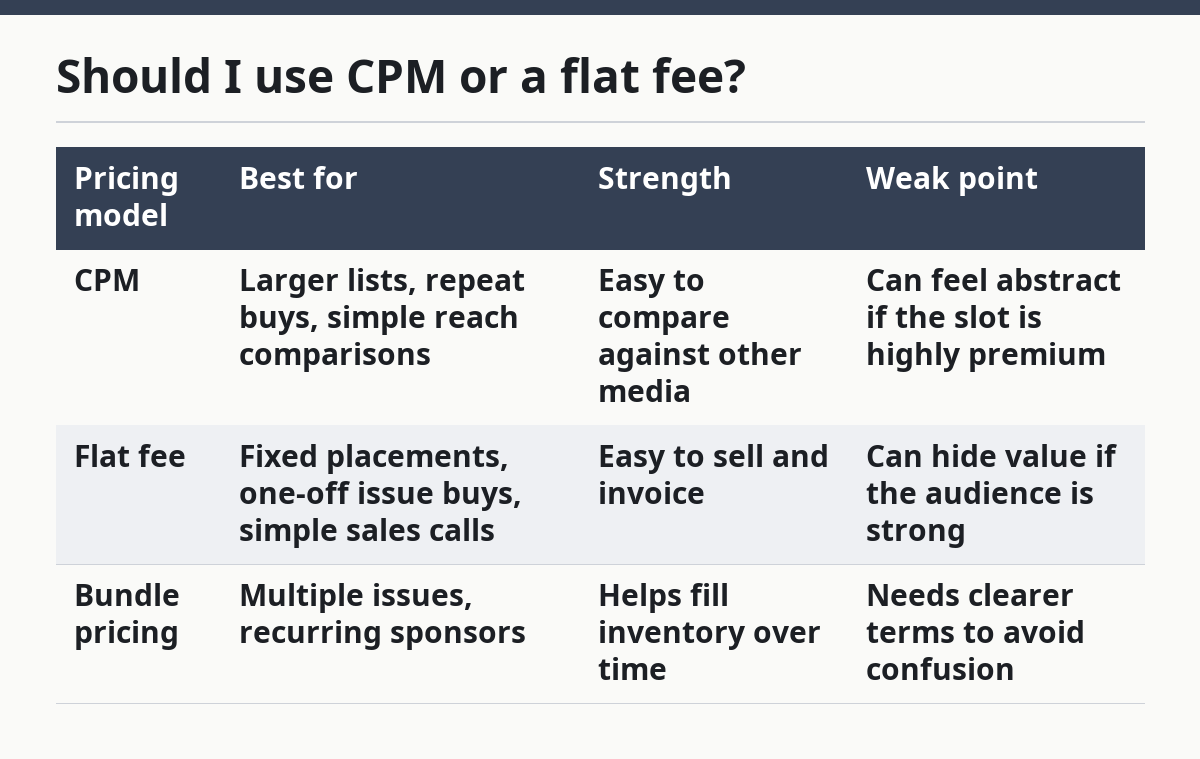
CPM works best when the audience count is the main selling point. If a sponsor is buying a standard ad slot and wants to compare options across newsletters, CPM gives a common language. A flat fee works best when the placement is specific and limited, like a top banner, a feature block, or a sponsor note inside one issue.
Bundle pricing deserves special attention because many newsletter sponsors prefer a run instead of a single send. A 3-issue or 4-issue package can make the buy easier for the sponsor and reduce sales work for the newsletter owner. The trade-off is that bundle pricing can undercut single-issue value if the package is built too cheaply. The package should reward commitment, not erase the worth of the premium slot.
This is also where a common mistake shows up: pricing everything the same because the newsletter is free. Free to the reader does not mean free to the sponsor. A niche AI audience can be more valuable than a broad but indifferent list, especially when the sponsor sells directly into the same category.
What makes a sponsor worth more?
A sponsor is worth more when the product matches the reader’s intent, the placement is scarce, and the issue content supports the ad. In a free AI tools newsletter, a tool for prompt work, image generation, or workflow automation usually fits better than a general business SaaS offer.
Readership fit changes pricing because it changes expected relevance. A sponsor that solves a problem your readers already have can justify a higher rate than a sponsor that only loosely connects to AI. That does not mean every relevant sponsor gets the same quote. It means your strongest placements should go to the most obvious fit, or they should cost more if the sponsor wants them first.
Inventory matters too. If the newsletter only has one premium sponsor slot per issue, that scarcity supports a higher price than a newsletter with six ad blocks. More inventory sounds useful, but it can push rates down if readers begin to ignore the placements. A narrow inventory often holds value better than a crowded page.
Timing matters in a smaller way. A sponsor buying a single issue on short notice may pay less if you are trying to fill the slot, but a sponsor buying a run of issues can justify a better package if the creative stays stable. That is one reason bundle pricing can work. It gives the sponsor consistency and gives the newsletter more predictable revenue.
There is one honest limit here: if the newsletter audience is too small or too general, even a strong AI sponsor will not pay premium rates. A niche topic helps only when the readers are clearly the right readers.
What should go into the insertion order?
The insertion order should name the slot, the issue, the price model, and the delivery rules. It is the simplest document that keeps a sponsorship deal from drifting.
A useful insertion order usually includes these items:
- issue date or send window
- exact placement, such as top slot, mid-body slot, or footer mention
- CPM or flat fee
- creative length and format
- link destination
- approval deadline
- payment terms
- bundle dates, if the sponsor bought more than one issue
The point is not paperwork for its own sake. The point is to keep the ad from expanding into something you never priced. A sponsor who wants one paragraph, one CTA, and one link should not quietly turn that into a mini-native article without a new rate.
A short insertion order also helps when you sell the same inventory more than once. If you sell a top slot in issue 14 and then again in issue 18, you want the terms to be easy to compare. That makes it simpler to see whether your CPM or flat fee is too low, too high, or just right for that specific placement.
What should you avoid when pricing?
You should avoid pricing by guesswork, underpricing premium slots, and mixing up the value of different placements. The most expensive mistake is selling a top placement at footer value, because that mistake repeats every issue.
A second mistake is making the sponsor price depend only on list size. A 2,000-subscriber newsletter with strong AI-tool intent can be more useful than a much larger list with weak fit. Price should reflect reader relevance, not just a raw count.
A third mistake is hiding the model. If you cannot explain whether the rate is CPM or flat fee in one short sentence, the price is too hard to sell. Sponsors do not need a lecture; they need a clear product. They should know what they are buying before they ask for the invoice.
The last mistake is selling every slot as if it were identical. Footer inventory is not the same as a headline mention, and a one-off issue is not the same as a 4-issue bundle. If the pricing sheet treats them as the same, the newsletter leaves money on the table and confuses buyers.
For advertising-disclosure basics that affect sponsorship presentation, the FTC’s endorsement guidance is a useful reference: FTC Endorsement Guides. For broader ad standards and measurement language, the IAB is another relevant standards body to review.
How should the package be framed to buyers?
The package should be framed as a clear media product, not a favor. A sponsor should be able to see the slot, the audience, and the terms in one pass.
A simple package frame might separate three offers: one premium placement, one standard placement, and one bundle. That structure gives buyers a choice without forcing them to decode the whole inventory sheet. It also keeps the sales conversation focused on placement value instead of haggling over vague exposure.
The strongest framing uses plain language. Say what the placement is, where it appears, and what the sponsor gets. If the newsletter has a top slot in every issue, that slot should have its own name and price. If a bundle lowers the per-issue rate, say that directly. Buyers respond better to a clean comparison than to a long explanation of why the rate is “dynamic.”
This is where a free AI tools newsletter has an advantage. The audience intent is narrow, so the package can be narrow too. A sponsor does not need to be sold on the whole internet; the sponsor needs the right readers in the right issue, with the right insertion order.
How do newsletter sponsorships get priced?
Newsletter sponsorships get priced by matching the placement to a model the buyer can understand, usually CPM or a flat fee. The slot, the audience fit, and the inventory all matter, but the placement itself is the starting point. A premium position in a niche AI tools newsletter should not be priced like a generic footer ad.
What factors affect sponsorship rates?
Sponsorship rates change with placement quality, audience fit, inventory scarcity, and whether the sponsor is buying one issue or a bundle. A sponsor that closely matches the newsletter topic can justify a stronger rate than a loose fit. The cleaner the slot and the clearer the insertion order, the easier it is to price accurately.
Should sponsorship pricing be flat fee or cpm?
Flat fee is better for fixed placements, while CPM is better when the buyer wants audience-based pricing. In a free AI tools newsletter, a flat fee often makes the sales process simpler for a single issue. CPM helps when you want a common pricing language for repeat buys, larger lists, or more standard inventory.
Drafted with AI; not yet reviewed by a person.