Last updated: November 20, 2026
Quick Answer: run 3 cross-promotions first, then keep the swaps that bring the best-fit readers to your free AI tools newsletter. In How to Grow a Free AI Tools Newsletter with Cross-Promotions, the goal is not just more signups; it is signups from people who already read about AI tools, productivity, or workflows. The right promo swap with the right newsletter partner can bring in subscribers who care about new tools, not just free stuff.
Key takeaways
- Cross-promotions often work best when the two newsletters share an audience, not just a topic.
- A strong partner usually has a similar reader level, a clean list, and a clear reason to recommend your newsletter.
- A short, specific swap tied to one promise, such as “free AI tools every week,” is often easier for partners to use.
- Bad partners can cost you more than they help because they can fill your list with inactive readers.
- A simple 3-step vetting process can save you from weak swaps and wasted placements.
What is a cross-promo for a newsletter?
A cross-promo is a simple exchange where one newsletter recommends another newsletter to its readers, often as a swap. For a free AI tools newsletter, that means another writer sends a short mention of your list to people who already like tools, productivity, or AI news.
This works better than broad growth tactics because the audience is already pre-sold on email as a format. A reader who opens a newsletter about no-code tools, maker tips, or AI workflows is much closer to your ideal subscriber than a random social follower.
The main trade-off is quality control. A cross-promo can bring fast list growth, but it can also bring weak subscribers if the partner audience is too broad or the message is sloppy. That is why the partner and the copy matter more than the size of the list.
A useful mental model is this: one good promo swap is not “free traffic.” It is a targeted referral channel. If the partner’s readers do not already care about finding free AI tools, the signup rate may look busy while the list quality falls.
How do newsletter cross-promotions work?
Newsletter cross-promotions work by trading attention, usually in one of three formats: a direct recommendation, a newsletter ad slot, or a swap inside a content block. The cleanest version for most small publishers is a straight promo swap, where each newsletter gives the other one mention.
Here is the core process, in the order that usually works best:
- Choose one partner newsletter with a close audience fit before you write anything.
- Offer one clear promo swap, such as a one-paragraph recommendation or a short slot in a roundup.
- Draft promo copy that says exactly what the reader gets, such as “free AI tools, use cases, and fresh releases.”
- Approve the send date and placement so both sides know where the mention will appear.
- Track new signups for the next 24 to 72 hours so you can compare partners later.
- Repeat with partners that bring subscribers who open and stay active.
That simple structure matters because cross-promotions break when they become vague favors. If the reader cannot tell what the newsletter does in one line, the swap wastes the slot. If the partner cannot explain why the audience matches, the result is usually low-intent signups.
A strong swap is not a long campaign. It is one clear recommendation, one clear call to action, and one clear audience match.
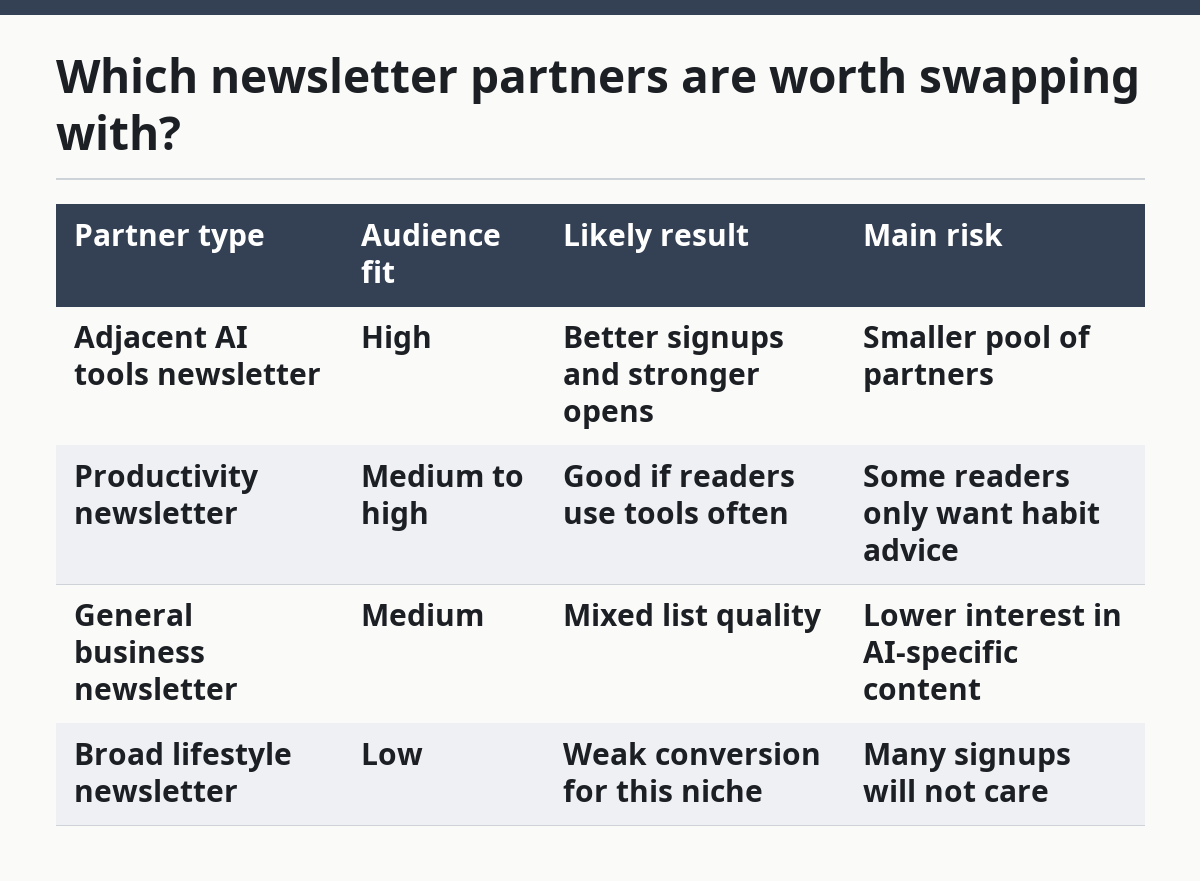
Which newsletter partners are worth swapping with?
The best newsletter partners are often adjacent newsletters whose readers already want AI tools, productivity tips, or creator workflows. This usually beats a giant general newsletter because the audience fit is closer and the signup intent is stronger.
A useful partner is not “any newsletter with lots of readers.” It is a newsletter whose readers would naturally care about finding free AI tools. That can include newsletters about:
- AI news and tool roundups
- No-code and automation
- Startup and maker updates
- Productivity and workflow tips
- Creator tools and content systems
The fit should be obvious in one sentence. If you have to explain the connection for 30 seconds, the partner is probably too far away.
Here is a simple comparison:
| Partner type | Audience fit | Likely result | Main risk |
|---|---|---|---|
| Adjacent AI tools newsletter | High | Better signups and stronger opens | Smaller pool of partners |
| Productivity newsletter | Medium to high | Good if readers use tools often | Some readers only want habit advice |
| General business newsletter | Medium | Mixed list quality | Lower interest in AI-specific content |
| Broad lifestyle newsletter | Low | Weak conversion for this niche | Many signups will not care |
A generic article often misses the point here and tells you to “partner with big newsletters.” That can backfire. A smaller adjacent list can outperform a larger unrelated one because the reader sees the match instantly.
If you run a free AI tools newsletter, your best partners are often the ones already serving people who want better tools, faster output, or easier workflows. That is the audience fit standard to use before you ask for a swap.
How do you choose a good cross-promo partner?
A good cross-promo partner passes three checks: audience fit, list quality, and promotion style. If any one of those fails, the swap can bring the wrong readers into your list.
Start with audience fit. Read the last few issues and ask one simple question: would a person who likes free AI tools also care about this newsletter? If the answer is only “maybe,” keep looking.
Next, check list quality through the partner’s newsletter behavior, not their hype. A partner who sends clear issues, uses consistent subject lines, and avoids spammy language is easier to trust. A partner who stuffs every issue with random offers may still have readers, but the audience may be trained to ignore recommendations.
Then check promotion style. Some partners are better at writing a personal recommendation. Others only do a tiny footer mention. Both can work, but you need to know which one you are getting before the swap goes live.
Here is a practical vetting rule: if the partner cannot explain who their readers are in one short paragraph, do not swap yet. That missing clarity usually shows up later in poor signup quality.
This is also where list growth gets real. Growth that comes from aligned readers can compound. Growth that comes from mismatched audiences often looks fine for a week and weakens everything after that.
What should your promo copy say?
Your promo copy should say what the newsletter gives, who it is for, and why the reader should care in one short block. For a free AI tools newsletter, the copy should feel specific, not generic.
A strong promo usually contains three parts:
- A plain promise, such as “free AI tools and practical ways to use them”
- A reader fit line, such as “for people who want useful tools without chasing every launch”
- A reason to click now, such as “get a weekly list you can actually use”
Keep the message simple enough that the partner can paste it without rewriting the whole thing. Long copy turns into fuzzy copy, and fuzzy copy gets ignored.
You should also match the partner’s tone. A newsletter for builders may want direct, utility-first language. A newsletter for creators may want a friendlier angle. The offer stays the same, but the wording should feel native to the host newsletter.
A common mistake is writing promo copy that sounds like a sales page. That costs trust. Readers in newsletter land respond better to a useful promise than to a hype line.
If your newsletter is part of a larger site, this copy should point to the same clear promise that appears on the landing page and on the hub for the free AI tools newsletter. The message should not change from partner to partner, or readers will feel a disconnect.
How do you avoid low-quality subscribers from swaps?
You avoid low-quality subscribers from swaps by screening partners, tightening the message, and watching what happens after signup. Cross-promotions are not just about list size; they are about the kind of reader who joins.
The first filter is audience fit, because it is the easiest way to protect list quality. If the partner’s readers are not already interested in AI tools, the email will still reach inboxes, but the new subscribers may not open future issues.
The second filter is the promise in the promo itself. A vague line like “check this out” attracts casual clicks. A specific line like “get free AI tools that save time in real work” attracts readers who know why they are subscribing.
The third filter is post-signup behavior. Track the first few days after the swap, then compare partners on the basics: opens, clicks, unsubscribes, and replies if you use them. A simple partner log is enough.
One honest limitation matters here: cross-promotions are not the right first move if your newsletter has no clear niche yet. If the offer is still broad, every partner will send a mixed crowd. For this topic, the niche is free AI tools, and the niche has to stay obvious in the signup pitch.
A swap can help list growth, but it cannot fix a weak offer. That is the part many generic articles leave out. The partner can open the door, but the newsletter still has to feel worth staying on.
How should you run the first 3 cross-promo swaps?
You should run the first 3 swaps as small tests so you can see which partner type brings the best readers. Start with one adjacent AI newsletter, one productivity newsletter, and one maker or startup newsletter if you can find them.
Keep the offer and copy as consistent as possible across all 3. That way you are comparing partner fit, not three different messages. Use the same lead line, the same promise, and the same signup path.
Then watch the early signs. A partner who sends the wrong crowd may still bring signups, but those readers may not stick. A better partner often brings fewer people but better fit.
Use a simple review after each swap:
- Did the partner fit the audience?
- Did the promo copy make the offer clear in one glance?
- Did the new subscribers seem likely to want free AI tools?
- Would this partner be worth repeating next month?
That review takes minutes, not hours, and it keeps you from repeating weak partnerships. The goal is not just more names on a list. The goal is a newsletter list that still looks useful after the first few sends.
What should you do after the swap?
You should turn the best swaps into repeatable partner relationships and stop treating every exchange like a one-off favor. The fastest list growth often comes from a small set of partners that match your audience well.
If a partner brings readers who fit, keep notes on what made the swap work: audience type, placement, copy style, and timing. Those notes become your playbook for the next round.
If a partner brings poor-fit readers, do not force a repeat just because the list is large. A bad match can drain your time and make later sends harder to judge. The cost is not only weaker growth; it is also a noisier list that hides what is working.
This is where the strategy becomes more than “find swaps.” It becomes partner management. A good cross-promo strategy for a free AI tools newsletter is a steady loop: find, vet, swap, review, repeat.
The limit of this approach is simple. It grows best when your niche is already clear. If your newsletter still covers everything under AI, the partner match will be hard to judge and the results will be muddier. For a focused newsletter about free AI tools, the method is much easier to use and much easier to repeat.
What if the partner newsletter is bigger than mine?
A bigger partner can help, but size alone is not the reason to say yes. A much larger list with a weak audience match can do less for you than a smaller, closer-fit partner. The better question is whether the readers already care about AI tools, not how many readers the newsletter has.
How many cross-promotions should I run at once?
Start with a small number so you can see what each partner brings. One or two at a time is easier to judge than a pile of swaps with different copy and dates. That keeps your notes readable and your list growth easier to trace.
Should the promo link go to the homepage or the signup page?
It should go to the page that makes the offer easiest to understand in one visit. For a free AI tools newsletter, that usually means the signup path that explains the promise clearly and does not add extra steps. The goal is fewer doubts, not more clicks.
How do I know if a partner is a bad fit?
A partner is a bad fit when their readers would not naturally care about free AI tools. If the newsletter’s topic needs a long explanation before the match makes sense, the swap is probably too wide. Poor fit usually shows up as weak engagement soon after signup.
Is a cross-promo better than paid ads for a new newsletter?
A cross-promo is often better for a new niche newsletter because it borrows trust from a related audience. Paid ads can work, but they are less targeted by relationship and can be harder to judge without a strong offer. For a free AI tools newsletter, a well-chosen swap is usually the cleaner first move.
Sources
- Mailchimp: What is email marketing?
- Litmus: Email marketing benchmark report
- Campaign Monitor: Email marketing benchmarks
Drafted with AI; not yet reviewed by a person.