Last updated: November 20, 2026
A free AI tools newsletter media kit should give a sponsor enough facts to decide fast: who reads it, what each issue looks like, where ads can appear, how the brand should be presented, and who to contact. If a sponsor has to guess at your audience profile or chase missing placement specs, the kit is too thin.
What should a newsletter media kit include?
A newsletter media kit should include the audience profile, issue format, placement specs, brand guidelines, contact details, and a short sponsor FAQ. That is the core set a sponsor needs before a first call.
For a free AI tools newsletter, the audience profile matters more than a polished slogan. Sponsors want to know whether readers are founders, marketers, builders, no-code users, or people hunting for free AI tools to save time. A clean media kit should also say what kind of issue goes out, such as a weekly roundup, a short tools list, or a longer digest with one featured tool and several quick mentions.
The quickest way to think about the kit is this: it is not a sales deck, and it is not a brand manifesto. It is a screening document. A sponsor should be able to skim it in 2 minutes, then know whether the newsletter is a fit.
Use the subject line of the kit to keep it plain: newsletter media kit. That helps a sponsor spot it in a folder full of PDFs, pitch decks, and rate sheets. For this page, the job is to show what belongs inside, not to explain how to price a placement or how to add sponsorships.
How do you build the audience profile?
A useful audience profile tells sponsors who reads the newsletter, what they care about, and why the list is worth a look. It should be specific enough to screen out bad fits, not so broad that it sounds like every newsletter on the internet.
Start with the most basic facts you can state clearly in 3 to 5 lines: the reader type, the main topic, and the problem the newsletter solves. For a free AI tools newsletter, that may mean people looking for free AI tools, practical AI shortcuts, and fast ways to test new products without paying first. If the list has a narrow angle, say so. If it is more general, say that too.
A sponsor also needs a plain-language snapshot of the reader’s intent. For example, are they looking for tools for work, content creation, automation, research, or design? That matters because a sponsor selling a product for marketers will not want to sort through a list that mainly attracts hobbyists. Keep the description honest. A small but well-matched audience is better than a large vague one.
If you have any audience segmentation, show it in a simple structure. A short bullet list works better than a dense paragraph. Keep each item concrete, like “startup founders,” “solo creators,” or “operators testing AI workflows.” If you do not know those details yet, say so rather than guessing.
What issue details do sponsors need?
Sponsors need to see the issue format, the ad slots, and the placement specs in one place. That tells them where their message would appear and what kind of attention it can reasonably earn.
A strong issue summary answers five questions: how often the newsletter sends, how long a typical issue is, what sections it includes, where sponsor placements sit, and whether ads are native or boxed off from editorial. If your newsletter has a fixed layout, describe it. If each issue changes, describe the usual structure instead.
Use a simple list for the placement specs. Include the slot names, the order they appear in, and any limits on copy length or image use. If a sponsor slot is a text placement, say whether it is one paragraph, a short blurb, or a line item inside a roundup. If it is visual, say what kind of image or logo fits.
A simple core procedure for this section
- List the issue rhythm first. State the send frequency, such as weekly or twice a month, so sponsors know the pace before they read anything else.
- Name each placement. Use the actual slot names in your newsletter, such as top slot, mid-roll, or featured mention, so the layout is easy to scan.
- Add the format limits. Note the word count, image size, or link rules for each placement, because that keeps sponsors from sending unusable copy.
- Show the order of the issue. Put the placements in sequence so a sponsor can see whether their ad appears before or after the main editorial block.
- State the outcome. A sponsor should finish this section knowing exactly where a placement will show up and what it can contain.
| Media kit format | Best use | Weak point |
|---|---|---|
| One-page PDF | Fast first send and easy forwarding | Limited space for detailed placement specs |
| Live webpage | Easy to update when issue format changes | Can feel less polished if badly organized |
| Shared document | Useful for early sponsor conversations | Can look temporary if not cleaned up |
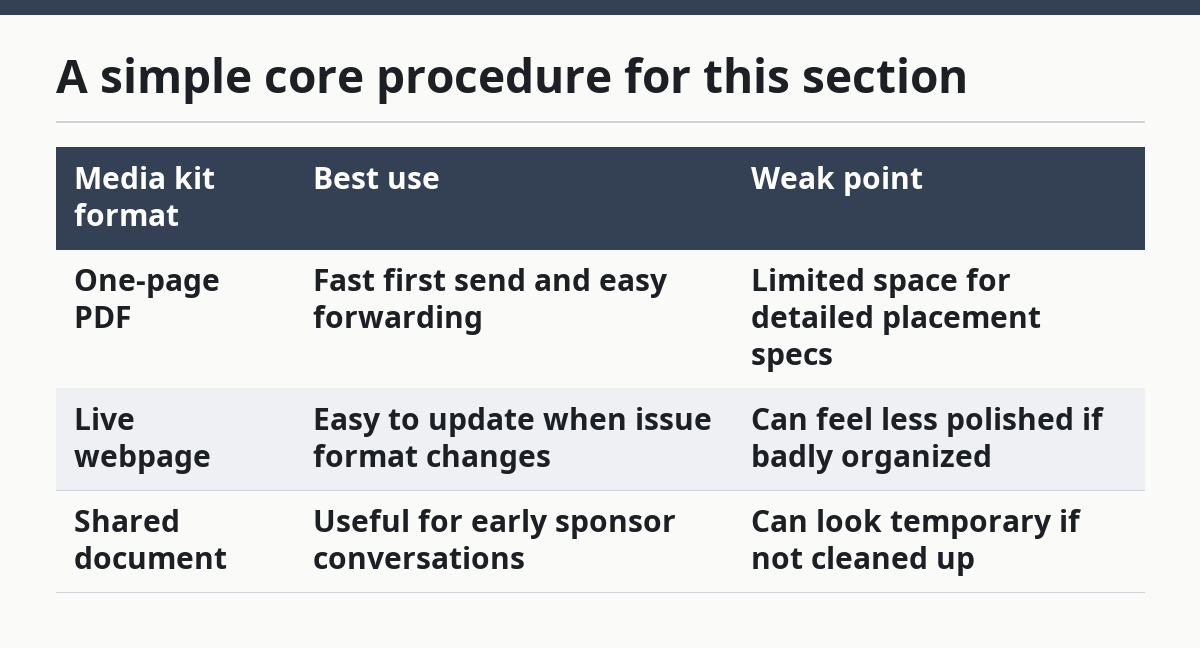
That table matters because a sponsor does not just want content. A sponsor wants a format that matches the stage of the conversation. A one-page PDF works when the goal is a quick screen. A live page works better when the issue format changes often. A shared document is fine for early outreach, but it can look unfinished if it is the only version you have.
How should you show brand fit?
A media kit should show brand fit by naming the kinds of sponsors that belong and the kinds that do not. That saves time for both sides and keeps weak matches out of the pipeline.
For a free AI tools newsletter, brand fit is mostly about audience alignment, tone, and trust. If the newsletter is about free tools, sponsors that sell expensive enterprise software may not be the best match. If the audience wants practical, low-friction tools, the kit should say that directly. The sponsor does not need a long philosophy lesson; it needs a clean yes or no.
This is also where brand guidelines belong. Keep them short and useful. Include logo rules, preferred name format, approved color use if relevant, and any tone limits for sponsor copy. If the newsletter only accepts plain text sponsor placements, say that. If a sponsor can use a logo, say where it can sit and whether it must be square or horizontal.
A brand fit note should be honest about boundaries. If the newsletter will not accept certain categories, say that in the kit. If editorial and sponsor content are kept separate, state that too. That gives sponsors confidence and prevents back-and-forth later.
What contact details and proof points belong there?
A media kit should list one clear contact path and a few proof points that help a sponsor trust the setup. The goal is speed, not paperwork.
Put the contact details where they are easy to find on the first page or the top of the webpage. Include a name or role, one email address, and any preferred subject line for sponsor inquiries. If there is a turnaround window for replies, mention it in a general way rather than pretending to promise exact timing you cannot keep.
Proof points should be light but real. A sponsor may want to know that the newsletter is active, that placements are available, and that the audience is aligned with AI tools. If you can show an issue archive, that belongs in the kit. If you have a brand guidelines page, link or reference it. Keep the proof focused on fit, not hype.
Two external references are worth keeping in mind when sponsor messages appear inside editorial content. The FTC’s guidance on disclosures for endorsements explains how clear labels should work, and it is a useful standard to keep in mind if a placement reads like an endorsement: https://www.ftc.gov/business-guidance/resources/disclosures-101-social-media-influencers. The IAB Tech Lab also publishes ad-related standards that many digital publishers use as a reference point for organized media planning: https://iabtechlab.com.
Those references do not replace your own kit. They simply remind sponsors that transparency and structure matter. A media kit that names the contact, the placements, and the brand rules is easier to evaluate than one that hides everything behind a form.
What makes a media kit weak?
A weak media kit leaves a sponsor with more questions than answers. That usually happens when the kit is pretty, but thin.
The most common mistake is writing a vague audience description. “Tech-savvy readers” sounds safe, but it says little about the actual people on the list. Another mistake is skipping placement specs, which forces the sponsor to guess whether the ad belongs at the top, inside the issue, or at the end. A third mistake is hiding brand guidelines until later, which makes the first exchange slower than it should be.
A kit can also be too long for its own good. A sponsor does not need a 12-page manifesto to understand a newsletter with one or two ad slots. If your kit takes more than a few minutes to scan, cut anything that does not help a sponsor decide. Long explanations of editorial mission belong elsewhere.
Here is the trade-off: a very short kit is easy to read, but it can undersell a newsletter if it leaves out the details that matter. A very long kit can impress on paper, but it often buries the practical facts. The right answer is a tight kit with enough structure to answer the next 3 sponsor questions before they are asked.
How do you present sponsor information for a newsletter?
Sponsor information should be presented in a clean order: who the readers are, what the issue looks like, where the placements live, and how to get in touch. That order matches how sponsors decide.
A good sponsor-facing layout usually starts with the newsletter name, then a short description, then the audience profile, then the issue format. After that, add placement specs, brand guidelines, and contact details. If you want a sponsor FAQ, put it near the end so the main facts stay at the top.
The sponsor FAQ should answer the small, recurring questions that slow down email threads. Think of it as a shortcut for the 80% of questions that repeat. If a sponsor asks the same thing twice, the kit was not specific enough. Keep the answers short and practical.
One simple format choice matters here: use headings that match the sponsor’s questions, not internal jargon. “Audience profile” works. “Monetization strategy notes” does not. The point is to help someone decide in a short reading window, often on a phone, not to sound like a deck made for a boardroom.
Key takeaways
- A sponsor needs a fast read, not a long story.
- The most useful parts are the audience profile, issue format, placement specs, brand guidelines, and contact details.
- Show where an ad appears and what it can contain.
- Keep the fit honest so weak matches drop out early.
- The kit should be easy to scan in a few minutes, not a long sales document.
What should a newsletter media kit include?
A newsletter media kit should include the audience profile, issue format, ad placements, brand guidelines, and contact details. Those pieces let a sponsor judge fit quickly without guessing about the readers or the layout.
For a free AI tools newsletter, the kit should also make the audience’s intent clear. Sponsors want to know whether readers are looking for tools, workflows, or general AI news, because that changes the value of a placement.
Do small newsletters need a media kit?
Yes, small newsletters need a media kit if they want sponsors to evaluate them quickly and clearly. A smaller list can still be a good fit if the audience is focused and the placement is easy to understand.
The kit does not need to be long. A one-page PDF or a simple webpage can be enough if it explains the reader profile, issue format, and contact path.
How do you present sponsor information for a newsletter?
Sponsor information should be presented in the same order a sponsor uses to decide: audience, issue format, placements, brand rules, and contact details. That structure keeps the page readable and cuts down on back-and-forth.
Use plain headings and short sections. If a sponsor has to hunt for where an ad goes or what it can say, the presentation is too hard to use.
Drafted with AI; not yet reviewed by a person.