
Last updated: November 19, 2026
Key Takeaways
- A relaunch email should reset expectations fast without making readers feel tricked.
- Say what changed, why it changed, and what readers can expect next.
- Write to current subscribers, not new prospects.
- Lead with the change, then add a short change log.
A newsletter relaunch can confuse subscribers fast if the email sounds like a new signup pitch. How to announce a newsletter relaunch without confusing subscribers starts with one answer: say what changed, why it changed, and what stays the same in the first screenful. The sections below settle the message, the timing, and the exact words that keep people on the list.
What a relaunch announcement has to do

A relaunch announcement has to reset expectations in one email without making readers feel tricked. If you changed the topic, cadence, format, or sender name, the message needs to say so plainly and fast.
According to Mailchimp, average email open rates across industries were about 34.23% in 2024, so clarity matters in the first send. If readers open once and still feel uncertain, you lose the moment. If you changed the newsletter in 2024 or 2025, say so in the first line.
Picture this: you’re about to email a list that subscribed for one thing and may now be getting another. The job is not to hype the relaunch into a sales pitch; it’s to reduce surprise before the next send lands. That means the announcement email should do three things: name the relaunch, explain the change, and show readers what they’ll get next.
A useful relaunch announcement usually includes these pieces:
- The new direction in one sentence
- The reason for the change in plain language
- What stays in the subscriber list and what changes in the content
- The next send date or cadence, if it changed
- A short path for people who no longer want the new version
The truth is, confusion comes from omission, not from change itself. If readers feel blindsided, they don’t need more enthusiasm; they need context. A good announcement email acts like a clean handoff, not a surprise reveal.
What should a newsletter relaunch announcement say?
A newsletter relaunch announcement should say what changed, why it changed, and what readers can expect next. That’s the core message, and it should fit into a short email, not a long brand essay.
The exact topic How to announce a newsletter relaunch without confusing subscribers works best when the first paragraph answers the reader’s main question immediately. If the list used to cover a broad subject and now covers a narrow one, say that in one sentence. If the cadence changed from monthly to weekly, put the number in the email.
Picture this: you’re writing to people who may not have opened in months. They do not need your origin story. They need the new promise, the format, and the practical next step if they want to stay subscribed.
Use this simple structure:
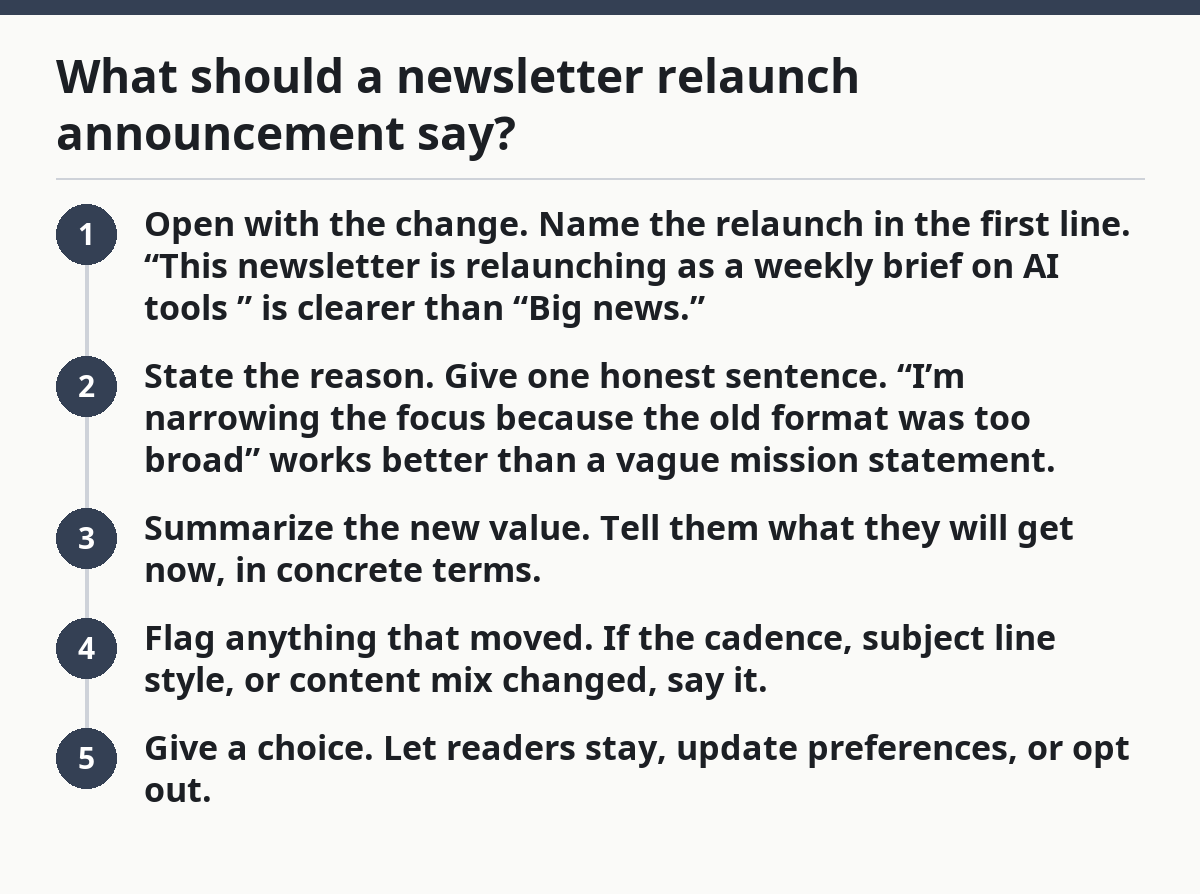
- Open with the change. Name the relaunch in the first line. “This newsletter is relaunching as a weekly brief on AI tools” is clearer than “Big news.”
- State the reason. Give one honest sentence. “I’m narrowing the focus because the old format was too broad” works better than a vague mission statement.
- Summarize the new value. Tell them what they will get now, in concrete terms.
- Flag anything that moved. If the cadence, subject line style, or content mix changed, say it.
- Give a choice. Let readers stay, update preferences, or opt out.
A 3-sentence change summary is often enough if the rest of the newsletter makes the new shape obvious. If the change is larger, a brief line for the old version and a brief line for the new one can do the job.
How do you keep the relaunch from sounding like a new signup email?
You keep it from sounding like a new signup email by writing to existing subscribers, not to strangers. The wording should assume they already know the brand, even if they have not been active for a while.
Picture this: you’re trying to remind people they’re already on the list, while also showing that the product has changed. That balance matters because the same subscriber can feel reassured or misled by one sentence. If the email reads like a lead magnet page, readers may think they were added by mistake.
Use these cues to make the difference obvious:
- Mention that they are already subscribed
- Reference the old version in one line, if needed
- Avoid long benefit bullets that sound like a sales page
- Put the relaunch date or first issue date near the top
- Use a subject line that signals change, not acquisition
A subject line like “The newsletter is back — here’s what’s changing” does more work than “Join the community” because it matches the subscriber’s real situation. It reduces the chance that they think this is a fresh opt-in flow.
Here’s the catch: if you use a welcome-sequence tone, you can accidentally erase trust. Existing readers want a subscriber update, not a funnel.
How to write the announcement email step by step
You write the announcement email by leading with the change, then using a short change log to show exactly what is different. A clean 5-step structure keeps the message tight and easy to scan on mobile.
According to Litmus, more than 50% of emails are opened on mobile, so short blocks help. A first screen of about 3 to 5 lines makes the update easier to read. If the relaunch happened on a specific date, place that date near the top.
Picture this: you have one email to prevent confusion across a list that may include active readers, dormant readers, and people who barely remember joining. A step-by-step draft helps you avoid rambling. It also keeps the message honest.
- Write the subject line first. Use the word relaunch, return, update, or new format. The reader should know this is a change notice before opening it.
- Open with the main change. Say what the newsletter is now in one sentence. Keep the sentence short enough to read in a glance.
- Add a compact change log. List the 2 to 4 things that changed — topic, cadence, format, sender, or audience focus. This is where you remove guesswork.
- Reset expectations. Tell readers how often you’ll send, what kinds of posts they’ll see, and what they won’t see anymore. If there’s a new archive or migration note, mention it here.
- Offer a simple next step. Tell them to stay subscribed, update preferences, or unsubscribe if the new direction is not for them.
A change log is the most useful part for confused readers. It turns “something is different” into a short, readable list. If the newsletter moved from broad commentary to a narrow topic, say that directly. If the cadence moved from monthly to weekly, say that too.
Do not make each step sound like a launch event. This is a communication task, not a brand trailer.
What should be in the change log and migration notes?
A change log and migration notes should explain the exact edits to the newsletter experience. They answer the question readers are already asking: “What did you change on me?”
Picture this: you moved platforms, split one list into two, or changed the subject line format. Readers will notice the effects even if they do not know the process. A plain change log gives them a map. It also lowers support replies because the answer is already in the email.
A useful change log can include:
- New topic focus
- New publishing cadence
- New name or sender line
- Any split between the subscriber list and a new audience segment
- A note about archived issues, migrated preferences, or missing history
If you moved lists or systems, the migration note should be brief and practical. Say whether subscribers need to do anything. If they do not, say that too. Silence makes people suspect a problem.
On the flip side, do not bury the migration note in the footer. Put it near the center of the announcement if it affects access, formatting, or delivery. Readers do not hunt for this kind of detail. They skim, decide, and move on.
A good migration note is boring on purpose. That is the point.
How do you phrase the message so subscribers stay oriented?
You phrase the message so subscribers stay oriented by using familiar nouns and one clear promise. Ordinary words will do the job better.
Picture this: you are trying to help someone decide, in under a minute, whether this list is still for them. The message should give them three anchors: what it is, how often it arrives, and why it belongs in their inbox.
Use plain phrases like these:
- “This newsletter is now focused on…”
- “You’ll get one issue each…”
- “Here’s what won’t change…”
- “If this is no longer a fit, you can unsubscribe below.”
That last line matters. A relaunch can make people feel cornered if the only path forward is silence. Give them a clean exit. It makes the rest of the email feel more honest.
A strong relaunch message often gets shorter when you remove brand language. If you can cut a sentence without losing meaning, cut it. If a sentence sounds like a press release, rewrite it.
For a newsletter tied to audience growth and subscriber management, the relaunch note should support the broader value proposition without repeating the hub article. This page is about the announcement itself, not the strategy behind the whole business.
Which mistakes confuse subscribers the most?
The mistakes that confuse subscribers most are vagueness, fake urgency, and hiding the change until the next issue. Those mistakes cost trust, and trust is harder to win back than open rates.
Picture this: you send a polished relaunch note, but it never says what changed. Readers open the next issue and think they joined the wrong list. That is the failure mode to avoid. The email sounded positive, yet it did not answer the practical question.
Common mistakes and what they cost:
- Saying “we’re back” without details. Readers do not know what “back” means. Fix it by naming the new format in the first paragraph.
- Writing like a launch page. That can feel manipulative to existing subscribers. Fix it by writing to current readers, not prospects.
- Hiding the cadence change. If you go from weekly to monthly, people will think delivery broke. Say the interval plainly.
- Skipping the opt-out line. Readers may stay out of inertia and then feel annoyed later. Give them a direct exit.
- Overexplaining the brand story. Long backstory pushes the real message below the fold. Cut it.
The truth is, readers forgive change more easily than surprise. A relaunch announcement that is plain, specific, and short usually beats a clever one. If you need a model, think of it as a change notice with context, not a sales email.
What should you send before and after the relaunch email?
You should send a short pre-announcement only if the relaunch changes the reader experience in a big way, and you should follow the main email with the new issue soon after. That second step matters because the promise should become visible quickly.
Picture this: you’ve told the list the newsletter is changing, and now the next send has to match the promise. If the follow-up takes too long, the announcement starts to feel abstract. Readers need proof, not a brand slogan.
A practical sequence looks like this:
- Before the relaunch email: only send a heads-up if the change is major, such as a new topic, a list split, or a platform migration
- Relaunch email day: send the announcement as a standalone announcement email, not as a buried paragraph inside another message
- First new issue: send it soon after, with the new format clearly visible
- If needed: add a short note in your onboarding or welcome sequence so new subscribers are not confused later
That last point is where many newsletters slip. Existing readers get the relaunch note, but new subscribers never see the explanation. A short line in the welcome sequence keeps the story consistent.
Do not stretch the gap between announcement and first issue. A same-week follow-up is usually easier for readers to connect than a vague promise “coming soon.” The closer the proof, the less doubt.
How do you announce a newsletter relaunch without confusing subscribers?
You announce a newsletter relaunch without confusing subscribers by leading with the change, showing the change in a short change log, and giving readers a clear choice. Keep the announcement email plain, brief, and specific.
Use the same three-part test on every draft: can a subscriber tell what changed, why it changed, and what happens next in under a minute? If the answer is no, trim the copy until it is.
The sharpest announcements do not try to impress anyone. They make the new shape obvious. That is what keeps the list steady while the newsletter changes.
How do you relaunch a newsletter?
You relaunch a newsletter by telling subscribers what is different, what stays the same, and when they can expect the next issue. Start with an announcement email that names the relaunch in the first line, then add a short change log and a simple opt-out path. The first new issue should follow soon after so the message feels real, not theoretical.
What should you say when a newsletter changes?
You should say exactly what changed, why you changed it, and what readers will get now. Keep the wording plain and direct, especially if the topic, cadence, or audience changed. If subscribers need no action, say that clearly; if they do, put the action in one short line.
How do you announce a newsletter update?
You announce a newsletter update with a short email that reads like a notice, not a pitch. State the update in the first sentence, add a compact change summary, and tell readers what to expect next. If the update affects delivery or format, mention that near the top so no one has to guess.
Drafted with AI; not yet reviewed by a person.
