Last updated: November 19, 2026
AI Detection Risk for Job Application Materials: What’s Safe in 2026: related questions matters most when AI is used for polish, not for pretending to be someone else. A resume, cover letter, or application answer is lowest-risk when AI helps with spelling, clarity, and formatting, while your own facts, tone, and examples stay intact. The biggest danger is not detection alone; it is false claims, obvious generic phrasing, and answers that no longer sound like you.
Key takeaways
- Light AI editing is generally far safer than AI writing from a blank page.
- The more the text sounds generic, the more likely it is to look machine-made or suspicious.
- Factual errors matter more than detector scores in real hiring decisions.
- A careful human pass is important if the material includes dates, titles, or achievements.
- If a job post bans AI help, do not argue with the rule.
What is actually safe to use?

Using AI as an editor, rather than as the author, is usually the lower-risk approach in 2026. That means asking for grammar cleanup, shorter sentences, stronger verbs, or help organizing bullet points you already wrote. It also means keeping your own job titles, dates, metrics, and examples unchanged.
The safest tools are the ones that do not invent content for you. Spellcheck, grammar repair, and formatting help carry little detection risk because they do not change the substance of the document. A resume that still sounds like a real person and still matches your work history is much less likely to create problems than one written from a prompt and then copied over with little review. For related guidance on model and output risk, NIST’s AI Risk Management Framework is a useful reference, and OpenAI’s GPT-4 System Card discusses reliability limits in model output.
The line gets fuzzy with cover letters and answers to application questions. A short rewrite for clarity is usually safer than asking for a full letter that claims personal passion, career history, and motivation you did not write yourself. If the final version includes language you would not naturally use in an interview, that is a warning sign.
This is also where current standards matter. NIST’s AI Risk Management Framework pushes the same basic idea: manage risk by checking output, not trusting it blindly. In hiring, that means a human should review every line before it goes out.
Can an AI-written resume get flagged?
Yes, an AI-written resume can raise suspicion even when no detector labels it. Hiring teams do not need a formal AI score to notice text that feels flat, repetitive, or too polished for the rest of the application. A generic summary with smooth but empty language often looks worse than a slightly rough but honest one.
Because the issue is not one detector, the real risk comes from three things: obvious generic phrasing, mismatched details, and a voice that does not fit the rest of your materials. If your resume sounds one way, your cover letter sounds another, and your interview answers sound like a different person again, that inconsistency can be more damaging than any software label.
Detectors are also not the whole story because hiring teams care about fit, accuracy, and trust. A false positive can happen, but a false sense of safety can hurt more. A document can slip past a checker and still read like it was built from a prompt with no real work history behind it.
The practical rule is simple: if AI wrote a sentence you could not defend in an interview, it is not safe. If it rewrote your sentence without changing the facts, that is usually fine.
How much editing makes it safer?

More editing generally makes it safer, but only if the edits change the words more than the facts. A draft that starts with AI and ends with a full human rewrite is far less risky than a draft that keeps the same structure, phrasing, and generic claims. The job is to make the document sound like a real person with a real work trail.
A good edit does four things. It cuts vague claims like “hard-working” and “results-driven,” replaces them with specific achievements, checks every company name and date, and trims any sentence that sounds like a template. That matters because templates often share the same rhythm, the same filler phrases, and the same recycled buzzwords.
Here is the practical difference:
| Criteria | Light AI editing | AI-first draft with light human edits | Winner for this condition |
|---|---|---|---|
| Risk of generic phrasing | Lower | Higher | Light AI editing |
| Chance of factual drift | Lower | Higher | Light AI editing |
| Speed for a blank page | Slower | Faster | AI-first draft |
| Voice consistency | Stronger | Weaker | Light AI editing |
| Need for deep review | Moderate | High | Light AI editing |
| Risk if the job post bans AI help | Lower | Higher | Light AI editing |
| Best for senior roles | Better | Worse | Light AI editing |
| Best for simple formatting help | Better | Not needed | Light AI editing |
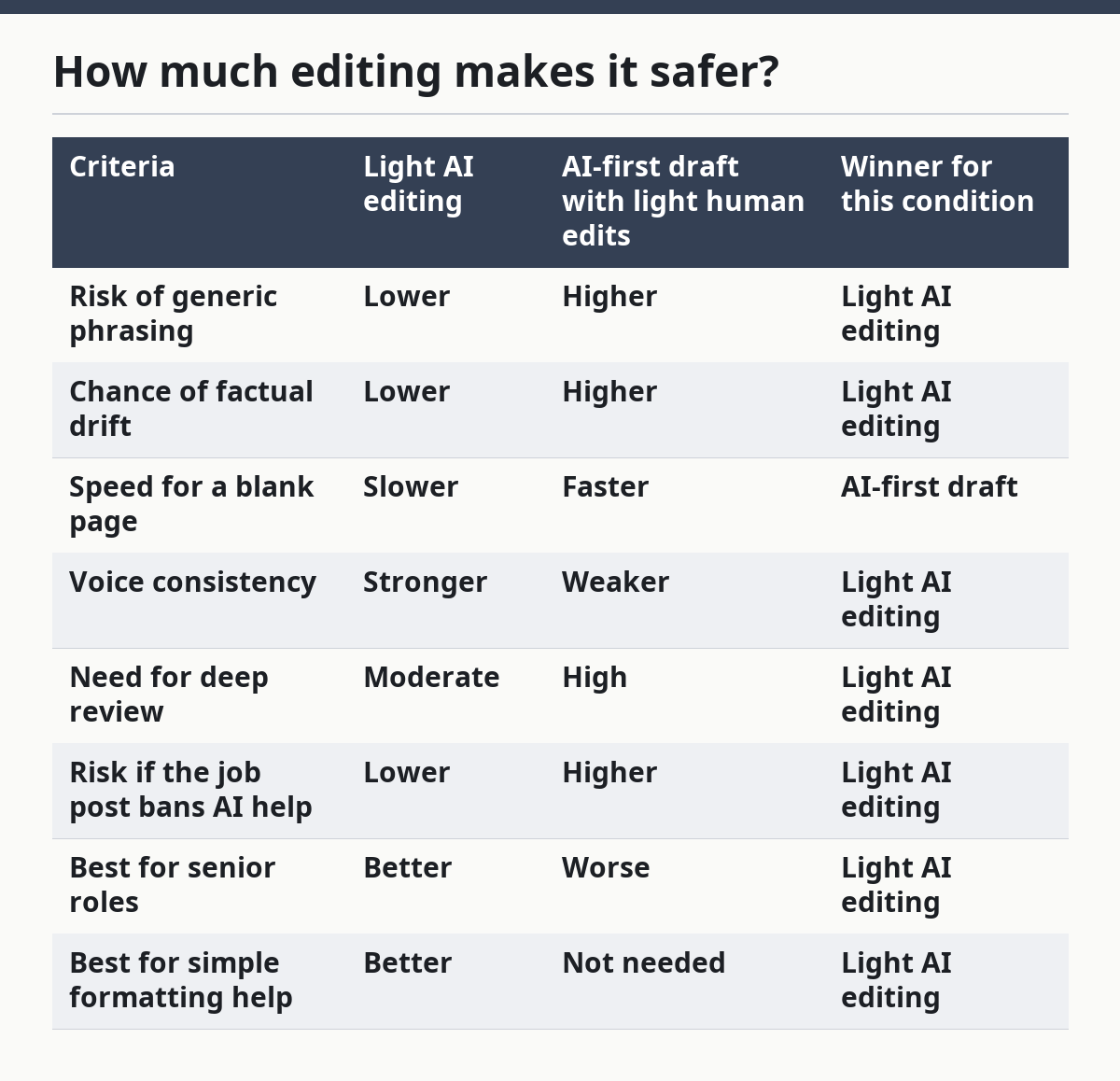
The weak spot of light editing is time. It still asks you to do the hard part: choose the right examples, decide what to leave out, and check for errors. The weak spot of AI-first drafting is that it can sound polished while quietly flattening your experience into a generic profile.
Who should avoid AI in job materials?
People applying for highly conservative roles should avoid heavy AI use. That includes jobs where accuracy, trust, and personal judgment matter more than style, such as legal work, public-facing compliance work, and roles where the application itself is a writing sample. In those cases, even a small whiff of machine writing can distract from the real point.
This is also the safer path if you are changing careers, have gaps in your work history, or need to explain unusual experience. AI tends to smooth over the exact details that matter most. If a recruiter needs a clear explanation of a gap, a license, a date range, or a project scope, a generic rewrite can make the story weaker, not stronger.
The same caution applies if the employer says not to use AI or asks for original writing. That rule does not need to be fair to be real. A job application is not the place to test whether the company will notice.
The other group that should be careful is anyone using AI to stretch the truth. If the tool turns “helped with reporting” into “led analytics strategy,” the risk is no longer detection; it is dishonesty. That can end the process fast if the facts are checked.
What should you do instead?
Use AI for structure, then rewrite for proof. Start with your own rough bullets, not a blank prompt. Then ask for help tightening the language, trimming repetition, and fixing grammar while keeping every date, title, and achievement in place.
A safer workflow looks like this: draft the content yourself, ask AI to simplify or shorten it, compare every changed line against your original, then read it out loud once. That last step matters because spoken language exposes fake polish fast. If you would never say a line in an interview, cut it.
The best check is usually simple and concrete. Ask: does this sentence point to a real job, real task, real result, or real skill from the last 12 months or the last role? If the answer is no, it probably belongs in the trash.
Tools do not solve the trust problem. They can make the prose cleaner, but they cannot make a weak claim true. For that reason, the safest application material in 2026 is not the most machine-like one; it is the one that is accurate, specific, and plainly yours.
When does the risk flip?
The risk flips when AI is doing your thinking for you instead of helping you express it. That happens in three common cases: the draft is copied with little change, the wording becomes vague and corporate, or the final version no longer matches your real history. At that point, the problem is bigger than detection because the application itself becomes unreliable.
A second flip happens when a system or employer has a clear no-AI rule. In that setting, even a harmless use case may not be worth the argument. A safer choice is to write it yourself and use AI only after submission, if at all, for future drafts.
A third flip happens when your materials need a human voice to stand out. If the role values communication, judgment, or personal fit, a slightly imperfect but honest letter usually beats a glossy generic one. That is especially true when the hiring process includes a follow-up interview, because the gap between the written voice and the spoken voice will be obvious.
The hard truth is that “safe” does not mean “undetectable.” It means low-risk enough that the content still reads as yours, survives review, and does not create avoidable doubt.
What if I just want the safest path?
If you want the safest path, write the first draft yourself and use AI only for cleanup. That choice gives you the best mix of control, honesty, and low detection risk. It is also the worst choice only for people who want speed over precision.
Choose human-first drafting if the job is conservative, the facts are delicate, or the employer bans AI help. Choose AI-assisted cleanup if you already have real bullets and need faster polishing. Neither if the material would be false without the tool or if you cannot review every line yourself.
Is AI in a cover letter different from AI in a resume?
Yes, a cover letter is riskier because it depends more on voice and motive. A resume mostly lists facts, so light editing is usually enough to keep it safe. A cover letter asks for tone, judgment, and personal reasons, which is exactly where generic AI language stands out.
That means a cover letter should be written from your own notes first. AI can help reduce repetition or tighten the opening, but it should not invent passion, career goals, or reasons for wanting the role. If the letter sounds interchangeable with any other applicant’s, it is too generic.
Will employers know if I used AI?
Some will suspect it, but most will notice the quality of the writing before they notice the tool. A polished, specific, accurate application is the best defense. A vague, inflated, or inconsistent one creates problems whether AI was involved or not.
Detection claims are noisy, and no single score decides your fate. The safer bet in 2026 is to treat AI as a helper for cleanup, not as a substitute for your own judgment. When the application still sounds like your work and your history, the risk stays low.
Drafted with AI; not yet reviewed by a person.