Last updated: November 19, 2026
If you want a free AI tools newsletter that readers actually open, the answer is simple: choose for editorial quality first, not tool count. For Free AI tools newsletter content quality and selection — The Complete Guide, the topic is not scarcity; it is signal loss. A newsletter built from 200 loosely related app mentions will usually underperform one that filters for a narrow audience, explains what each tool does, and skips dead weight.
I write from the standpoint of someone who follows the AI tools market as a content category: product pages change fast, free plans disappear, and most newsletters blur product discovery with promotion. That makes curation, not volume, the deciding factor.
Key takeaways
- A strong AI tools newsletter has a point of view, not just a feed of launches.
- Good selection filters often include use case, trust, update freshness, and whether the free tier is actually usable.
- “More tools” usually means less reader value if the editorial rules are loose.
- The right newsletter for you depends on whether you want discovery, workflow ideas, or a short list you can act on today.
- If a newsletter cannot explain why a free tool matters, skip it.
What makes a free AI tools newsletter worth your inbox?
A free AI tools newsletter is worth subscribing to when it consistently saves you time, not when it merely reports that a tool exists. The difference shows up in the selection rules. A useful issue names the problem the tool solves, says what the free tier includes, and explains where the limits start. A weak issue gives you names and logos, then leaves you to sort out the rest.
The first filter is audience fit. A newsletter for marketers will naturally favor copywriting, ad, SEO, and social tools; a newsletter for builders will cover API wrappers, coding assistants, and automation products. That is not a flaw. It becomes a flaw when the publication pretends to be universal but has no selection logic. If every tool gets equal space, readers cannot tell which one matters.
The second filter is editorial restraint. A good curator can pass on most launches. That discipline matters because the AI tools market is flooded with clones: summarizers, chat interfaces, prompt managers, image generators, meeting assistants. If the newsletter keeps all of them, the reader gets repetition rather than curation.
The third filter is practical detail. “Free” is not a single category. One tool may offer a permanent free tier with daily limits; another may only offer a free trial; a third may give a one-time credit. Those are not interchangeable, and newsletter readers need that distinction before they click. If the publication does not separate permanent free access from trial access, it is not really helping selection.
According to the FTC, advertisers should avoid misleading claims, and NIST’s AI RMF is useful for thinking about trust, validity, and transparency in AI systems. Those standards do not replace editorial judgment, but they do give newsletter readers a way to check whether a claim is being handled carefully. See the FTC’s guidance on advertising claims and NIST’s AI RMF page for a standards-based view of risk and transparency.
This approach is wrong for readers who only want a firehose of launches. If the goal is to scan everything, not to choose well, then strict curation can feel slow. For everyone else, selection quality beats raw volume.
How do I judge newsletter content quality before subscribing?

A newsletter shows its quality in the first three issues, and the giveaway is how much work it does for the reader. Good content answers three questions fast: What is the tool? Why does it matter? What can I do with the free version? If those answers are missing, the newsletter is trading on novelty rather than usefulness.
Start with the subject line and issue structure. A solid issue uses a predictable pattern: one-sentence summary, category tag, use case, and free-tier note. That makes scanning easy. A messy issue buries the important detail under hype. If the subject line promises “20 new AI tools,” but the article opens with vague commentary and links without context, the newsletter is optimizing for clicks, not decisions.
Then look at the editor’s selection discipline. Quality newsletters usually narrow the field by role or task. They might focus on content creation, sales, coding, image generation, or automation. That is useful because it tells you what not to expect. A broad newsletter can still be excellent, but only if it has a clear rubric. If the same issue includes a newsletter writer, a coding copilot, a design app, and a voice generator with no explanation of why they belong together, the curation is thin.
Pay attention to how the newsletter handles claims. Careful editors avoid unsupported superlatives. They tell you whether a tool has a free tier, whether sign-up is required, and whether the company name appears on the landing page. They do not pretend that “free” means unlimited, and they do not bury waitlists, watermarking, or export limits. That honesty matters because most disappointment in free AI tools comes from discovering the catch after the click.
One more signal: does the newsletter explain the reader’s next step? “Try this” is not enough. Better is “Use this if you need short-form summaries, not long-form drafting.” The practical frame makes the issue useful even when you never open the product page.
This section is less relevant if you already know the creators behind the newsletter and trust their judgment. Familiarity can compensate for lighter explanation. But if you are new, a newsletter without structure, constraints, or plain-language trade-offs is not worth much.
The real difference between broad curation and niche curation
Broad curation wins for readers who want market coverage, while niche curation wins for readers who need immediate usefulness. That is the core trade-off. One gives you range; the other gives you relevance.
Broad newsletters try to cover the whole AI tools market. They are useful when you want to see what is newly available across content, design, productivity, video, code, and operations. The advantage is discovery. A broad issue can surface tools you would never search for on your own. The weakness is dilution. A reader can spend ten minutes scrolling and still find nothing that fits a current workflow. Broad curation also increases the odds that the issue repeats itself from week to week, because adjacent tools often serve the same job.
Niche newsletters are narrower by design. A newsletter built around, say, AI tools for marketers or AI tools for solo founders can go deeper into fit, pricing model, and workflow use. That makes the content stronger because the editor can compare similar tools against the same use case. The downside is obvious: you may miss adjacent innovations that could matter later. A niche newsletter also risks becoming stale if the category slows down or if the editor runs out of fresh angles.
The right choice depends on why you subscribe. If you need a monitoring layer — a weekly scan of what is new — broad curation is better. If you need a decision layer — a shortlist of tools you might actually use — niche curation is better.
The hidden issue is trust. Broad curation often attracts sponsorship pressure because it has more inventory to sell. That does not make it bad, but it does mean the reader should watch for uneven depth. A sponsored mention with no real evaluation is a weak signal. Niche newsletters can have sponsorship too, yet their tighter focus makes obvious fluff easier to spot.
A good rule: choose broad only if the publisher still explains relevance in under 100 words per tool. Choose niche if your job depends on a few specific workflows and you want less noise. Skip both if the publication cannot explain why the free tier is actually usable.
Which selection criteria matter most?
The most important selection criteria are use case match, free-tier quality, freshness, credibility, and editorial consistency. Those five decide whether a newsletter is helpful or merely busy.
Use case match comes first because a perfect tool in the wrong category is still a bad recommendation. A content creator should not need to sort through developer SDKs to find a writing assistant. A founder should not have to sift through image toys to find automation tools. The best newsletters segment by task, not by hype level.
Free-tier quality is the next filter. A newsletter should tell you whether the free plan is permanent, rate-limited, feature-limited, credit-based, or trial-only. That one distinction changes the value of the issue. A permanent free plan can be genuinely useful. A trial can still be worth knowing about, but it belongs in a different mental bucket. If the newsletter lumps them together, the selection is weak.
Freshness matters because AI tools shift quickly. A newsletter can be excellent and still lose value if it republishes the same set of tools for months. The most useful issues reflect current product states: active development, current pricing models, recent feature updates, and whether the tool still exists in the form described. Stale curation is one of the easiest ways for a free newsletter to waste reader trust.
Credibility is about evidence. A good issue links to the product page, gives the product name accurately, and avoids saying more than the page supports. If the newsletter relies on screenshots, copied marketing copy, or empty praise, the reader has no way to tell whether the tool is real value or just a momentary novelty.
Editorial consistency is the last major filter. A strong newsletter applies the same standards every time. That means readers can learn its judgment. If the quality jumps wildly from issue to issue, the newsletter is not a reliable filter. It is a mood.
The wrong candidate for this section is the reader who wants entertainment more than utility. If the goal is casual browsing, these criteria can feel strict. But if the goal is to keep a tab open and come back to it when a real need appears, these filters are the right ones.
Head-to-head: broad discovery vs. tight editorial curation
Broad discovery gives you more surface area; tight editorial curation gives you better decisions. The table below shows where each wins.
| Criteria | Broad discovery newsletter | Tight editorial curation newsletter | Winner for this condition |
|---|---|---|---|
| Tool variety | Covers many categories in one issue | Limits the field to a narrower task set | Broad discovery, when you want market scanning |
| Reader effort needed | Higher; you must sort relevance yourself | Lower; the editor already filtered by use case | Tight curation, when time is tight |
| Depth per tool | Usually thinner | Usually stronger and more contextual | Tight curation, when you need a shortlist |
| Novelty | More likely to surface fringe tools | More likely to repeat proven categories | Broad discovery, for trend watching |
| Free-tier clarity | Often inconsistent across mentions | Usually more explicit about limits | Tight curation, for practical use |
| Risk of repetition | Higher because categories overlap | Lower if the editor has a stable rubric | Tight curation, for regular readers |
| Best fit audience | General readers and tool scouts | Role-specific professionals | Depends on job function |
| Trust signal | Can weaken if sponsorship dominates | Stronger when selection rules are obvious | Tight curation, if consistency matters |
| Speed to action | Slower because the reader must filter more | Faster because the editor pre-filters | Tight curation, for execution |
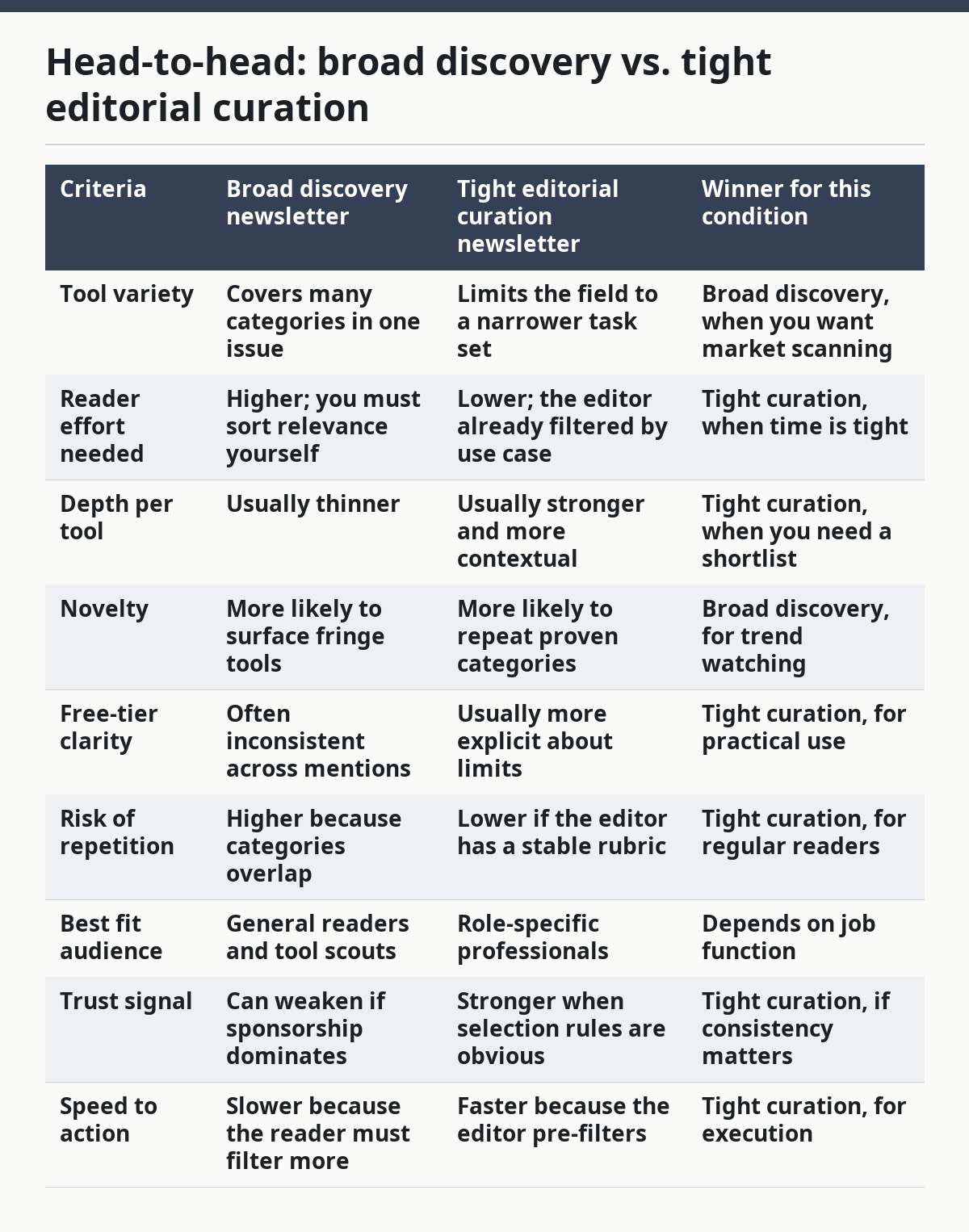
The table points to a simple conclusion: broad discovery is for scanning, tight curation is for choosing. One is not inherently superior. The better one is the one that matches the reader’s current job.
A broad newsletter can still be excellent if it has a real editorial standard. A tight newsletter can still disappoint if it hides sponsorship behind “best tools” language. The difference is not category breadth alone; it is whether the newsletter makes the reader’s decision easier.
The specific situations where one format wins
Broad newsletters win when the reader has no fixed use case and wants a weekly map of the market. That is the right format for generalists, analysts, or anyone who wants to know what kinds of free AI tools are emerging across several categories. It is also useful when the reader enjoys discovery for its own sake. The strength here is coverage. The weakness is that coverage does not equal utility.
Tight editorial newsletters win when the reader has a job to do. A social media manager wants content workflows. A solo operator wants automation. A designer wants image or video assistance. A developer wants APIs and integrations. In these cases, a focused newsletter saves mental energy because the editor has already done the sorting. The narrower format is especially strong when it explains exactly what the free tier does not include, because those limits are what usually decide adoption.
The best newsletter for a beginner is not the one with the most tools; it is the one with the clearest labels. If the issue uses category tags, short summaries, and plain language around free access, the reader can learn faster. If the issue reads like a product dump, a beginner will lose the thread. A detailed but confusing newsletter is worse than a shorter one with strong structure.
The biggest weakness of broad discovery is decision fatigue. After five or six undifferentiated listings, the reader may stop trusting the issue. The biggest weakness of tight curation is tunnel vision. A newsletter can become so specialized that it misses adjacent tools worth knowing about. For example, a writing-focused newsletter may ignore transcription or research tools that sit one step away from the core workflow.
This is where the recommendation gets specific: choose broad if your goal is awareness. Choose tight if your goal is action. Skip both if the newsletter cannot name the free-tier restriction in the first screenful of text.
When should you skip a free AI tools newsletter?
Skip it when the issue is mostly promotion, the free plan is unclear, or the editorial voice cannot explain why a tool belongs in the newsletter at all. Those are the three cleanest warning signs.
The first red flag is promotional drift. If every other item reads like an ad, the newsletter is not curating; it is selling attention. A little sponsorship is normal. A feed that feels like a catalog is not. The practical consequence is obvious: the reader stops trusting the picks, which destroys the newsletter’s main asset.
The second red flag is vague free access. A newsletter that says “free” without specifying whether the product is forever-free, trial-based, or limited by credits is doing the reader a disservice. In the AI tools market, that distinction matters more than the label itself. A free plan with a 3-day trial and a free plan with a permanent usage cap are different products in practice.
The third red flag is empty evaluation. If the newsletter never tells you who the tool is for, what it replaces, or why it is better suited to a certain task, then the publication is just passing along links. A reader can get that anywhere.
A fourth warning sign is stale repetition. If a newsletter keeps resurfacing the same names with no clear update, the reader is paying for memory, not insight. That can be fine for a casual hobbyist, but not for someone trying to track active tools.
There is also a category mismatch problem. Some newsletters are simply aimed at the wrong reader. A developer-focused AI tools bulletin may be excellent and still useless to a marketer. That is not a quality failure. It is a fit failure. The lesson is to judge the editorial standard and the audience boundary at the same time.
If you want a newsletter that helps with decisions, not just discovery, skip any publication that cannot answer three things in one read: what the tool does, what the free tier includes, and who should ignore it.
The verdict: what to choose and why
Choose a tight editorial curation newsletter if you want a shortlist of free AI tools you can act on quickly. Choose a broad discovery newsletter if your job is to monitor the market and you do not mind extra sorting. Neither if the newsletter mixes paid promotion with vague “free” labels and no clear use case.
That is the clean decision. Tight curation is the better default for most readers because it reduces noise, protects your time, and makes the free tier easier to evaluate. Broad discovery is the right exception when you need range more than relevance.
If the newsletter is for a team, choose the one with the clearer editorial standard and the stronger explanation of free-tier limits. If it is just for one person browsing occasionally, choose the one with the highest signal-to-noise ratio. That usually means fewer tools, better context, and a visible filter.
For anyone building a reading habit around AI tools, the rule is simple: subscribe to the publication that tells you what to ignore. That is the real test of quality.
What an excellent issue should contain
An excellent issue should include the tool name, a one-line use case, the free-tier terms, and one sentence on why the tool is worth attention now. That format is compact, but it is enough. A reader does not need a long essay on every listing; the reader needs enough detail to decide whether to click.
The best issues also separate categories cleanly. A list of five AI tools is more useful when it says which one is for research, which one is for images, which one is for meeting notes, and which one is for automation. The category label saves time and lowers ambiguity.
One more useful detail is the state of the product. Is it in beta? Is it a live free tier? Is it a trial? Is there a waitlist? Those small differences change whether the tool is genuinely available or only theoretically interesting. A newsletter that omits them is making the reader do detective work.
This matters because free AI tools are not interchangeable. A tool with generous output limits, export options, or browser access can be much more useful than a prettier product with a hidden ceiling. Good curation names those ceilings before the reader clicks.
The issue should also avoid pretending every tool is equally mature. A startup with a clean landing page and a new model integration is not the same as a stable product with a clear free plan. If the newsletter treats both as equal, it should be more careful about preserving useful distinctions, and readers should consider whether that fits their needs. In a professional setting, if the stakes are significant, consult an appropriate expert before making a decision based on a newsletter alone.
That is the standard to use when comparing free AI tools newsletter content quality and selection: clear use case, honest limits, current status, and an editor who is willing to leave weak items out. Without those pieces, the newsletter is just another inbox burden.
Drafted with AI; not yet reviewed by a person.